The smallest unit capable of life by itself is: a. The organ b. The organelle c. The tissue d. The cell e. The nucleus
Verified step by step guidance
1
Understand the hierarchy of biological organization, which ranges from atoms and molecules up to organs and organ systems.
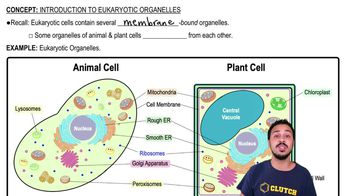
Recall that an organelle is a specialized structure within a cell, but it cannot live independently outside the cell.
Recognize that tissues are groups of similar cells working together, but individual cells are the smallest units that can perform all life functions independently.
Identify that the nucleus is a part of the cell, specifically the control center, but it is not capable of life on its own.
Conclude that the cell is the smallest unit capable of life by itself because it can carry out all necessary life processes such as metabolism, growth, and reproduction.
Verified video answer for a similar problem:
This video solution was recommended by our tutors as helpful for the problem above
Video duration:
1m
Play a video:
0 Comments
Key Concepts
Here are the essential concepts you must grasp in order to answer the question correctly.
Cell as the Basic Unit of Life
The cell is the smallest unit capable of performing all life processes independently. It can grow, reproduce, respond to stimuli, and carry out metabolism, making it the fundamental building block of all living organisms.
Organelles are specialized structures within a cell that perform specific functions, such as energy production or protein synthesis. However, organelles cannot live independently outside the cell, as they rely on the cell's environment and systems.
Biological structures are organized hierarchically from molecules to cells, tissues, organs, and organ systems. Tissues and organs are composed of many cells working together, but they cannot function or live independently like a single cell can.