Back

Introduction to Eukaryotic Organelles quiz #1

Control buttons has been changed to "navigation" mode.
1/40
  • What is the role of the centrioles in a eukaryotic cell?

    Centrioles play a crucial role in cell division by helping to organize the mitotic spindle and ensuring the proper segregation of chromosomes.
  • Which of these organelles produces H2O2 as a by-product?

    Peroxisomes produce hydrogen peroxide (H2O2) as a by-product during the breakdown of fatty acids and detoxification processes.
  • In most animal cells, what is the function of lysosomes?

    Lysosomes are responsible for breaking down waste materials and cellular debris through enzymatic digestion.
  • Read the description of the centrioles. What is their function?

    Centrioles are involved in organizing microtubules during cell division and forming the spindle apparatus.
  • Which statement correctly describes the nuclear envelope of a eukaryotic cell?

    The nuclear envelope is a double membrane structure that encloses the nucleus, separating it from the cytoplasm and containing nuclear pores for transport.
  • Centrioles are important to what cell function?

    Centrioles are important for cell division, particularly in the formation of the mitotic spindle.
  • Which statements correctly describe the nuclear envelope?

    The nuclear envelope consists of two lipid bilayer membranes and contains nuclear pores that regulate the passage of molecules between the nucleus and cytoplasm.
  • What cellular component is not found in the nucleus?

    Ribosomes
  • What type of RNA is found within the nucleolus?

    Ribosomal RNA
  • How are the rough ER and smooth ER different?

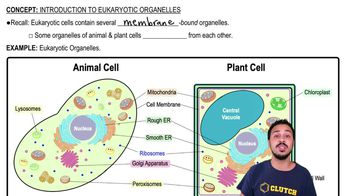
    The rough ER has ribosomes attached to its surface, making it involved in protein synthesis, while the smooth ER lacks ribosomes and is involved in lipid synthesis and detoxification.
  • Which structure in the human body will use flagella to move?

    Sperm cells use flagella to move.
  • What is a primary function of the nucleus?

    The nucleus stores the cell's genetic material and coordinates activities such as growth, metabolism, and reproduction.
  • What is the main difference between rough endoplasmic reticulum and smooth endoplasmic reticulum?

    The main difference is that the rough ER has ribosomes on its surface for protein synthesis, while the smooth ER is involved in lipid synthesis and lacks ribosomes.
  • Which organelle has enzymes necessary for lipid synthesis and metabolism of drugs?

    The smooth endoplasmic reticulum has enzymes necessary for lipid synthesis and drug metabolism.
  • Are ribosomes membrane-bound organelles?

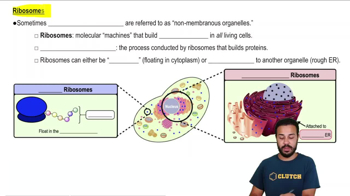
    They are not membrane-bound organelles.
  • What is a multinucleated cell caused by the cytopathic effect of a viral infection called?

    A syncytium is a multinucleated cell that can result from the cytopathic effect of a viral infection.
  • Where are the ribosomes assembled inside the nucleus?

    Ribosomes are assembled in the nucleolus inside the nucleus.
  • Tay-Sachs disease causes lysosomes to rupture. How would this affect the cell? Check all that apply.

    Ruptured lysosomes would release digestive enzymes into the cytoplasm, leading to cellular damage and cell death.
  • Which stain is used to stain the cytoplasm of the cells in the capsule stain?

    The capsule stain typically uses a negative stain like India ink or nigrosin to stain the background, leaving the capsule clear.
  • Which organelle contains hydrolytic enzymes?

    Lysosomes
  • What is the approximate diameter of the mature parent cell?

    The approximate diameter of a mature parent cell can vary widely depending on the cell type, but typical eukaryotic cells range from 10 to 30 micrometers.
  • Which cell type is correctly matched with its function: red blood cells, neurons, muscle cells, or skin cells?

    Red blood cells - oxygen transport
  • What is the function of the centrioles?

    Centrioles help organize microtubules during cell division and are involved in forming the spindle apparatus.
  • What is found within the nucleolus?

    The nucleolus contains ribosomal RNA (rRNA) and is involved in ribosome assembly.
  • What is the approximate diameter of the budding cell?

    The approximate diameter of a budding yeast cell is typically around 3 to 5 micrometers.
  • What is the difference between smooth and rough endoplasmic reticulum?

    The rough ER has ribosomes on its surface for protein synthesis, while the smooth ER is involved in lipid synthesis and lacks ribosomes.
  • Which component is not part of the cytoplasm?

    Nucleus
  • Following an endospore stain, what color do endospores appear?

    Endospores typically appear green after an endospore stain, while the rest of the cell appears red or pink.
  • Which organelle is responsible for storing waste?

    Vacuoles are responsible for storing waste products in cells.
  • Which cell part would be called the 'control center' of the cell?

    The nucleus is often referred to as the 'control center' of the cell.
  • What molecule is required by cells to assemble cilia or flagella?

    b) Tubulin
  • What is the composition of the nuclear envelope?

    b) Double lipid bilayer
  • How are cilia most like flagella?

    Cilia and flagella are similar in structure, both being composed of microtubules arranged in a '9+2' pattern, and they both function in cell movement.
  • What are the two subunits of a ribosome called?

    The two subunits of a ribosome are called the large subunit and the small subunit.
  • What helps maintain the shape of the nucleus?

    b) Nuclear matrix
  • What is the control center of a cell?

    The nucleus is the control center of a cell.
  • Which organelles would be present in high numbers in the leg muscles of a marathon runner?

    Mitochondria would be present in high numbers in the leg muscles of a marathon runner due to their role in energy production.
  • What is the approximate volume of the mature parent cell?

    The approximate volume of a mature parent cell can vary, but typical eukaryotic cells have volumes ranging from 1,000 to 10,000 cubic micrometers.
  • What is the difference between rough and smooth endoplasmic reticulum?

    The rough ER has ribosomes on its surface for protein synthesis, while the smooth ER is involved in lipid synthesis and lacks ribosomes.
  • What cellular structure is located in the nucleus?

    b) Chromatin