 Back
BackActive Membrane Transport, Vesicular Transport, and Membrane Potentials in Human Cells
Study Guide - Smart Notes
 Tailored notes based on your materials, expanded with key definitions, examples, and context.
Cells: The Living Units
Active Membrane Transport
Active membrane transport is a vital process by which cells move substances across the plasma membrane against their concentration gradients, requiring energy input. This process is essential for maintaining cellular homeostasis and involves two main mechanisms: active transport and vesicular transport.
Active Transport: Movement of solutes against their electrochemical gradients using energy, typically from ATP.
Vesicular Transport: Movement of large particles, macromolecules, and fluids via membranous sacs called vesicles, also requiring ATP.
Reasons for Active Transport: Solutes may be too large for channels, not lipid soluble, or unable to move down their concentration gradient.
Types of Active Transport
Primary Active Transport: Direct use of ATP to transport molecules. The energy from ATP hydrolysis changes the shape of transport proteins, allowing solutes to be pumped across the membrane. Examples include calcium, hydrogen (proton), and sodium-potassium (Na+-K+) pumps.
Secondary Active Transport: Indirect use of ATP. Energy is derived from ionic gradients created by primary active transport, allowing other substances to be co-transported.
The Sodium-Potassium Pump (Na+-K+ ATPase)
Most studied active transport pump, present in all plasma membranes, especially in excitable cells (nerves and muscles).
Pumps 3 Na+ ions out of the cell and 2 K+ ions into the cell against their concentration gradients, maintaining electrochemical gradients essential for muscle and nerve function.
Works as an antiporter and helps maintain resting membrane potential.
Equation for ATP hydrolysis:
Electrochemical gradients involve both the concentration and electrical charge of ions across the membrane.
Vesicular Transport
Vesicular transport is responsible for moving large particles and fluids across the plasma membrane using vesicles. This process is crucial for nutrient uptake, waste removal, and intercellular communication.
Endocytosis: Transport into the cell. Includes phagocytosis ("cell eating"), pinocytosis ("cell drinking"), and receptor-mediated endocytosis.
Exocytosis: Transport out of the cell. Used for secretion of hormones, neurotransmitters, mucus, and cellular wastes.
Transcytosis: Transport into, across, and then out of the cell.
Vesicular Trafficking: Transport from one area or organelle in the cell to another.
Endocytosis
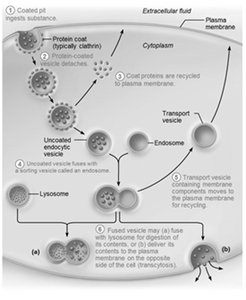
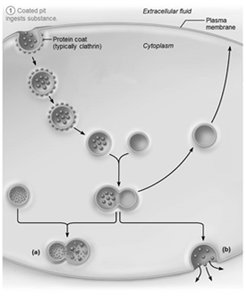
Endocytosis involves the formation of protein-coated vesicles, often mediated by receptors, making it a selective process. Substances bind to specific receptors, and the vesicle may fuse with a lysosome or undergo transcytosis.
Phagocytosis
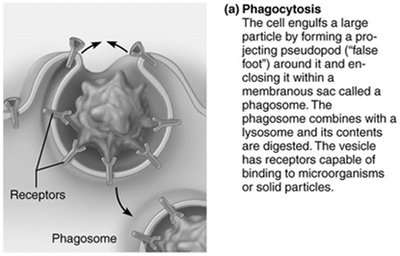
Phagocytosis is a type of endocytosis where the cell engulfs large particles by extending pseudopods around them, forming a phagosome. This process is used by macrophages and certain white blood cells to ingest microorganisms or debris.
Exocytosis
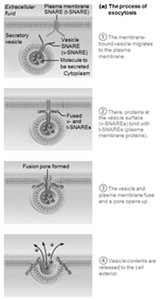
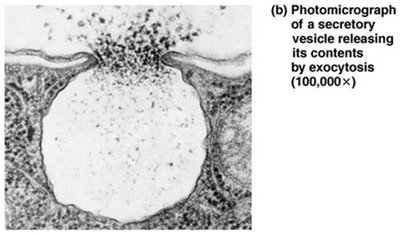
Exocytosis is the process by which cells expel materials. The substance to be ejected is enclosed in a secretory vesicle, which fuses with the plasma membrane, releasing its contents outside the cell. This process is triggered by cell-surface signals or changes in membrane voltage.
Membrane Potential
Resting Membrane Potential (RMP)
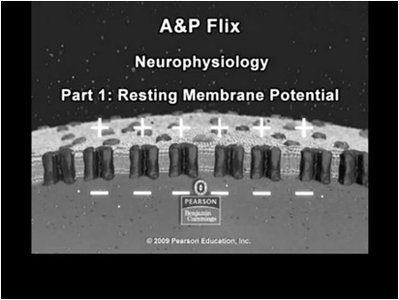
The resting membrane potential is the electrical potential energy produced by the separation of oppositely charged particles across the plasma membrane. It is a key feature of all cells, especially excitable cells like neurons and muscle fibers.
Voltage: The difference in electrical charge between two points. Cells are said to be polarized when a voltage exists across their membrane.
Typical RMP: Ranges from –50 to –100 mV, with the inside of the cell being more negative relative to the outside.
Role of Potassium (K+) in RMP
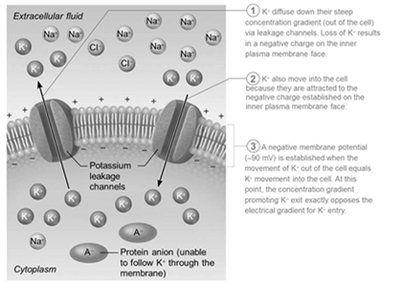
K+ diffuses out of the cell through leakage channels, making the cytoplasmic side more negative due to the presence of impermeable anions.
The electrical gradient pulls K+ back into the cell, and when the chemical and electrical gradients are balanced, the RMP is established (typically around –90 mV).
Na+ also influences RMP, but the membrane is more permeable to K+, making K+ the primary determinant.
Maintenance of Electrochemical Gradients
The Na+-K+ pump maintains RMP by continuously ejecting 3 Na+ ions out and bringing 2 K+ ions in, balancing passive diffusion and active transport.
Excitable cells (neurons and muscle cells) can disrupt this steady state by opening voltage-gated Na+ and K+ channels during signaling events.
Cell-Environment Interactions
Cell Communication and Membrane Receptors
Cells interact with their environment through direct contact or chemical signaling, often involving the glycocalyx, cell adhesion molecules (CAMs), and plasma membrane receptors.
Contact Signaling: Cells recognize each other by unique surface membrane receptors, important in development and immunity.
Chemical Signaling: Ligands (e.g., neurotransmitters, hormones) bind to receptors, triggering changes in cellular activity. The same ligand can cause different responses in different cells depending on the receptor's pathway.
G Protein–Linked Receptors: These receptors activate G proteins, which act as intermediaries to affect ion channels, enzymes, or release second messengers like cyclic AMP or calcium.
Example: When a neurotransmitter binds to its receptor on a neuron, it may open ion channels, altering the cell's excitability and enabling nerve impulse transmission.
