Back
BackCells: The Living Units – Cytoplasm, Organelles, and the Nucleus
Study Guide - Smart Notes
 Tailored notes based on your materials, expanded with key definitions, examples, and context.
Cells: The Living Units
Overview of the Cytoplasm
The cytoplasm is the cellular material located between the plasma membrane and the nucleus. It is the site of most cellular activities and consists of three main components:
Cytosol: A gel-like solution composed mainly of water and dissolved substances such as proteins, salts, and sugars.
Inclusions: Insoluble particles that vary by cell type (e.g., glycogen granules, pigments, lipid droplets, vacuoles, crystals).
Organelles: Specialized structures that perform specific metabolic functions. Organelles can be membranous or nonmembranous.
Cytoplasmic Organelles
Classification of Organelles
Membranous Organelles: Mitochondria, Endoplasmic Reticulum (ER), Golgi Apparatus, Peroxisomes, Lysosomes
Nonmembranous Organelles: Ribosomes, Cytoskeleton, Centrioles
Membranes allow compartmentalization, which is essential for efficient cellular function.
Mitochondria
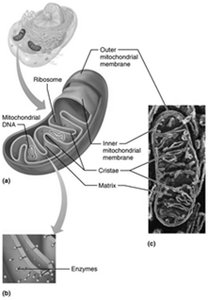
Mitochondria are known as the "power plants" of the cell because they generate most of the cell's ATP through aerobic respiration. They are enclosed by a double membrane, with the inner membrane folded into cristae that contain proteins for cellular respiration. Mitochondria have their own DNA, RNA, and ribosomes, and can divide independently by fission.
Function: ATP production via aerobic respiration
Structure: Outer and inner membranes, cristae, matrix
Unique Features: Contain their own genetic material and ribosomes
Ribosomes
Ribosomes are nonmembranous organelles responsible for protein synthesis. They are composed of protein and ribosomal RNA (rRNA) and exist in two forms:
Free ribosomes: Float in the cytosol and synthesize proteins for use within the cell.
Membrane-bound ribosomes: Attached to the rough ER; synthesize proteins for membranes, lysosomes, or export.
Endoplasmic Reticulum (ER)
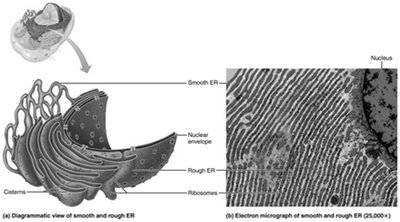
The endoplasmic reticulum (ER) is a network of interconnected membranous sacs and tubules. It is continuous with the nuclear envelope and exists in two forms:
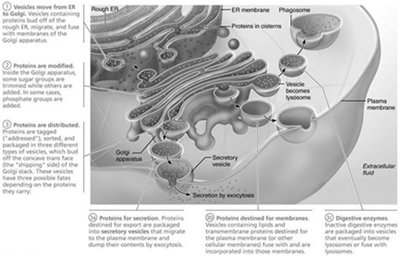
Rough ER: Studded with ribosomes; synthesizes proteins for secretion, membranes, and lysosomes. Proteins are modified and sent to the Golgi apparatus.
Smooth ER: Lacks ribosomes; involved in lipid metabolism, detoxification, glycogen breakdown, and calcium storage (especially in muscle cells as the sarcoplasmic reticulum).
Golgi Apparatus
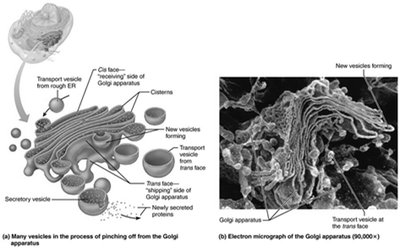
The Golgi apparatus is a stack of flattened membranous sacs that modifies, sorts, and packages proteins and lipids from the rough ER. It directs these products to their appropriate destinations via vesicles.
Pathway A: Secretory vesicles fuse with the plasma membrane to release contents outside the cell.
Pathway B: Vesicles deliver lipids or proteins to membranes.
Pathway C: Lysosomes remain in the cell to digest materials.
Peroxisomes
Peroxisomes are membranous sacs containing enzymes that detoxify harmful substances. They neutralize free radicals using oxidase (producing hydrogen peroxide) and catalase (converting hydrogen peroxide to water). They also participate in fatty acid metabolism.
Lysosomes
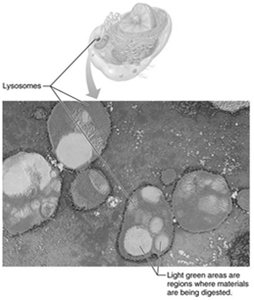
Lysosomes are spherical membranous organelles containing digestive enzymes (acid hydrolases). They break down ingested substances, nonfunctional organelles, and cellular debris. Lysosomes are also involved in autolysis (self-digestion) and metabolic functions such as glycogen breakdown and calcium release from bone.
Clinical Note: Lysosomal storage diseases, such as Tay-Sachs disease, result from defective lysosomal enzymes, leading to accumulation of undigested substances and severe cellular dysfunction.
The Endomembrane System
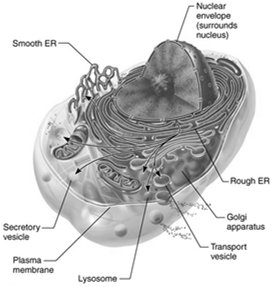
The endomembrane system includes the ER, Golgi apparatus, secretory vesicles, lysosomes, nuclear envelope, and plasma membrane. These structures work together to produce, degrade, store, and export biological molecules, as well as to detoxify harmful substances.
The Cytoskeleton
Structure and Function
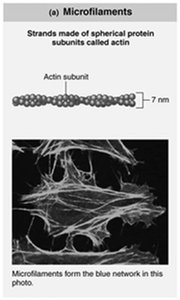
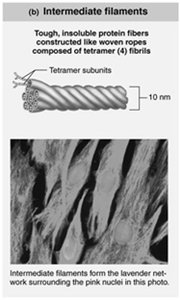
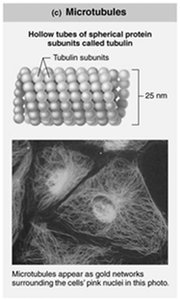
The cytoskeleton is an elaborate network of protein rods that provide structural support, shape, and movement for the cell. It consists of three main types:
Microfilaments: Thinnest elements, composed of actin; involved in cell shape, movement, and muscle contraction.
Intermediate filaments: Tough, ropelike fibers; provide tensile strength and help resist pulling forces.
Microtubules: Largest elements, hollow tubes of tubulin; determine cell shape, organelle distribution, and serve as tracks for motor proteins.
Centrosome and Centrioles
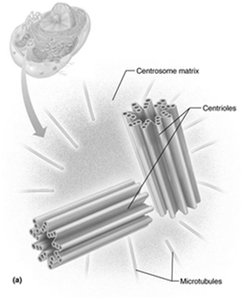
The centrosome is the cell's microtubule organizing center, located near the nucleus. It contains a pair of centrioles, which are barrel-shaped organelles that play a role in cell division and the formation of cilia and flagella.
Cellular Extensions
Cilia and Flagella
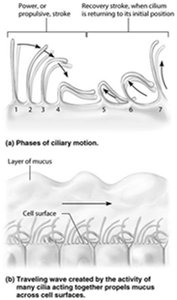
Cilia are short, motile extensions that move substances across the cell surface, while flagella are longer and propel the entire cell (e.g., sperm tail). Cilia beat in coordinated waves to move mucus or other materials.
Microvilli
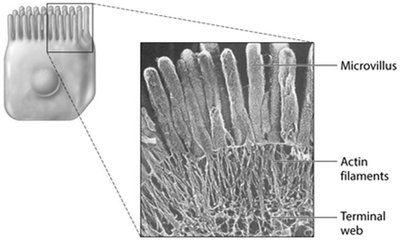
Microvilli are minute, fingerlike projections of the plasma membrane that increase surface area for absorption. They contain a core of actin filaments for structural support.
The Nucleus
Structure and Function
The nucleus is the largest organelle and contains the genetic material (DNA) necessary for protein synthesis. It responds to cellular signals and regulates gene expression. Most cells have a single nucleus, but some are multinucleate or anucleate.
Nuclear Envelope
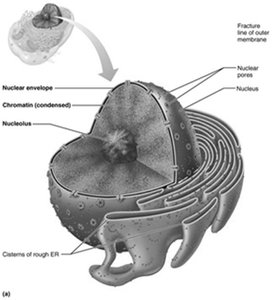
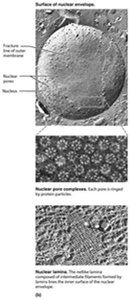
The nuclear envelope is a double membrane that encloses the nucleoplasm. The outer membrane is continuous with the rough ER and is studded with ribosomes. Nuclear pores regulate the movement of molecules between the nucleus and cytoplasm.
Nucleoli
Nucleoli are dark-staining bodies within the nucleus responsible for synthesizing rRNA and assembling ribosome subunits. They are associated with regions of DNA that code for rRNA.
Chromatin and Chromosomes
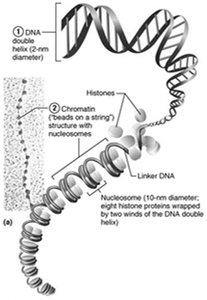
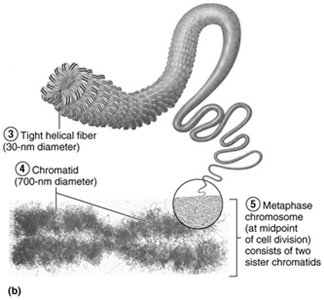
Chromatin consists of DNA, histone proteins, and RNA. During cell division, chromatin condenses to form chromosomes, which protect the genetic material and ensure accurate distribution to daughter cells.
Chromatin composition: 30% DNA, 60% histone proteins, 10% RNA
Chromosome formation: Condensed chromatin during cell division