 Back
BackCellular Level of Organization: Structure and Function of Eukaryotic Cells
Study Guide - Smart Notes
 Tailored notes based on your materials, expanded with key definitions, examples, and context.
Chapter 3: The Cellular Level of Organization
Introduction to Cells
The cell is the fundamental unit of life in the human body. All physiological functions originate at the cellular level, and cells are responsible for maintaining homeostasis. The human body contains trillions of cells, each contributing to the overall function and health of tissues, organs, and organ systems.
Cells are the smallest living units and building blocks of all organisms.
All cells arise from the division of preexisting cells.
Each cell maintains homeostasis, and collective cellular activity results in homeostasis at higher levels of organization.
The body contains more microbial cells than human cells.
Plasma Membrane
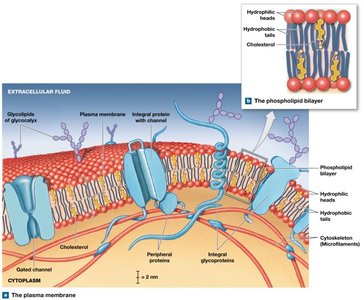
The plasma membrane forms the outer boundary of the cell, separating the intracellular fluid (ICF) from the extracellular fluid (ECF). It is selectively permeable, regulating the passage of substances and maintaining cellular integrity.
Phospholipids and cholesterol are major components.
Functions include physical separation, regulation of transport, sensitivity (cell communication), and support (anchoring cells).
The phospholipid bilayer consists of hydrophilic heads (contact with water) and hydrophobic tails (repel water and ions).
Cholesterol stiffens the membrane, reducing fluidity and permeability.
Proteins are classified as integral (embedded) or peripheral (surface-bound).
Eukaryotic Cell Organelles
The cytoplasm contains all materials between the plasma membrane and the nucleus. It consists of cytosol, organelles, and inclusions. Organelles are specialized structures that perform distinct cellular functions.
Cytosol: Jelly-like substance with water, nutrients, ions, proteins, and waste.
Organelles: Internal structures with specific functions.
Inclusions: Insoluble masses (e.g., glycogen, lipid droplets, pigment granules).
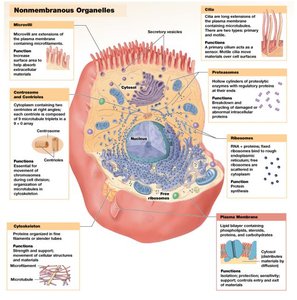
Nonmembranous Organelles
Not enclosed by membranes; direct contact with cytosol.
Includes cytoskeleton, centrioles, and ribosomes.
Membranous Organelles
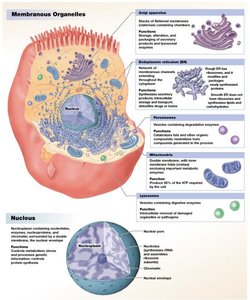
Enclosed by phospholipid membranes; isolated from cytosol.
Includes endoplasmic reticulum (ER), Golgi apparatus, lysosomes, peroxisomes, nucleus, and mitochondria.
Cytoskeleton
The cytoskeleton is an internal framework of proteins that provides strength, flexibility, and shape to the cell. It consists of three types of fibers:
Microfilaments: Smallest, composed of actin; provide mechanical strength and attach plasma membrane to cytoplasm.
Intermediate filaments: Provide cell strength, maintain shape, and stabilize organelle positions.
Microtubules: Largest, hollow tubes of tubulin; radiate from centrosome, anchor organelles, assist in cell movement, and form spindle apparatus during cell division.
Centrosome and Centrioles
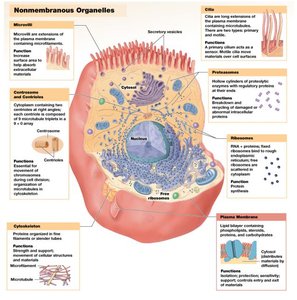
The centrosome is the microtubule-organizing center near the nucleus. Centrioles within the centrosome form the spindle apparatus during cell division.
Microtubules radiate outward from the centrosome.
Centrioles are cylindrical structures essential for mitosis.
Ribosomes
Ribosomes synthesize proteins and are composed of ribosomal RNA (rRNA) and proteins. They exist as free ribosomes in the cytosol or fixed ribosomes attached to the rough ER.
Free ribosomes produce proteins for the cytosol.
Fixed ribosomes produce proteins for modification and packaging in the ER.
Endoplasmic Reticulum (ER)
The ER is a network of membranes continuous with the nuclear envelope. It is divided into smooth ER (SER) and rough ER (RER).
SER: Lacks ribosomes; synthesizes phospholipids, cholesterol, steroid hormones, triglycerides, glycogen, stores Ca2+, and detoxifies drugs.
RER: Has ribosomes; synthesizes proteins, modifies and folds them, packages them into vesicles for the Golgi apparatus.
Golgi Apparatus
The Golgi apparatus consists of flattened membranous discs (cisternae) and modifies, packages, and sorts proteins and secretions. It also produces lysosomes.
Further modifies proteins from the ER.
Packages digestive enzymes into lysosomes.
Lysosomes
Lysosomes are vesicles containing digestive enzymes. They hydrolyze organic polymers, recycle damaged organelles, destroy bacteria, and perform autolysis (self-destruction of damaged cells).
Mitochondria
Mitochondria are the cell's powerhouses, producing ATP. The number of mitochondria varies by cell type, reflecting energy demands.
Many mitochondria in cardiac muscle cells; none in red blood cells.
Structure relates to function at the cellular level.
Nucleus
The nucleus is the control center, storing genetic information (DNA) and regulating protein synthesis. It is surrounded by a double membrane (nuclear envelope) with nuclear pores for communication with the cytoplasm.
Contains nucleolus (synthesizes rRNA and assembles ribosomal subunits).
DNA is organized as chromatin (loose) or chromosomes (condensed for cell division).
Protein Synthesis
Protein synthesis follows the central dogma: DNA → mRNA → protein. Genes are DNA sequences coding for proteins. Transcription (in the nucleus) produces mRNA, which is processed and exported to the cytoplasm for translation (at ribosomes).
Transcription: DNA template is copied to mRNA.
RNA processing: Introns removed, exons spliced; alternative splicing increases protein diversity.
Translation: mRNA codons are read by tRNA anticodons, assembling amino acids into polypeptides.
Transport Across the Plasma Membrane
The plasma membrane is selectively permeable, allowing passive and active transport.
Passive transport: No energy required (diffusion, osmosis, facilitated diffusion).
Active transport: Requires energy (ATP), moves substances against concentration gradients.
Diffusion
Net movement from high to low concentration.
Simple diffusion: Lipid-soluble compounds and gases cross membrane without channels.
Channel-mediated diffusion: Small water-soluble compounds and ions pass through protein channels.
Osmosis
Net diffusion of water across a selectively permeable membrane.
Water moves toward higher solute concentration.
Equilibrium is reached when solute concentrations are equal.
Tonicity
Isotonic: Equal solute concentrations; cell size unchanged.
Hypotonic: Lower ECF solute; water enters cell, cell swells (hemolysis).
Hypertonic: Higher ECF solute; water exits cell, cell shrivels (crenation).
Carrier-Mediated Transport
Carrier proteins transport specific substances.
Symporters: Move two substances in same direction.
Antiporters: Move two substances in opposite directions.
Facilitated diffusion: Passive, uses carrier proteins for large, water-soluble molecules.
Active transport: Uses ATP; e.g., sodium-potassium pump (exports 3 Na+, imports 2 K+ per ATP).
Cell Life Cycle
Cell division produces new cells for growth and repair. Somatic cells divide by mitosis; gametes are produced by meiosis. The cell cycle includes interphase (G1, S, G2), mitosis, and cytokinesis.
Interphase: Cell performs normal functions; G1 (growth), S (DNA replication), G2 (protein synthesis).
G0 phase: Nondividing state; some cells remain here indefinitely.
Mitosis: Nuclear division; stages are prophase, metaphase, anaphase, telophase.
Cytokinesis: Division of cytoplasm; cleavage furrow forms, cells separate.
Mitosis Stages
Prophase: Chromosomes condense, nuclear envelope disintegrates, spindle fibers form.
Metaphase: Chromatid pairs align at metaphase plate.
Anaphase: Chromatids separate, move to opposite poles.
Telophase: Nuclear membranes reform, chromosomes return to chromatin, spindle breaks down.
Cytokinesis
Cleavage furrow forms, contractile band of microfilaments separates cells.
Example: The sodium-potassium pump maintains cellular homeostasis by actively transporting ions against their concentration gradients, crucial for nerve and muscle function.
Additional info: Alternative splicing of mRNA allows a single gene to code for multiple proteins, increasing cellular complexity and adaptability.
