 Back
BackChapter 1 – An Introduction to Anatomy & Physiology: Foundational Concepts and Terminology
Study Guide - Smart Notes
 Tailored notes based on your materials, expanded with key definitions, examples, and context.
Introduction to Anatomy and Physiology
Definitions and Scope
Anatomy and physiology are foundational sciences in understanding the human body. Anatomy describes and names the parts of the body, while physiology explains how these parts function and interact.
Anatomy: The study of the structure of body parts and their relationships to one another.
Physiology: The study of the function of body parts and the body as a whole.
Levels of Organization in the Human Body
Hierarchical Structure
The human body is organized into several levels, each with increasing complexity:
Atomic and Molecular Level: Atoms and molecules form the chemical basis of life.
Cellular Level: The smallest living unit of the body; cells perform specific functions.
Tissue Level: Groups of cells working together to perform a function.
Organ Level: Grouping of two or more tissue types into a recognizable structure with a specific function.
Organ System Level: Collection of related organs with a common function.
Organism Level: One living individual, the sum of all structural levels working together.
Principal Systems of the Human Body
The Integumentary System
The integumentary system protects against environmental hazards and helps control body temperature.
Cutaneous Membrane: Composed of the epidermis and dermis; covers skin surface and protects deeper tissues.
Hair Follicles: Produce hair; innervation provides sensation; protect against UV radiation.
Sebaceous Glands: Secrete lipid coating that lubricates hair shaft and epidermis.
Sweat Glands: Provide perspiration for evaporative cooling.
Nails: Protect and stiffen distal tips of digits.
Subcutaneous Layer: Stores lipids; attaches skin to deeper structures.
The Skeletal System
The skeletal system provides support, protects tissues, stores minerals, and forms blood cells.
Bones, Cartilages, and Joints: Axial and appendicular skeleton; support and protect soft tissues; store minerals.
Bone Marrow: Primary site of blood cell production (red marrow); storage of energy reserves in fat cells (yellow marrow).
The Muscular System
The muscular system allows for locomotion, provides support, and produces heat.
Skeletal Muscles: Provide skeletal movements; control entrances/exits to digestive and respiratory tracts; produce heat; support skeleton; protect soft tissue.
Tendons and Aponeuroses: Harness forces of contraction to perform specific tasks.
The Digestive System
The digestive system processes food and absorbs minerals/nutrients.
Mouth: Receptacle for food; breaks up food and passes it to pharynx.
Salivary Glands: Provide buffers and lubrication; produce enzymes for digestion.
Pharynx: Conducts food and liquids to esophagus; shared with respiratory tract.
Esophagus: Delivers food to stomach.
Stomach: Secretes acids and enzymes.
Liver: Secretes bile; regulates nutrient composition of blood.
Gallbladder: Stores and concentrates bile.
Pancreas: Secretes digestive enzymes and buffers; contains endocrine cells.
Large Intestine: Removes water from fecal material; stores wastes.
Anatomical Position and Directional Terms
Standard Anatomical Position
The anatomical position is a standard reference for describing the location and movement of body parts. The body stands erect, facing forward, feet pointed forward and slightly apart, arms at the sides with palms facing forward.
Prone Position: Lying face down.
Supine Position: Lying face up.
Directional Terms
Directional terms are used to describe the locations of structures relative to other structures or locations in the body.
Anterior (ventral): In front of, front.
Posterior (dorsal): Behind, toward the rear.
Distal: Away from, farther from the origin.
Proximal: Near, closer to the origin.
Dorsal: Near the upper surface, toward the back.
Ventral: Toward the belly.
Superior: Above, over.
Inferior: Below, under.
Lateral: Toward the side, away from the mid-line.
Medial: Toward the mid-line, middle.
Rostral: Toward the front.
Caudal: Toward the back, toward the tail.
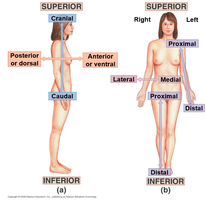
Anatomical Body Planes
Body Planes and Sections
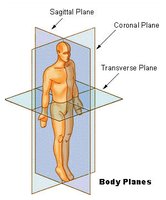
Body planes are imaginary lines that divide the body into sections, useful for anatomical study and medical imaging.
Sagittal Plane: Vertical plane dividing the body into right and left regions.
Median (Midsagittal) Plane: Sagittal plane dividing the body into equal right and left regions.
Parasagittal Plane: Sagittal plane dividing the body into unequal right and left regions.
Frontal (Coronal) Plane: Vertical plane dividing the body into anterior (front) and posterior (back) regions.
Transverse Plane: Horizontal plane dividing the body into superior (upper) and inferior (lower) regions.
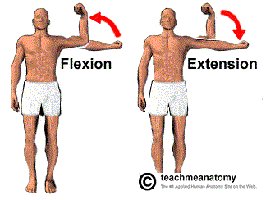
Anatomical Terms of Movement
Flexion and Extension
Flexion and extension refer to increasing and decreasing the angle between two body parts.
Flexion: Movement that decreases the angle between two body parts (e.g., bending the elbow).
Extension: Movement that increases the angle between two body parts (e.g., straightening the elbow).
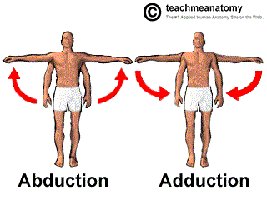
Abduction and Adduction
Abduction and adduction describe movements toward or away from the midline of the body.
Abduction: Movement away from the midline.
Adduction: Movement toward the midline.
Note: For fingers and toes, the midline is that of the hand or foot, not the body.
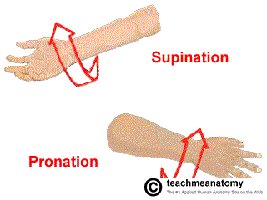
Pronation and Supination
Pronation and supination are movements of the forearm that rotate the palm.
Pronation: Palm faces posteriorly (downward).
Supination: Palm faces anteriorly (upward).
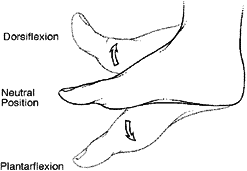
Dorsiflexion and Plantar Flexion
Dorsiflexion and plantar flexion describe movements at the ankle.
Dorsiflexion: Extension at the ankle, foot points superiorly.
Plantar Flexion: Flexion at the ankle, foot points inferiorly.
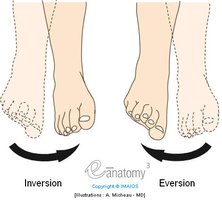
Inversion and Eversion
Inversion and eversion describe movements of the soles of the feet.
Inversion: Ankle rotation so the bottom of the foot faces inward.
Eversion: Ankle rotation so the bottom of the foot faces outward.
Abdominopelvic Quadrants and Regions
Abdominal Quadrants
The abdominopelvic area is divided into four quadrants for clinical and anatomical reference:
Right Upper Quadrant (RUQ)
Left Upper Quadrant (LUQ)
Right Lower Quadrant (RLQ)
Left Lower Quadrant (LLQ)
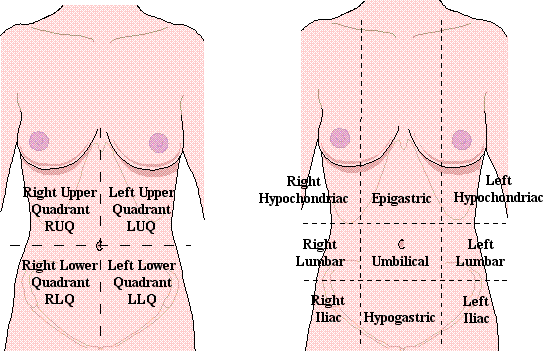
Abdominal Regions
For more detailed localization, the abdomen is divided into nine regions:
Right Hypochondriac
Epigastric
Left Hypochondriac
Right Lumbar
Umbilical
Left Lumbar
Right Iliac (Inguinal)
Hypogastric
Left Iliac (Inguinal)
Organs in Abdominal Quadrants
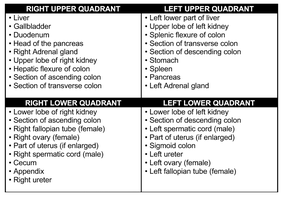
The following table summarizes the main organs found in each abdominal quadrant:
Quadrant | Main Organs |
|---|---|
Right Upper Quadrant | Liver, Gallbladder, Duodenum, Head of pancreas, Right kidney, Hepatic flexure of colon, Section of ascending and transverse colon |
Left Upper Quadrant | Stomach, Spleen, Left lobe of liver, Body of pancreas, Left kidney, Splenic flexure of colon, Section of transverse and descending colon |
Right Lower Quadrant | Lower lobe of right kidney, Section of ascending colon, Right fallopian tube (female), Right ovary (female), Right ureter, Cecum, Appendix |
Left Lower Quadrant | Lower lobe of left kidney, Section of descending colon, Left fallopian tube (female), Left ovary (female), Left ureter, Sigmoid colon |
Organs in Abdominal Regions
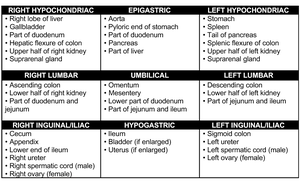
The following table summarizes the main organs found in each abdominal region:
Region | Main Organs |
|---|---|
Right Hypochondriac | Right lobe of liver, Gallbladder, Part of duodenum, Hepatic flexure of colon, Upper half of right kidney, Suprarenal gland |
Epigastric | Aorta, Pyloric end of stomach, Part of duodenum, Pancreas, Part of liver |
Left Hypochondriac | Stomach, Spleen, Tail of pancreas, Splenic flexure of colon, Upper half of left kidney, Suprarenal gland |
Right Lumbar | Ascending colon, Lower half of right kidney, Part of duodenum and jejunum |
Umbilical | Omentum, Mesentery, Lower part of duodenum, Part of jejunum and ileum |
Left Lumbar | Descending colon, Lower half of left kidney, Part of jejunum and ileum |
Right Inguinal/Iliac | Cecum, Appendix, Lower end of ileum, Right ureter, Right spermatic cord (male), Right ovary (female) |
Hypogastric | Ileum, Bladder (if enlarged), Uterus (if enlarged) |
Left Inguinal/Iliac | Sigmoid colon, Left ureter, Left spermatic cord (male), Left ovary (female) |
Summary
This guide provides an overview of the basic concepts, terminology, and organizational structure of the human body, essential for further study in anatomy and physiology.
