 Back
BackChapter 1: The Human Body - Orientation and Organization Study Guide
Study Guide - Smart Notes
 Tailored notes based on your materials, expanded with key definitions, examples, and context.
Q1. Anatomy studies the ____________ of body parts, while physiology studies the ____________ of body parts.
Background
Topic: Introduction to Anatomy and Physiology
This question tests your understanding of the basic definitions and distinctions between anatomy and physiology, which are foundational concepts in human biology and ANP.
Key Terms:
Anatomy: The study of the structure of body parts.
Physiology: The study of the function of body parts.
Step-by-Step Guidance
Recall the definitions of anatomy and physiology from your textbook or lecture notes.
Think about how structure (anatomy) and function (physiology) are related in the human body.
Fill in the blanks with the correct terms based on your understanding.
Try solving on your own before revealing the answer!
Q2. List three subdivisions of gross anatomy and two subdivisions of microscopic anatomy.
Background
Topic: Subdivisions of Anatomy
This question is about the different ways anatomy is studied, both at the macroscopic (gross) and microscopic levels.
Key Terms:
Gross Anatomy: Study of structures visible to the naked eye.
Microscopic Anatomy: Study of structures too small to be seen without a microscope.
Step-by-Step Guidance
Review the main subdivisions of gross anatomy (such as regional, systemic, and surface anatomy).
Recall the subdivisions of microscopic anatomy (such as cytology and histology).
List three subdivisions for gross anatomy and two for microscopic anatomy.
Try solving on your own before revealing the answer!
Q3. Which topic of anatomy specifically studies body tissues?
Background
Topic: Microscopic Anatomy
This question asks you to identify which branch of anatomy focuses on the study of tissues.
Key Terms:
Histology: The study of tissues.
Step-by-Step Guidance
Review the definitions of the options provided (surface anatomy, histology, regional anatomy, gross anatomy).
Identify which option is most closely associated with the study of tissues.
Try solving on your own before revealing the answer!
Q4. Renal physiology considers the operation of which specific organ system?
Background
Topic: Physiology Subdivisions
This question tests your knowledge of the organ systems and their physiological study areas.
Key Terms:
Renal Physiology: Study of kidney function.
Urinary System: The organ system involved in renal physiology.
Step-by-Step Guidance
Recall what 'renal' refers to in medical terminology.
Identify the organ system associated with the kidneys.
Try solving on your own before revealing the answer!
Q5. In your own words, describe “the principle of complementarity of structure and function.”
Background
Topic: Structure-Function Relationship
This question is about the fundamental concept that the structure of a body part determines its function.
Key Terms:
Complementarity: The idea that structure and function are interrelated.
Step-by-Step Guidance
Think about examples where the shape or structure of a body part enables its function.
Formulate a concise explanation in your own words.
Try solving on your own before revealing the answer!
Q6. Figure 1.1 in your text shows one example of the complementarity of structure and function. Give another example of this key concept.
Background
Topic: Structure-Function Relationship
This question asks you to apply the principle of complementarity by providing your own example.
Key Terms:
Structure-Function Relationship: How anatomy enables physiology.
Step-by-Step Guidance
Recall examples from class or your textbook (e.g., the shape of red blood cells, the structure of bones).
Choose one example and explain how its structure enables its function.
Try solving on your own before revealing the answer!
Q7. Which body system is shown?
Background
Topic: Organ Systems of the Human Body
This question asks you to identify the body system depicted in the provided image.
Key Terms:
Body System: A group of organs working together to perform a function.
Step-by-Step Guidance
Examine the image carefully and identify the organs and structures highlighted.
Recall the main organ systems and match the structures to the correct system.
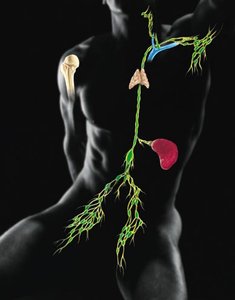
Try solving on your own before revealing the answer!
Q8. Assign the letters (A-WW) to the corresponding regional terms used to designate specific body areas.
Background
Topic: Anatomical Regions
This question tests your ability to identify and label anatomical regions using a diagram.
Key Terms:
Regional Terms: Names for specific areas of the body (e.g., gluteal, umbilical).
Step-by-Step Guidance
Refer to the provided diagram and match each letter to the correct regional term.
Use your textbook or lecture notes to help identify unfamiliar terms.
Start with terms you know, then work through the rest systematically.
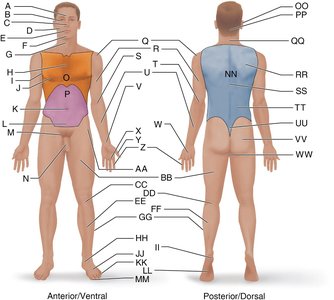
Try solving on your own before revealing the answer!
