 Back
BackChapter 11: Fundamentals of the Nervous System and Nervous Tissue – Study Notes
Study Guide - Smart Notes
 Tailored notes based on your materials, expanded with key definitions, examples, and context.
Nervous System Overview
Introduction
The nervous system is the master controlling and communicating system of the body. It uses electrical and chemical signals to coordinate functions and respond to internal and external stimuli.
Electrical signals: Rapid transmission of information via action potentials.
Chemical signals: Neurotransmitters facilitate communication between cells.
Functions of the Nervous System
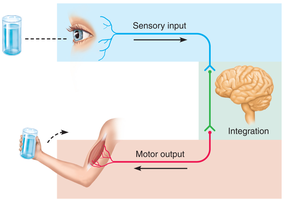
The nervous system performs three essential functions: sensory input, integration, and motor output.
Sensory input: Gathers information from sensory receptors about internal and external environments.
Integration: Processes and interprets sensory input, deciding what action is needed.
Motor output: Activates effector organs (muscles and glands) to produce a response.
Structural Organization of the Nervous System
Central and Peripheral Nervous Systems
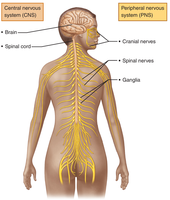
The nervous system is divided into two main structural components:
Central Nervous System (CNS): Consists of the brain and spinal cord. It is the integration and control center, interpreting sensory input and dictating motor output.
Peripheral Nervous System (PNS): Composed of cranial and spinal nerves. It serves as communication lines between the CNS and the rest of the body.
Functional Organization
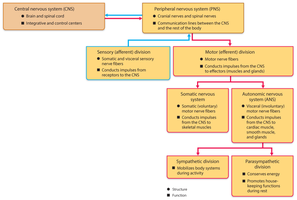
The PNS is further divided into sensory (afferent) and motor (efferent) divisions. The motor division includes the somatic (voluntary) and autonomic (involuntary) systems.
Somatic nervous system: Controls voluntary movements of skeletal muscles.
Autonomic nervous system: Regulates involuntary functions of organs and glands. Includes sympathetic and parasympathetic divisions.
Histology of Nervous Tissue
Cell Types
Nervous tissue contains billions of densely packed cells, primarily neuroglia (glial cells) and neurons.
Neuroglia: Supporting cells, outnumber neurons by about 10:1.
Neurons: Excitable cells that transmit electrical signals.
Types of Neuroglia in the CNS
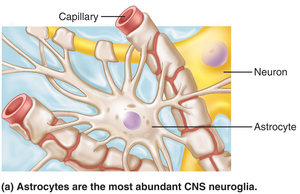
Astrocytes: Most abundant; support neurons, facilitate exchange of nutrients and gases, and clean up the environment.
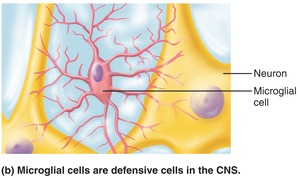
Microglial cells: Defensive cells; monitor neurons, migrate toward injured neurons, and become phagocytic.
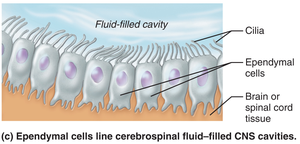
Ependymal cells: Line central cavities of the brain and spinal cord; ciliated to circulate cerebrospinal fluid (CSF).
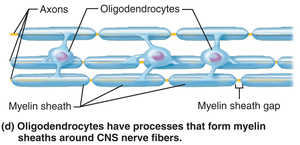
Oligodendrocytes: Branched cells; processes wrap CNS nerve fibers, forming insulating myelin sheaths.
Types of Neuroglia in the PNS
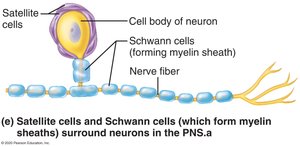
Satellite cells: Surround neuron cell bodies; function like astrocytes in the CNS.
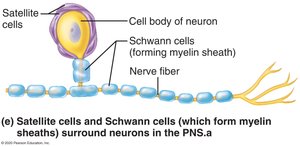
Schwann cells (neurolemmocytes): Surround nerve fibers and form myelin sheaths; similar function as oligodendrocytes.
Neurons: Structure and Function
Characteristics of Neurons
Neurons are specialized for transmitting nerve impulses.
Excitable: Can generate and conduct electrical impulses.
Extreme longevity: Last a person's lifetime.
Amitotic: Most do not divide after development.
High metabolic rate: Require continuous supply of oxygen and glucose.
Neuron Structure
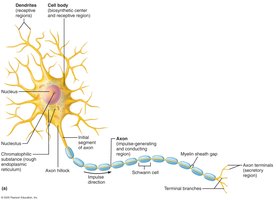
Cell body (soma): Contains nucleus and most organelles; most located in CNS.
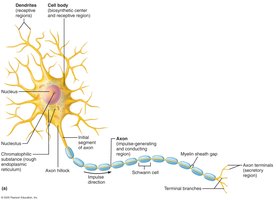
Nuclei: Clusters of neuron cell bodies in CNS.
Ganglia: Clusters of neuron cell bodies in PNS.
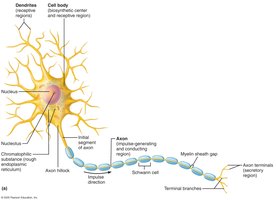
Processes: Dendrites and axons.
Dendrites
Dendrites are the receptive (input) regions of the neuron, often short and highly branched. They receive signals from other neurons and convey them toward the cell body. 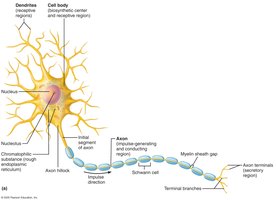
Axons
Axons are the conducting regions of the neuron, starting at the axon hillock and ending at axon terminals. They generate and transmit nerve impulses along the axolemma to the axon terminal.
Tracts: Bundles of processes in CNS.
Nerves: Bundles of processes in PNS.
Myelin Sheath
The myelin sheath is a whitish, fatty (protein-lipid) substance that protects and electrically insulates axons, increasing the speed of transmission.
Myelinated fibers: Sheath surrounds long axons; conduct quickly.
Nonmyelinated fibers: Conduct impulses slowly.
Myelination in the PNS
Schwann cells: Wrap around axon in a jelly roll fashion; one cell forms one segment of sheath.
Myelin sheath gaps: Gaps between adjacent Schwann cells, formerly called nodes of Ranvier.
Myelination in the CNS
Oligodendrocytes: Each cell can wrap up to 60 axons at once; no outer collar of perinuclear cytoplasm.
White matter: Dense collections of myelinated fibers (fiber tracts).
Gray matter: Neuron cell bodies and nonmyelinated fibers.
Classification of Neurons
Structural Classification
Neurons are classified by the number of processes extending from the cell body.
Multipolar: Three or more processes (one axon, others dendrites); most common and main type in CNS.
Bipolar: Two processes (one axon, one dendrite); rare, found in retina and olfactory mucosa.
Unipolar: One T-like process (two axons); peripheral process associated with sensory receptor, proximal process enters CNS.
Functional Classification
Sensory (afferent): Transmit impulses from sensory receptors to CNS; almost all are unipolar; cell bodies located in ganglia in PNS.
Motor (efferent): Carry impulses from CNS to effectors; multipolar; most cell bodies located in CNS.
Interneurons (association neurons): Lie between motor and sensory neurons; shuttle signals through CNS; 99% are multipolar.
Comparison Table: Structural Classes of Neurons
Type | Number of Processes | Location | Function |
|---|---|---|---|
Multipolar | 3 or more | CNS | Motor, interneurons |
Bipolar | 2 | Retina, olfactory mucosa | Sensory |
Unipolar | 1 (T-like) | PNS | Sensory |
Summary
The nervous system is a complex network responsible for sensing, integrating, and responding to stimuli. Its structural and functional organization, along with specialized cell types, enables rapid and precise control of bodily functions. Understanding the histology and classification of neurons is fundamental to comprehending how the nervous system operates.
