Back
BackChemistry of Life: Foundations for Anatomy & Physiology
Study Guide - Smart Notes
 Tailored notes based on your materials, expanded with key definitions, examples, and context.
Chemistry of Life
Levels of Chemical Organization
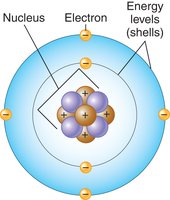
The study of anatomy and physiology begins with understanding the chemical basis of life. Atoms are the smallest units of matter, consisting of a central nucleus (containing protons and neutrons) and surrounding electrons in energy levels (shells). The atomic number is the number of protons, while the atomic mass is the sum of protons and neutrons.
Atom: Smallest unit of matter, indivisible by chemical means.
Nucleus: Central core containing protons (+) and neutrons (neutral).
Electron: Negatively charged particle in energy levels around the nucleus.
Energy Levels: Regions (shells) where electrons are likely to be found; farther shells have higher energy.
Elements, Molecules, and Compounds
All matter is composed of elements, molecules, and compounds. Understanding these terms is essential for grasping chemical reactions in the body.
Element: Pure substance made of only one kind of atom (e.g., Oxygen, Carbon).
Molecule: Two or more atoms bonded together (e.g., O2).
Compound: Molecule containing more than one kind of atom (e.g., H2O).
Chemical Bonding
Chemical bonds form to stabilize atoms by filling their outermost energy levels. The three major types of chemical bonds are ionic, covalent, and hydrogen bonds.
Ionic Bonds
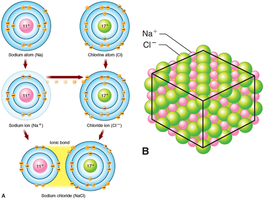
Ionic bonds form when atoms transfer electrons, resulting in charged particles called ions. Oppositely charged ions attract each other to form ionic compounds.
Ion: Atom that has gained or lost electrons.
Electrolyte: Ionic compound that dissociates in water to form ions.
Example: Sodium chloride (NaCl) forms when Na+ and Cl− ions attract.
Covalent Bonds
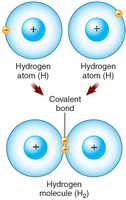
Covalent bonds form when atoms share electrons to complete their outer shells. These bonds are strong and do not easily dissociate in water. Covalent bonding is fundamental to organic molecules in the body.
Example: Two hydrogen atoms share electrons to form H2.
Hydrogen Bonds
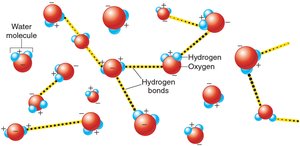
Hydrogen bonds are weak attractions between the positive end of one polar molecule and the negative end of another. They do not form new molecules but are crucial for the structure of water, DNA, and proteins.
Example: Hydrogen bonds hold water molecules together and stabilize DNA structure.
Inorganic vs. Organic Compounds
Compounds in the body are classified as inorganic or organic based on their structure and presence of carbon.
Inorganic Compounds: Usually lack carbon-hydrogen bonds (e.g., water, salts).
Organic Compounds: Contain carbon-carbon and/or carbon-hydrogen bonds; generally larger and more complex (e.g., carbohydrates, proteins).
Water: The Essential Inorganic Compound
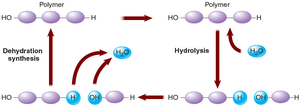
Water is vital for life, acting as a solvent and participating in chemical reactions such as dehydration synthesis and hydrolysis. Chemical equations represent these reactions, showing the transformation of reactants into products.
Dehydration Synthesis: Builds larger molecules by removing water.
Hydrolysis: Breaks down molecules by adding water.
Acids, Bases, and Salts
Water can dissociate into hydrogen ions (H+) and hydroxide ions (OH−). Acids increase H+ concentration, while bases decrease it. Salts are formed when acids and bases neutralize each other.
Acid: Substance that donates H+ ions.
Base: Substance that accepts H+ ions (alkaline).
Salt: Compound formed from acid-base neutralization.
pH: Measuring Acidity and Alkalinity
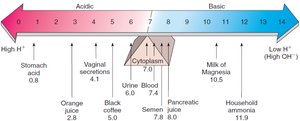
The pH scale quantifies the concentration of hydrogen ions in a solution. A pH of 7 is neutral; values below 7 are acidic, and above 7 are basic. Buffers help maintain stable pH in biological systems.
Neutralization: Mixing acids and bases to form water and salts.
Buffer: Chemical system that absorbs excess acids or bases.
Organic Molecules
Organic molecules are essential for structure and function in living organisms. The four main types are carbohydrates, lipids, proteins, and nucleic acids.
Carbohydrates
Carbohydrates provide energy and structural support. They are classified by the number of sugar units:
Monosaccharides: Single sugar units (e.g., glucose).
Disaccharides: Two monosaccharides joined (e.g., sucrose, lactose).
Polysaccharides: Many monosaccharides linked (e.g., glycogen).
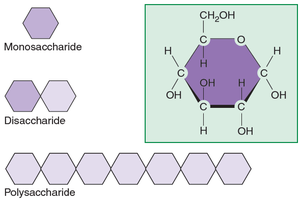
Lipids
Lipids are hydrophobic molecules used for energy storage, membrane structure, and signaling. Major types include triglycerides, phospholipids, and cholesterol.
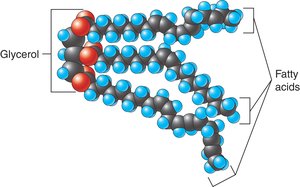
Triglycerides: Glycerol + three fatty acids; main energy storage form.
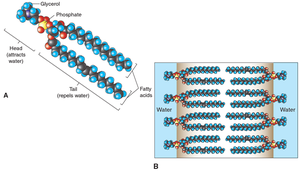
Phospholipids: Glycerol, two fatty acids, and a phosphate group; form cell membranes as bilayers.
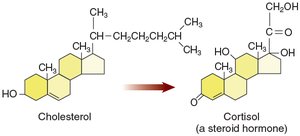
Cholesterol: Steroid molecule that stabilizes membranes and is a precursor for steroid hormones.
Proteins
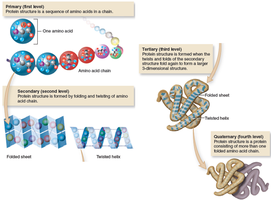
Proteins are large molecules made of amino acids linked by peptide bonds. They serve structural and functional roles in the body.
Structural Proteins: Collagen (connective tissues), keratin (skin, hair).
Functional Proteins: Enzymes, hormones, receptors.
Enzymes
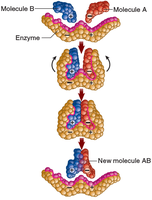
Enzymes are proteins that act as catalysts, speeding up chemical reactions without being consumed. They operate via a lock-and-key model, where the enzyme's active site binds specific substrates.
Nucleic Acids
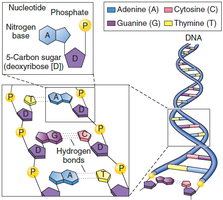
Nucleic acids store and transmit genetic information. They are polymers of nucleotides, each containing a phosphate group, a sugar (ribose or deoxyribose), and a nitrogenous base.
DNA (Deoxyribonucleic Acid): Double helix; stores genetic code; bases are adenine (A), thymine (T), cytosine (C), guanine (G).
RNA (Ribonucleic Acid): Single-stranded; temporary copy of DNA; bases are adenine (A), uracil (U), cytosine (C), guanine (G).
Adenosine Triphosphate (ATP)
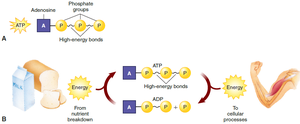
ATP is the primary energy carrier in cells. It stores energy in high-energy phosphate bonds and releases it for cellular processes when converted to ADP (adenosine diphosphate).