 Back
BackEndocrinology: The Endocrine System and Hormone Regulation
Study Guide - Smart Notes
 Tailored notes based on your materials, expanded with key definitions, examples, and context.
Endocrinology Overview
Definition and Scope
Endocrinology is the study of hormones and endocrine organs, focusing on how these chemical messengers regulate metabolic activities and coordinate responses throughout the body. The endocrine system works closely with the nervous system to maintain homeostasis and control various physiological processes.
Hormones: Chemical messengers produced by endocrine glands that travel through the bloodstream to target organs.
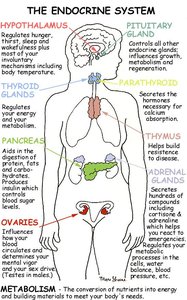
Endocrine glands: Ductless glands that secrete hormones directly into the blood (e.g., pituitary, thyroid, parathyroid, adrenal, pineal).
Exocrine glands: Glands with ducts that secrete non-hormonal substances (e.g., sweat, saliva).
Types of Chemical Messengers
Autocrine, Paracrine, and Endocrine Signaling
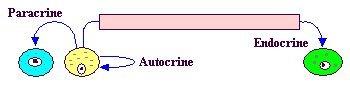
Chemical messengers can act locally or at a distance, depending on their mode of action:
Autocrine: Chemicals or hormones that exert effects on the same cells that secrete them.
Paracrine: Chemicals or hormones that affect other cell types within the same tissue.
Endocrine: Hormones distributed in blood, binding to distant target cells.
Hormone Classification
Amino Acid-Based, Steroid, and Eicosanoid Hormones
Hormones are classified based on their chemical structure:
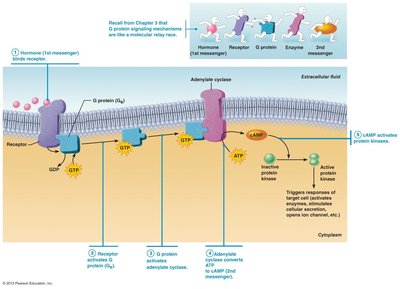
Amino acid-based hormones: Most hormones; water-soluble; act on plasma membrane receptors.
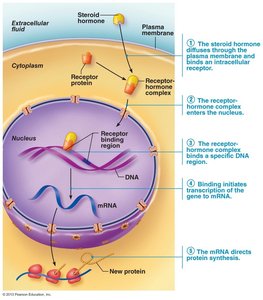
Steroid hormones: Synthesized from cholesterol; lipid-soluble; act on intracellular receptors.
Eicosanoids: Active lipids (e.g., leukotrienes, prostaglandins) with local effects.
Mechanisms of Hormone Action
Hormones influence target cells by:
Altering plasma membrane permeability or potential
Stimulating synthesis of proteins or enzymes
Activating or deactivating enzymes
Inducing secretory activity
Stimulating mitosis
Water-Soluble Hormones
Act on receptors in the plasma membrane, often using second messenger systems such as cAMP.
Lipid-Soluble Hormones
Act on intracellular receptors, regulating transcription and protein synthesis. Steroid hormones exert long-term effects, stimulating cell growth and differentiation.
Hormone Regulation: Feedback Mechanisms
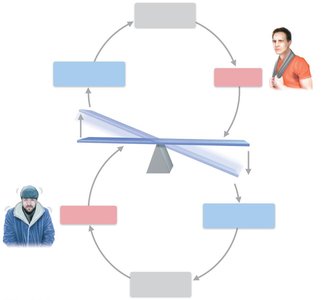
Negative Feedback
Most hormone synthesis and release are regulated by negative feedback, which stabilizes physiological systems by reducing the output in response to a stimulus.
Positive Feedback
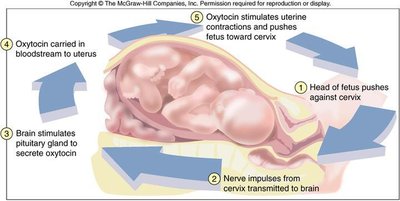
Positive feedback enhances the original stimulus, accelerating the response. It typically controls infrequent events, such as labor.
Hormone Interactions
Permissiveness, Synergism, and Antagonism
Permissiveness: One hormone enhances the responsiveness or activity of another (e.g., estrogen induces progesterone receptors).
Synergism: Two or more hormones work together to produce a greater effect (e.g., epinephrine and norepinephrine increase cardiac rate).
Antagonism: One hormone opposes the action of another (e.g., estrogen/progesterone).
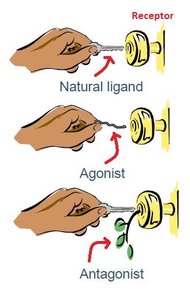
Agonists and Antagonists
Agonists: Bind receptors and induce biological effects.
Antagonists: Bind receptors and block agonist binding, preventing intracellular events.
Major Endocrine Glands and Their Hormones
Pituitary Gland and Hypothalamus
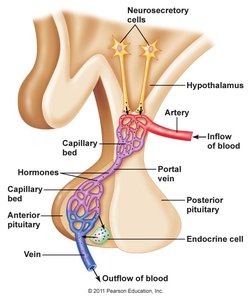
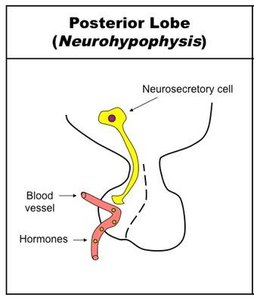
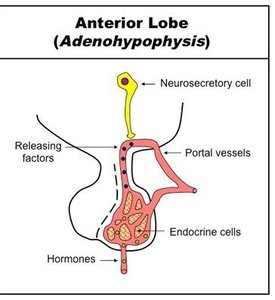
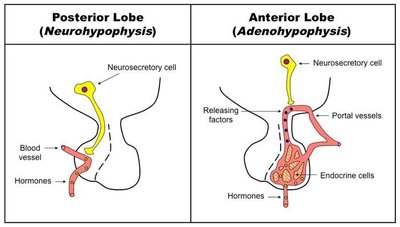
The pituitary gland, controlled by the hypothalamus, secretes at least eight hormones and has two major lobes:
Posterior pituitary: Neural tissue; releases oxytocin and antidiuretic hormone (ADH).
Anterior pituitary: Glandular tissue; releases growth hormone (GH), thyroid-stimulating hormone (TSH), adrenocorticotropic hormone (ACTH), prolactin (PRL), follicle-stimulating hormone (FSH), and luteinizing hormone (LH).
Posterior Pituitary Hormones
Oxytocin: Stimulates uterine contractions and milk ejection.
Antidiuretic hormone (ADH): Regulates water balance by targeting the kidneys.
Anterior Pituitary Hormones
Growth Hormone (GH): Stimulates growth; hypersecretion causes gigantism or acromegaly; hyposecretion causes pituitary dwarfism.
Thyroid-Stimulating Hormone (TSH): Stimulates thyroid gland activity.
Adrenocorticotropic Hormone (ACTH): Stimulates adrenal cortex to release corticosteroids.
Prolactin (PRL): Stimulates milk production.
Gonadotropins (FSH and LH): Regulate reproductive organ function.


Gonads and Placenta
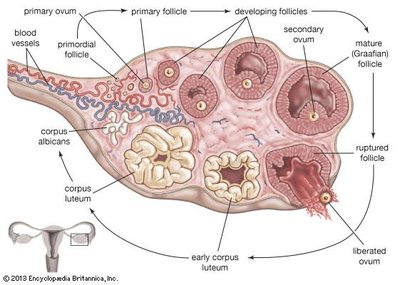
Ovaries: Produce estrogen and progesterone; regulate reproductive organ maturation and secondary sex characteristics.
Testes: Produce testosterone; essential for sperm production and male reproductive organ maintenance.
Placenta: Temporary endocrine organ; produces estrogens, progesterones, and human chorionic gonadotropin (HCG).
Thyroid Gland
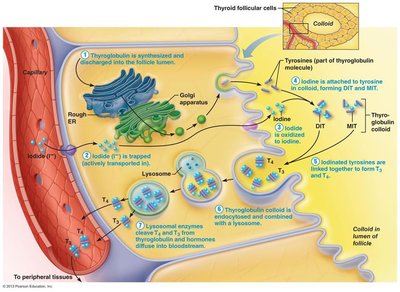
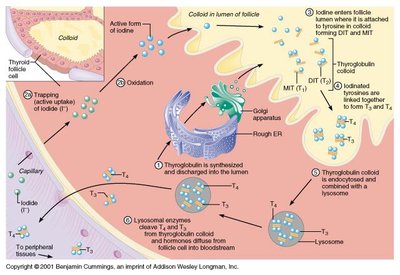
The largest pure endocrine gland, composed of follicles producing thyroglobulin and colloid. Thyroid hormone (TH) is derived from iodinated thyroglobulin.
Thyroxine (T4): Major hormone secreted by thyroid follicles.
Triiodothyronine (T3): Formed at target tissues by conversion of T4.
Functions: Increases metabolic rate, regulates tissue growth, maintains blood pressure.
Thyroid Disorders
Hypothyroidism (adults): Myxedema; symptoms include low metabolic rate, dry skin, edema, lethargy.
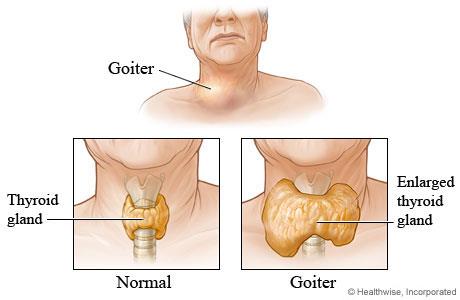
Goiter: Enlarged thyroid gland due to iodine deficiency.
Hypothyroidism (children): Cretinism; mental retardation, short stature, thick tongue and neck.
Graves' Disease: Most common hyperthyroid pathology; autoimmune; symptoms include high metabolic rate, sweating, weight loss, nervousness, exophthalmos (protruding eyeballs).

Parathyroid Glands
Usually four glands; produce parathyroid hormone (PTH).
PTH: Stimulates osteoclasts, enhances Ca2+ reabsorption, promotes vitamin D activation.
Function: Critical for calcium homeostasis (nerve impulses, muscle contractions, blood clotting).
Adrenal Glands
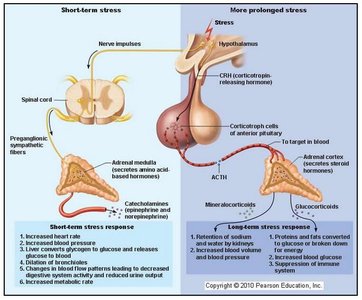
Paired glands above kidneys; consist of adrenal cortex and medulla.
Adrenal cortex: Produces corticosteroids (mineralocorticoids, glucocorticoids).
Adrenal medulla: Produces epinephrine and norepinephrine (fight or flight response).
Pineal Gland
Produces melatonin; regulates sleep-wake cycles and may control antioxidant production.
Pancreas
Both endocrine and exocrine functions.
Islets of Langerhans: Alpha cells produce glucagon (raises blood glucose); beta cells produce insulin (lowers blood glucose).
Glucagon: Stimulates glycogen breakdown and glucose release from liver.
Insulin: Enhances glucose uptake, inhibits glycogen breakdown, and influences protein/fat metabolism.
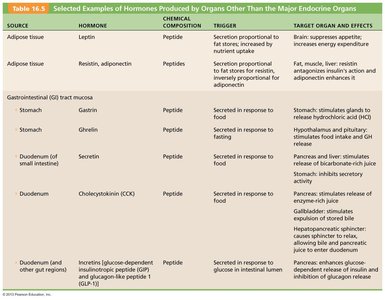
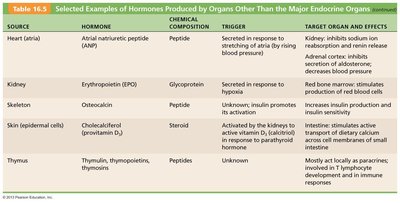
Other Hormone-Producing Tissues
Adipose Tissue, GI Tract, Heart, Kidney, Skeleton, Skin, Thymus
Various tissues and organs produce hormones that regulate metabolism, appetite, blood pressure, and immune responses.
Source | Hormone | Chemical Composition | Trigger | Target Organ and Effects |
|---|---|---|---|---|
Adipose tissue | Leptin | Peptide | Secretion proportional to fat stores | Regulates appetite and energy expenditure |
Stomach | Gastrin | Peptide | Secreted in response to food | Stimulates gastric glands |
Heart | Atrial natriuretic peptide (ANP) | Peptide | Secreted in response to stretching of atria | Reduces blood pressure |
Kidney | Erythropoietin (EPO) | Glycoprotein | Secreted in response to hypoxia | Stimulates red blood cell production |
Skeleton | Osteocalcin | Peptide | Unknown | Increases insulin production |
Skin | Cholecalciferol (vitamin D3) | Steroid | Activated by kidneys | Increases calcium absorption |
Thymus | Thymulin, thymopoietins, thymosins | Peptides | Unknown | Involved in immune responses |
Summary
The endocrine system is a complex network of glands and tissues that produce hormones to regulate metabolism, growth, development, and homeostasis. Understanding hormone classification, mechanisms of action, feedback regulation, and the roles of major glands is essential for mastering endocrinology in Anatomy & Physiology.
