 Back
BackExam 3 Study Guide: Muscular and Nervous System (Anatomy & Physiology)
Study Guide - Smart Notes
 Tailored notes based on your materials, expanded with key definitions, examples, and context.
Q1. Classification of Muscles: Based on Actions and Shapes
Background
Topic: Muscle Classification
This question tests your understanding of how muscles are categorized by their actions (e.g., flexors, extensors) and shapes (e.g., fusiform, pennate, circular).
Key Terms:
Flexor: Muscle that decreases the angle at a joint.
Extensor: Muscle that increases the angle at a joint.
Fusiform: Spindle-shaped muscle.
Pennate: Feather-like arrangement of fibers.
Circular: Muscles that surround openings.
Step-by-Step Guidance
Identify the main categories of muscle actions (flexion, extension, abduction, adduction, etc.).
List the common muscle shapes and describe their structural features.
Match examples of muscles to their classification based on action and shape.
Try solving on your own before revealing the answer!
Q2. Muscles: Location in the Body and Functions
Background
Topic: Muscle Anatomy and Physiology
This question requires you to identify the location and function of specific muscles such as the deltoid, biceps, pectoralis, and others.
Key Terms:
Origin: The fixed attachment of a muscle.
Insertion: The movable attachment.
Function: The action performed by the muscle.
Step-by-Step Guidance
Review anatomical diagrams to locate each muscle listed.
Describe the primary function of each muscle (e.g., deltoid abducts the arm).
Relate the muscle's location to its function in movement or stability.
Try solving on your own before revealing the answer!
Q3. Muscle Lever System
Background
Topic: Biomechanics of Muscle Action
This question tests your understanding of how muscles act as levers in the body, including the types of levers and their components.
Key Terms and Formulas:
Lever: A rigid bar (bone) that moves on a fulcrum (joint).
Fulcrum: The pivot point.
Effort: Force applied by muscle.
Load: Resistance moved by the lever.
Step-by-Step Guidance
Identify the three classes of levers (first, second, third).
Describe the anatomical components of each lever type.
Provide examples of each lever in the human body.
Try solving on your own before revealing the answer!
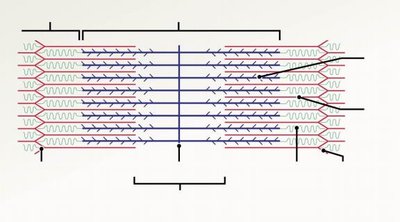
Q4. Sarcomere Microscopic Structure
Background
Topic: Muscle Cell Anatomy
This question focuses on the microscopic anatomy of the sarcomere, the functional unit of skeletal muscle.
Key Terms:
Sarcomere: The contractile unit of muscle.
Actin: Thin filament.
Myosin: Thick filament.
Z-line, M-line, A-band, I-band: Structural features of the sarcomere.
Step-by-Step Guidance
Label the main components of the sarcomere in a diagram.
Describe the arrangement of actin and myosin filaments.
Explain the significance of each band and line in muscle contraction.
Try solving on your own before revealing the answer!
Q5. Sliding Filament Theory
Background
Topic: Muscle Contraction Mechanism
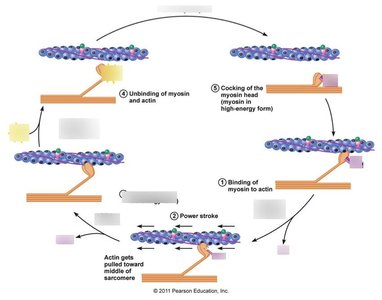
This question tests your understanding of how muscles contract at the molecular level, specifically the interaction between actin and myosin.
Key Terms and Formulas:
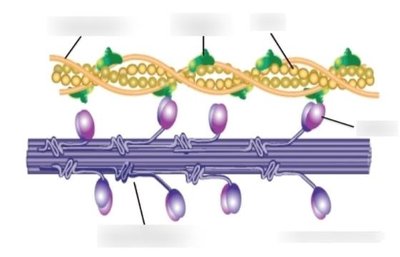
Actin: Thin filament.
Myosin: Thick filament.
ATP: Energy source for contraction.
Cross-bridge: Connection between actin and myosin.
Step-by-Step Guidance
Describe the role of ATP in muscle contraction.
Explain how myosin heads bind to actin to form cross-bridges.
Outline the steps of the power stroke and filament sliding.
Try solving on your own before revealing the answer!
Q6. Sequence of Muscle Contraction Events
Background
Topic: Muscle Physiology
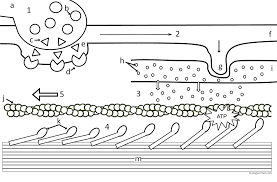
This question requires you to outline the sequence of events that occur during muscle contraction, from nerve impulse to relaxation.
Key Terms:
Neuromuscular junction: Site where nerve meets muscle.
Acetylcholine: Neurotransmitter involved in muscle contraction.
Calcium ions: Trigger contraction.
Step-by-Step Guidance
Describe the release of neurotransmitter at the neuromuscular junction.
Explain how calcium ions are released and their effect on the sarcomere.
Outline the steps leading to muscle contraction and relaxation.
Try solving on your own before revealing the answer!
Q7. Isometric and Isotonic Muscle Contractions
Background
Topic: Types of Muscle Contraction
This question tests your understanding of the differences between isometric (no change in muscle length) and isotonic (change in muscle length) contractions.
Key Terms:
Isometric: Muscle contracts without changing length.
Isotonic: Muscle contracts and changes length.
Concentric: Muscle shortens during contraction.
Eccentric: Muscle lengthens during contraction.
Step-by-Step Guidance
Define isometric and isotonic contractions.
Provide examples of each type in daily activities.
Explain the physiological significance of each contraction type.
Try solving on your own before revealing the answer!
Q8. Nervous System: General Structure and Functions
Background
Topic: Nervous System Anatomy
This question covers the basic structure and function of the nervous system, including synapses, neuron polarization, and neurotransmission.
Key Terms:
Neuron: Nerve cell.
Synapse: Junction between neurons.
Polarization: Resting state of neuron.
Depolarization: Activation state.
Repolarization: Return to resting state.
Hyperpolarization: Increased negative charge inside cell.
Step-by-Step Guidance
Describe the main parts of the nervous system (central and peripheral).
Explain the process of synaptic transmission.
Outline the steps of neuron polarization, depolarization, and repolarization.
Try solving on your own before revealing the answer!
