 Back
BackFluid, Electrolyte, and Acid-Base Homeostasis: Study Notes
Study Guide - Smart Notes
 Tailored notes based on your materials, expanded with key definitions, examples, and context.
Fluid, Electrolyte, and Acid-Base Homeostasis
Introduction to Body Fluids
Body fluids encompass all water-based liquids in the body, including blood plasma, interstitial fluid, cytosol, cerebrospinal fluid, lymph, exocrine secretions, and other specialized fluids. The main component of these fluids is water, which is essential for physiological processes and homeostasis.
Fluid balance refers to maintaining the appropriate volume and concentration of intracellular and extracellular fluids, primarily through water balance.
Water acts as a polar solvent, enabling the transport of solutes, distribution of heat, cushioning, and lubrication of organs and tissues.
Fluid balance is influenced by water intake, physical activity, kidney function, medications, and digestive activities.
Imbalances in water can disrupt homeostasis and have serious physiological consequences.
Electrolytes and Nonelectrolytes
Electrolytes are substances that dissociate into ions in water and conduct electricity, while nonelectrolytes do not dissociate and do not conduct electricity.
Electrolyte balance is maintained by the principle of mass balance: intake equals loss.
Hormonal mechanisms regulate electrolyte concentrations, which depend on both ion number and water volume in body fluids.
Fluid balance is critical for maintaining electrolyte balance.
Acids, Bases, and pH
Acids, bases, and pH are fundamental to physiological processes and cellular function.
Acid: A chemical that dissociates in water to release hydrogen ions (H+). Examples: hydrochloric acid (HCl), carbonic acid (H2CO3).
Base: A chemical that accepts hydrogen ions, often resulting in a salt and water. The most common base in the body is bicarbonate (HCO3–).
pH scale: Measures hydrogen ion concentration. pH < 7 is acidic, pH > 7 is basic, and pH = 7 is neutral.
Total Body Water and Fluid Compartments
Total Body Water
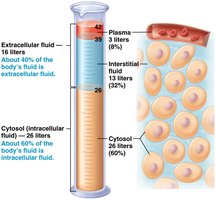
Total body water is about 60% of body weight in a standard 70 kg adult, equating to approximately 42 liters. This value varies with gender, age, body mass, and adipose tissue content.
Fluid Compartments
Body fluids are distributed between two main compartments:
Intracellular fluid (ICF): The cytosol within cells, accounting for about 60% of body fluids (26 liters).
Extracellular fluid (ECF): Includes plasma (8%, 3 liters) and interstitial fluid (32%, 13 liters).
Solute Composition of Body Fluids
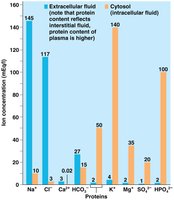
The solute composition of plasma and interstitial fluid is similar, except plasma has more proteins. ECF and cytosol differ significantly in ion concentrations:
ECF: Higher in sodium, chloride, calcium, and bicarbonate ions.
Cytosol: Higher in proteins, potassium, magnesium, sulfate, and monohydrogen phosphate ions.
Osmotic Movement of Water Between Compartments
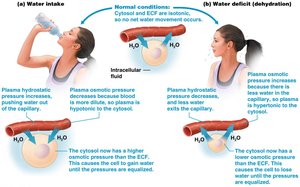
Osmosis governs water movement between compartments, driven by tonicity (osmotic pressure gradient):
Isotonic: No net water movement; ECF and ICF osmotic pressures are equal.
Hypotonic ECF: Water moves into cells, causing swelling.
Hypertonic ECF: Water moves out of cells, causing shrinkage.
Water Losses and Gains
Water Losses
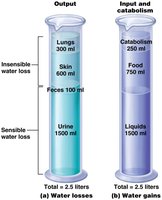
Water is lost from the body through several routes:
Urine: Major route, about 1500 ml/day (obligatory loss is 500 ml).
Feces: Sensible loss, about 100 ml/day.
Skin and lungs: Insensible loss, about 900 ml/day (sweat, evaporation, expired air).
Water Gains
Water is gained from:
Metabolic water: 250 ml/day from catabolic reactions.
Food: 750 ml/day.
Ingested liquids: 1500 ml/day, regulated by thirst mechanisms.
Regulation of Thirst
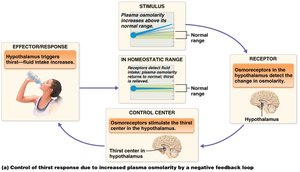
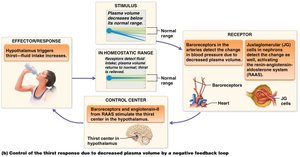
Thirst is regulated by negative feedback loops involving osmoreceptors in the hypothalamus (responding to plasma osmolarity) and baroreceptors (responding to plasma volume and blood pressure). The renin-angiotensin-aldosterone system (RAAS) also plays a role.
Daily Water Requirement
Water intake should match water loss. On average, 2.5 liters of water must be gained daily, with 1.5 liters typically ingested as liquids. Physical activity and environmental factors can increase requirements.
Hormonal Regulation of Fluid Balance
Key Hormones
Antidiuretic hormone (ADH): Increases water reabsorption in kidneys, reducing urine output and increasing ECF volume.
Renin-angiotensin-aldosterone system (RAAS): Stimulates thirst and sodium retention.
Atrial natriuretic peptide (ANP): Promotes sodium and water excretion.
Imbalances of Fluid Homeostasis
Dehydration
Characterized by decreased ECF volume and increased solute concentration, leading to water movement out of cells (crenation) and potential electrolyte imbalances.
Overhydration (Hypotonic Hydration)
Excess water intake or impaired renal function can dilute ECF, causing water to enter cells (swelling), hyponatremia, and potentially cerebral edema.
Hypovolemia and Hypervolemia
Hypovolemia: Equal loss of water and solute, often due to blood loss.
Hypervolemia: Excess ECF volume without osmotic change, leading to edema (fluid accumulation in interstitial space).
Electrolyte Homeostasis
Sodium (Na+)
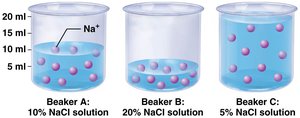
Hypernatremia: Na+ > 145 mEq/l, usually from dehydration.
Hyponatremia: Na+ < 135 mEq/l, usually from overhydration.
The concentration of sodium depends on both the number of sodium ions and the amount of water present.
Potassium (K+)
Hyperkalemia: K+ > 4.5 mEq/l, can cause dangerous cardiac and neuromuscular effects.
Hypokalemia: K+ < 3.9 mEq/l, often due to diuretics, leading to hyperpolarized cells and reduced excitability.
Calcium (Ca2+) and Phosphate (HPO42–)
Regulated by bone, kidneys, small intestine, parathyroid hormone (PTH), and vitamin D3.
Hypercalcemia: Ca2+ > 10.5 mg/dl, reduces neuronal excitability.
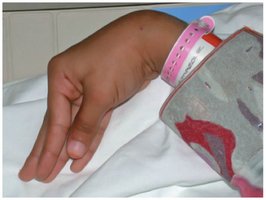
Hypocalcemia: Ca2+ < 8.7 mg/dl, increases neuronal excitability and risk of tetany.
Other Critical Ions
Chloride (Cl–): Major ECF anion, important for osmotic balance and acid-base homeostasis.
Magnesium (Mg2+): Enzyme cofactor and bone component.
Acid-Base Homeostasis
Buffer Systems
Buffer systems resist changes in pH by binding or releasing H+ ions. Major buffer systems include:
Carbonic acid–bicarbonate buffer: Most important in blood.
Phosphate buffer: Important in cytosol and kidney tubules.
Protein buffer: Carboxylic acid groups of amino acids act as buffers, especially in cytosol and erythrocytes.
Acid-Base Imbalances
Acidosis: pH < 7.35, due to excess H+ or loss of base. Causes nervous system depression.
Alkalosis: pH > 7.45, due to excess base or loss of H+. Causes neuronal hyperexcitability.
Compensation involves respiratory (altering CO2 exhalation) and renal (altering H+ and HCO3– excretion) mechanisms.
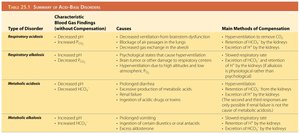
Summary Table: Acid-Base Disorders
The following table summarizes the main types of acid-base disorders, their causes, and compensatory mechanisms:
Type of Disorder | Characteristic Blood Gas Findings (without Compensation) | Causes | Main Methods of Compensation |
|---|---|---|---|
Respiratory acidosis | ↓ pH, ↑ PCO2 | Decreased ventilation, lung disease, airway obstruction | Renal retention of HCO3–, excretion of H+ |
Respiratory alkalosis | ↑ pH, ↓ PCO2 | Hyperventilation, anxiety, high altitude | Renal excretion of HCO3–, retention of H+ |
Metabolic acidosis | ↓ pH, ↓ HCO3– | Diarrhea, renal failure, excess metabolic acids | Hyperventilation (↓ PCO2), renal retention of HCO3– |
Metabolic alkalosis | ↑ pH, ↑ HCO3– | Vomiting, diuretics, antacid overuse | Hypoventilation (↑ PCO2), renal excretion of HCO3– |
Arterial Blood Gases (ABGs)
ABGs are used clinically to assess acid-base status by measuring pH, PCO2, and HCO3–. Compensation can be partial or complete, depending on whether pH is restored to normal.
