 Back
BackFundamentals of the Nervous System and Nervous Tissue: Membrane Potentials and Action Potentials
Study Guide - Smart Notes
 Tailored notes based on your materials, expanded with key definitions, examples, and context.
Membrane Potentials and Basic Principles of Electricity
Introduction to Membrane Potentials
Neurons, like all cells, possess a resting membrane potential, but they are unique in their ability to rapidly change this potential, making them highly excitable. The resting membrane potential is essential for the generation and transmission of electrical signals in the nervous system.
Basic Principles of Electricity in Biological Systems
Opposite charges attract, and energy is required to keep them separated across a membrane.
When separated, the system has potential energy that can be used to do work when charges move toward each other.
Key Definitions
Voltage (V): The measure of potential energy generated by separated charge, measured in volts (V) or millivolts (mV). The greater the charge difference, the higher the voltage.
Current (I): The flow of electrical charge (ions) between two points, which can be used to do work. Current depends on voltage and resistance.
Resistance (R): The hindrance to charge flow. Insulators have high resistance; conductors have low resistance.
Role of Membrane Ion Channels
Large proteins in the plasma membrane act as ion channels, allowing selective movement of ions across the membrane. There are two main types:
Leakage (nongated) channels: Always open, allowing ions to move down their concentration gradients.
Gated channels: Open or close in response to specific signals.
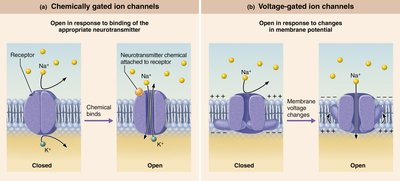
Types of Gated Channels
Chemically (ligand)-gated channels: Open in response to binding of a specific chemical, such as a neurotransmitter.
Voltage-gated channels: Open and close in response to changes in membrane potential.
Mechanically gated channels: Open in response to physical deformation of the receptor, as in sensory receptors.
Electrochemical Gradients and Ion Movement
When gated channels open, ions diffuse quickly across the membrane. The direction of movement is determined by the electrochemical gradient:
Concentration gradient: Ions move from high to low concentration.
Electrical gradient: Ions move toward areas of opposite electrical charge.
The strongest gradient determines the net flow of ions, creating an electrical current and changing the membrane voltage.
Resting Membrane Potential (RMP)
Establishing the Resting Membrane Potential
The resting membrane potential (RMP) of a neuron is typically about -70 mV, but can range from -40 mV to -90 mV. The membrane is said to be polarized at rest. The RMP is generated by:
Differences in ionic composition between the intracellular fluid (ICF) and extracellular fluid (ECF).
Differences in plasma membrane permeability to various ions.
Ionic Composition
ECF: Higher concentration of Na+, balanced by Cl-.
ICF: Higher concentration of K+, balanced by negatively charged proteins.
K+ plays the most important role in establishing the membrane potential.
Membrane Permeability
Impermeable to large anionic proteins.
Slightly permeable to Na+ (few leakage channels).
Much more permeable to K+ (many leakage channels).
Quite permeable to Cl-.
More K+ diffuses out than Na+ diffuses in, making the inside of the cell more negative and establishing the RMP.
The sodium-potassium pump (Na+/K+ ATPase) stabilizes the RMP by maintaining the concentration gradients: three Na+ are pumped out for every two K+ pumped in.
Changes in Membrane Potential
Types of Membrane Potential Changes
Membrane potential changes when ion concentrations or membrane permeability change. These changes produce two types of signals:
Graded potentials: Short-distance, localized changes in membrane potential.
Action potentials: Long-distance signals transmitted along axons.
These changes are essential for neurons to receive, integrate, and send information.
Terms Describing Membrane Potential Changes
Depolarization: Decrease in membrane potential (inside becomes less negative). Increases the probability of producing a nerve impulse.
Hyperpolarization: Increase in membrane potential (inside becomes more negative). Decreases the probability of producing a nerve impulse.
Graded Potentials
Characteristics of Graded Potentials
Graded potentials are short-lived, localized changes in membrane potential. The strength of the stimulus determines the magnitude of the voltage change and the distance the current flows. They are triggered by stimuli that open gated ion channels and can result in depolarization or hyperpolarization.
Receptor (generator) potential: Graded potential in sensory neuron receptors.
Postsynaptic potential: Graded potential in neurons.
End-plate potential: Graded potential at the neuromuscular junction.
Graded potentials decay quickly and act as signals only over short distances, such as in dendrites and the cell body. They are essential for initiating action potentials.
Action Potentials (APs)
Definition and Properties
An action potential (AP) is a brief reversal of membrane potential, typically from -70 mV to +30 mV. APs are the means by which neurons send signals over long distances. They occur only in excitable membranes (mainly axons) and do not decay with distance. In neurons, an AP is also called a nerve impulse and involves the opening of specific voltage-gated channels.
Phases of the Action Potential
Resting State: All gated Na+ and K+ channels are closed. Only leakage channels are open, maintaining the RMP. Na+ channels have two gates: activation (closed at rest) and inactivation (open at rest). K+ channels have one gate (closed at rest).

Depolarization: Voltage-gated Na+ channels open, and Na+ rushes into the cell. At threshold (–55 to –50 mV), all Na+ channels open, causing a rapid spike in membrane potential to +30 mV.

Repolarization: Na+ channels inactivate, and K+ channels open. K+ exits the cell, returning the membrane potential toward resting values.

Hyperpolarization: Some K+ channels remain open, causing the membrane potential to dip below the resting value. Na+ channels reset.

Restoration of Ionic Conditions
Repolarization restores the electrical conditions, but not the ionic gradients. The Na+/K+ pump restores the original ionic distribution after an AP.
Threshold and the All-or-None Phenomenon
Not all depolarizations produce APs; the membrane must reach a threshold voltage to trigger an AP.
At threshold, Na+ permeability increases, and the positive feedback cycle begins.
All-or-none phenomenon: An AP either happens completely or not at all.
Propagation of the Action Potential
Mechanism of Propagation
APs are transmitted from their origin down the entire axon length toward the terminals. Na+ influx in one area causes local currents that open Na+ channels in adjacent areas, leading to depolarization and propagation of the AP. In nonmyelinated axons, each segment depolarizes and repolarizes in sequence. In myelinated axons, APs occur only at the nodes of Ranvier, jumping rapidly from gap to gap (saltatory conduction).

Coding for Stimulus Intensity
Frequency Coding
All APs are alike and independent of stimulus intensity. The central nervous system (CNS) distinguishes between weak and strong stimuli by the frequency of APs: higher frequencies indicate stronger stimuli.

Refractory Periods
Absolute and Relative Refractory Periods
Absolute refractory period: Time during which a neuron cannot trigger another AP, ensuring one-way transmission and the all-or-none nature of APs.
Relative refractory period: Follows the absolute period; most Na+ channels have reset, some K+ channels are still open, and only a strong stimulus can trigger another AP.

Conduction Velocity
Factors Affecting Conduction Velocity
Axon diameter: Larger-diameter fibers conduct impulses faster due to less resistance to current flow.
Degree of myelination: Myelinated axons conduct impulses much faster than nonmyelinated axons.
Types of Conduction
Continuous conduction: Occurs in nonmyelinated axons; slower.
Saltatory conduction: Occurs in myelinated axons; about 30 times faster, as the AP jumps from node to node.
Classification of Axon Fibers
Fiber Type | Diameter | Myelination | Conduction Speed | Function |
|---|---|---|---|---|
A fibers | Largest | Heavily myelinated | ~150 m/s | Somatic motor and most somatic sensory neurons |
B fibers | Intermediate | Lightly myelinated | ~15 m/s | Autonomic sensory and motor neurons |
C fibers | Smallest | Nonmyelinated | ~1 m/s or less | Pain and temperature from skin, smaller somatic sensory neurons |
Example: A fibers are responsible for rapid reflexes, while C fibers transmit slow, dull pain sensations.
Additional info: The rapid conduction in myelinated axons is crucial for efficient nervous system function, especially in processes requiring quick responses, such as reflexes and motor control.
