 Back
BackHistology and the Integumentary System: Structure and Function of Human Tissues
Study Guide - Smart Notes
 Tailored notes based on your materials, expanded with key definitions, examples, and context.
Body Tissues: Overview
Introduction to Tissues
Tissues are groups of cells with similar structure and function, forming the foundation for all organs and body structures. There are four primary tissue types in the human body: epithelial, connective, muscle, and nervous tissue.
Epithelial tissue: Covers body surfaces and lines cavities.
Connective tissue: Supports, binds, and protects other tissues.
Muscle tissue: Responsible for movement.
Nervous tissue: Receives and transmits electrical impulses.
Epithelial Tissue
Classification of Epithelia
Epithelial tissues are classified based on the number of cell layers and the shape of the cells:
Number of layers:
Simple: One layer of cells
Stratified: More than one layer
Cell shape:
Squamous: Flattened cells
Cuboidal: Cube-shaped cells
Columnar: Tall, column-like cells
Simple Epithelia
Simple epithelia are specialized for absorption, secretion, and filtration due to their thinness, but are not suited for protection.
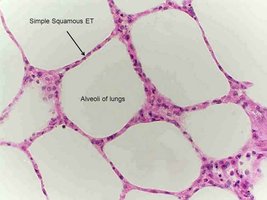
Simple Squamous Epithelium
Structure: Single layer of flat cells
Locations:
Air sacs (alveoli) of lungs
Walls of capillaries
Serous membranes (serosae) lining ventral body cavities
Functions: Filtration and diffusion
Simple Cuboidal Epithelium
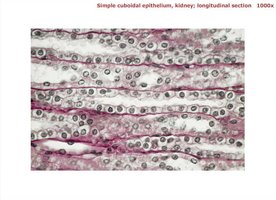
Structure: Single layer of cube-like cells
Locations:
Glands and their ducts
Walls of kidney tubules
Surface of ovaries
Functions: Secretion and absorption
Simple Columnar Epithelium
Structure: Single layer of tall, column-like cells; often contains goblet cells that secrete mucus
Locations:
Lining of digestive tract (stomach to anus)
Mucous membranes (mucosae) lining body cavities opening to the exterior
Functions: Absorption and secretion of mucus and enzymes

Stratified Epithelia
Stratified epithelia consist of two or more layers of cells and primarily function in protection.
Stratified Squamous Epithelium
Structure: Multiple layers; cells at the free (apical) surface are squamous
Locations:
Outer portion of skin (epidermis)
Lining of mouth
Lining of esophagus
Lining of vagina
Functions: Protection against abrasion and friction

Connective Tissue
Types of Connective Tissue
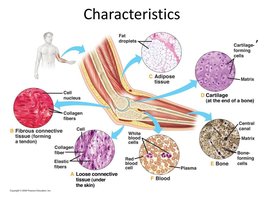
Connective tissue is the most abundant and widely distributed tissue type. It supports, binds, and protects other tissues and organs. Major types include:
Bone (osseous tissue)
Cartilage (hyaline, elastic, fibrocartilage)
Dense connective tissue (regular and irregular)
Loose connective tissue (areolar, adipose, reticular)
Blood (vascular tissue)
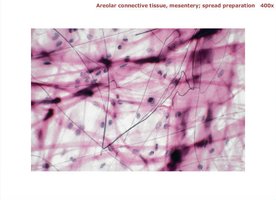
Areolar Connective Tissue
Structure: Loose arrangement of fibers and cells; resembles cobwebs
Functions: Packing tissue; "glue" that holds organs in place
Location: Widely distributed under epithelia
Adipose Connective Tissue
Structure: Large, closely packed adipocytes (fat cells) with nuclei pushed to the side
Functions: Insulates the body, protects organs, stores energy
Location: Subcutaneous tissue beneath the skin (hypodermis), around kidneys, eyeballs, and within abdomen

Dense Connective Tissue
Dense Regular: Collagen fibers aligned in parallel; found in tendons (attach muscle to bone) and ligaments (attach bone to bone)
Dense Irregular: Collagen fibers arranged irregularly; found in the dermis of the skin

Hyaline Cartilage
Structure: Abundant collagen fibers hidden by a glassy, rubbery matrix
Locations:
Covers ends of long bones
Forms the fetal skeleton
Epiphyseal (growth) plates in long bones
Trachea
Functions: Provides support and flexibility

Bone (Osseous Tissue)
Structure: Osteocytes (bone cells) in lacunae, hard matrix of calcium salts, collagen fibers
Functions: Protects and supports the body, stores minerals, produces blood cells

Blood (Vascular Tissue)
Structure: Blood cells surrounded by a fluid matrix (plasma)
Functions: Transport of nutrients, wastes, and respiratory gases
Muscle Tissue
Types of Muscle Tissue
Muscle tissue contracts to produce movement and is classified into three types:
Skeletal muscle: Voluntary, striated, multinucleate, long cylindrical cells; attached to skeleton for body movement
Cardiac muscle: Involuntary, striated, one nucleus per cell, branching cells, intercalated discs; found only in the heart
Smooth muscle: Involuntary, non-striated, one nucleus per cell, spindle-shaped cells; found in walls of hollow organs (e.g., stomach, blood vessels)
Nervous Tissue
Structure and Function
Nervous tissue is specialized for communication by electrical impulses. It is composed of neurons (nerve cells) and neuroglia (supporting cells).
Functions: Receive and conduct electrical impulses to and from body parts
Properties: Irritability (ability to respond to stimuli) and conductivity (ability to transmit impulses)
Summary Table: Major Tissue Types
Tissue Type | Main Function | Key Locations |
|---|---|---|
Epithelial | Protection, absorption, filtration, secretion | Body surfaces, lining of cavities, glands |
Connective | Support, binding, protection, transport | Bones, cartilage, blood, fat, tendons, ligaments |
Muscle | Movement | Skeletal muscles, heart, walls of hollow organs |
Nervous | Communication, control | Brain, spinal cord, nerves |
Additional info: This summary integrates histological images and textbook content to provide a comprehensive overview of tissue types, their structure, and function, as required for introductory anatomy and physiology courses.
