 Back
BackLife Processes and Homeostasis: Foundations of Human Anatomy & Physiology
Study Guide - Smart Notes
 Tailored notes based on your materials, expanded with key definitions, examples, and context.
Life Processes and Homeostasis
Introduction to Life Processes
The study of anatomy and physiology begins with understanding the fundamental life processes that distinguish living organisms from non-living matter. These processes are essential for survival and normal function in humans and include metabolism, responsiveness, movement, growth, differentiation, and reproduction.
Metabolism: The sum of all chemical reactions in the body, including catabolism (breaking down molecules for energy) and anabolism (building complex molecules from simpler ones).
Responsiveness: The ability to detect and respond to changes in the internal or external environment (e.g., moving your hand away from a hot surface).
Movement: Includes motion of the whole body, individual organs, single cells, or even structures within cells.
Growth: An increase in body size due to an increase in the number of cells, size of cells, or both.
Differentiation: The process by which unspecialized cells become specialized in structure and function.
Reproduction: The formation of new cells for growth, repair, or replacement, and the production of a new individual.
These processes enable the body to maintain life and adapt to changing conditions.
Homeostasis: Definition and Importance
Homeostasis is the body's ability to maintain a stable internal environment despite fluctuations in the external or internal environment. This stability is crucial for the survival of complex organisms, as it allows physiological processes to function optimally even when conditions change.
Examples: Regulation of body temperature, blood glucose levels, and water balance.
Significance: Disruptions in homeostasis can lead to disease or dysfunction.
Mechanisms of Homeostatic Regulation
Homeostatic regulation involves a series of steps that detect changes and initiate responses to restore balance. This process typically includes:
Stimulus: A change in the environment that disrupts homeostasis.
Receptor: Detects the stimulus and sends information to the control center.
Control Center: Processes the information and determines the appropriate response (often the brain or endocrine glands).
Effector: Carries out the response to restore balance.
Feedback: The response alters the original stimulus, either reducing it (negative feedback) or enhancing it (positive feedback).
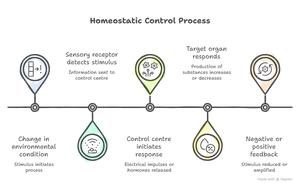
Example: During exercise, increased body temperature (stimulus) is detected by temperature receptors. The hypothalamus (control center) triggers sweating (effector) to cool the body, restoring normal temperature (feedback).
Feedback Mechanisms
Feedback mechanisms are essential for maintaining homeostasis. There are two main types:
Negative Feedback: The most common mechanism. The response reduces or eliminates the original stimulus, restoring balance. Example: Regulation of blood glucose levels.
Positive Feedback: The response enhances or amplifies the original stimulus. This is less common and usually occurs in specific situations, such as blood clotting or childbirth.
Example: Blood Glucose Homeostasis
The regulation of blood glucose is a classic example of negative feedback involving both the endocrine and nervous systems. The pancreas detects changes in blood glucose and releases hormones to restore balance:
High blood glucose: The pancreas releases insulin, promoting glucose uptake by cells and storage as glycogen in the liver, lowering blood glucose to normal levels.
Low blood glucose: The pancreas releases glucagon, stimulating the liver to break down glycogen and release glucose, raising blood glucose to normal levels.
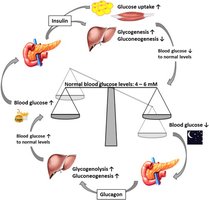
Equation: The relationship between glucose, insulin, and glucagon can be summarized as:
Disruption Example: In diabetes mellitus, insulin production or response is impaired, leading to chronic high blood glucose levels and associated complications.
Examples of Homeostatic Regulation in the Body
Calcium Homeostasis: The endocrine system regulates blood calcium via parathyroid hormone (PTH) and calcitonin. PTH increases blood calcium when it is low; calcitonin decreases it when high.
Heart Rate and Blood Pressure: The nervous system (sympathetic and parasympathetic divisions) and hormones (e.g., adrenaline) adjust heart rate and blood pressure in response to stress or rest.
Summary Table: Components of a Homeostatic Control System
Component | Function | Example |
|---|---|---|
Stimulus | Change in environment | Increased blood glucose after a meal |
Receptor | Detects change | Pancreatic beta cells |
Control Center | Processes information, initiates response | Pancreas (insulin secretion) |
Effector | Carries out response | Liver, muscle, adipose tissue |
Feedback | Modifies original stimulus | Blood glucose returns to normal |
Clinical Relevance
Understanding homeostasis is fundamental for clinical practice. Every clinical decision, from managing fever to treating chronic diseases, relies on knowledge of these regulatory mechanisms. Disruptions in homeostasis underlie many pathological conditions, making this concept central to all health sciences.
Key Points for Exam Preparation
Be able to define and provide examples of the major life processes.
Explain the concept of homeostasis and its importance.
Identify and describe the components of a homeostatic control system.
Distinguish between negative and positive feedback mechanisms, with examples.
Apply these concepts to real-life physiological scenarios (e.g., exercise, dehydration, disease states).
Additional info: For further study, refer to the recommended textbook chapters and videos listed in the module resources. These provide deeper explanations and additional examples relevant to human anatomy and physiology.
