 Back
BackMatter and Measurement: Foundations of Chemistry for Anatomy & Physiology
Study Guide - Smart Notes
 Tailored notes based on your materials, expanded with key definitions, examples, and context.
Matter and Measurement
Introduction to Matter
Matter is defined as anything that occupies space and has mass. Understanding the classification, properties, and changes of matter is fundamental in chemistry and essential for students in Anatomy & Physiology, as all biological processes are rooted in chemical principles.
Matter: Anything that occupies space and has mass.
Mass: Measure of the quantity of matter (SI unit: kilogram, kg).
Weight: Force that gravity exerts on an object; depends on location (e.g., Earth vs. Moon).

Classification of Matter
Matter can be classified based on its composition and physical state. The main categories are pure substances and mixtures.
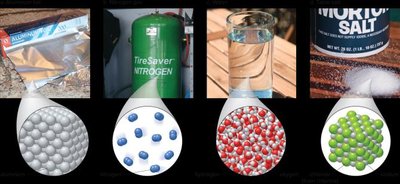
Pure Substances: Have uniform chemical composition throughout and between samples. Subdivided into:
Elements: Cannot be broken down into simpler substances by chemical means (e.g., O2, Fe).
Compounds: Composed of two or more elements in a fixed ratio (e.g., H2O, NaCl).
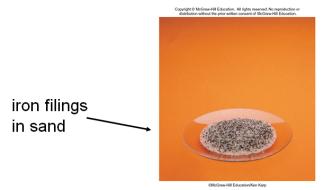
Mixtures: Combinations of two or more pure substances where each retains its identity. Subdivided into:
Homogeneous Mixtures: Uniform composition throughout (solutions, e.g., saltwater).
Heterogeneous Mixtures: Non-uniform composition (e.g., sand in water).
States of Matter
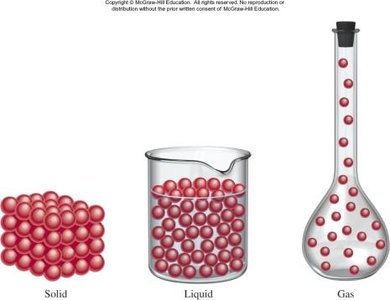
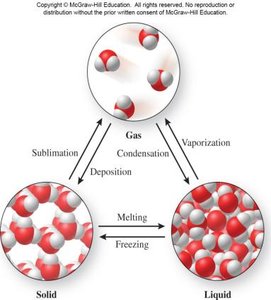
Matter exists in three primary states, each with distinct particle arrangements and properties:
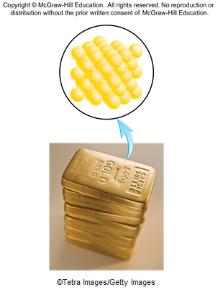
Solid: Definite shape and volume; particles are closely packed.
Liquid: Definite volume but no definite shape; particles are less tightly packed than in solids.
Gas: No definite shape or volume; particles are far apart and move freely.
Properties of Matter
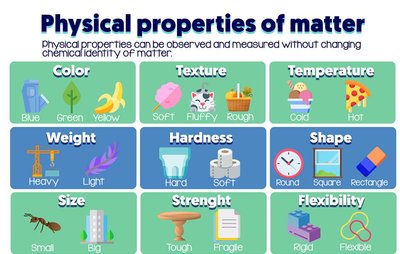
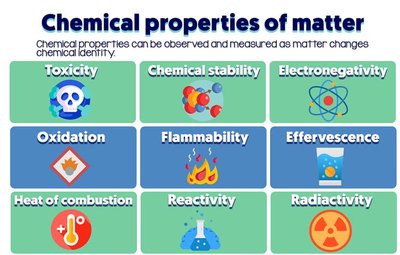
Properties are characteristics used to identify and distinguish substances. They are classified as physical or chemical properties.
Physical Properties: Can be observed or measured without changing the substance's identity (e.g., color, melting point, density).
Chemical Properties: Describe a substance's ability to undergo chemical changes (e.g., flammability, reactivity with acids).

Physical and Chemical Changes
Changes in matter are classified as physical or chemical:
Physical Change: Alters the form or appearance but not the composition (e.g., melting ice, dissolving sugar).
Chemical Change: Produces new substances with different properties (e.g., rusting iron, burning wood).
Extensive and Intensive Properties
Properties can also be classified based on their dependence on the amount of matter:
Extensive Properties: Depend on the amount of matter (e.g., mass, volume).
Intensive Properties: Independent of the amount of matter (e.g., density, temperature).
Measurement and Units
Scientific measurements require standard units. The International System of Units (SI) is used globally.
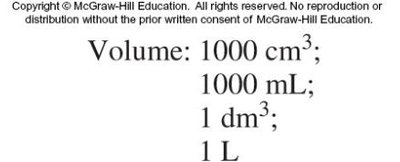
Base SI Units: meter (m) for length, kilogram (kg) for mass, second (s) for time, kelvin (K) for temperature, mole (mol) for amount of substance.
Prefixes: Used to indicate multiples or fractions of units (e.g., kilo-, centi-, milli-).
Density
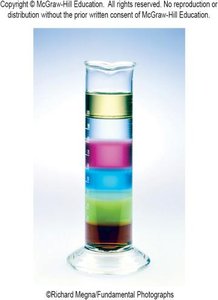
Density is a key intensive property, defined as mass per unit volume:
Formula: $\text{Density} = \frac{\text{mass}}{\text{volume}}$
Common units: g/cm³ or g/mL for liquids and solids; g/L for gases.
Temperature Scales
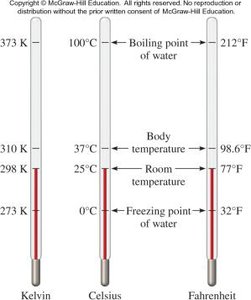
Temperature is measured in Celsius (°C), Kelvin (K), and Fahrenheit (°F). Conversions are essential in scientific calculations.
Kelvin to Celsius: $K = ^\circ C + 273.15$
Celsius to Fahrenheit: $^\circ F = 1.8(^\circ C) + 32$
Significant Figures and Scientific Notation
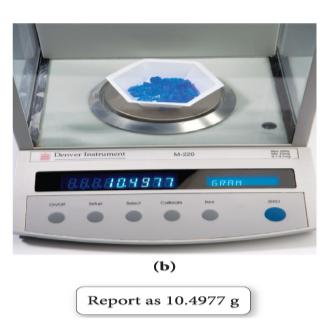
Significant figures reflect the precision of a measurement. Scientific notation expresses very large or small numbers conveniently.
Rules for Significant Figures:
All nonzero digits are significant.
Zeros between nonzero digits are significant.
Leading zeros are not significant.
Trailing zeros are significant only if there is a decimal point.
Scientific Notation: $N \times 10^n$, where N is a number between 1 and 10, and n is an integer.
Accuracy, Precision, and Error
Understanding the reliability of measurements is crucial in scientific work.
Accuracy: How close a measurement is to the true value.
Precision: How close repeated measurements are to each other.
Random Error: Equal probability of being too high or too low.
Systematic Error: Consistently too high or too low.
Dimensional Analysis and Conversion Factors
Dimensional analysis is a systematic approach to problem-solving that uses conversion factors to move between units.
Conversion Factor: A ratio equal to one, used to convert from one unit to another (e.g., $1 \text{kg} = 2.20 \text{lb}$).
Example: To convert 2 kilometers to inches:
$2 \text{ km} \times \frac{1000 \text{ m}}{1 \text{ km}} \times \frac{100 \text{ cm}}{1 \text{ m}} \times \frac{1 \text{ in}}{2.54 \text{ cm}} = 78,740 \text{ in}$
Summary Table: Classification of Matter
Type | Description | Example |
|---|---|---|
Element | Cannot be decomposed chemically | Oxygen (O2), Iron (Fe) |
Compound | Composed of two or more elements in a fixed ratio | Water (H2O), Sodium chloride (NaCl) |
Homogeneous Mixture | Uniform composition throughout | Saltwater, Air |
Heterogeneous Mixture | Non-uniform composition | Sand in water, Salad |
Key Equations
Density: $d = \frac{m}{v}$
Temperature Conversions:
$K = ^\circ C + 273.15$
$^\circ F = 1.8(^\circ C) + 32$
Conclusion
Understanding matter and measurement is foundational for all scientific disciplines, including Anatomy & Physiology. Mastery of these concepts enables accurate experimentation, data analysis, and comprehension of biological processes at the molecular level.
