 Back
BackMechanisms Promoting Secretion and Release of Bile and Pancreatic Juice
Study Guide - Smart Notes
 Tailored notes based on your materials, expanded with key definitions, examples, and context.
The Digestive System
Mechanisms Promoting Secretion and Release of Bile and Pancreatic Juice
The secretion and release of bile and pancreatic juice are essential processes in digestion, regulated by both neural and hormonal mechanisms. The hormones cholecystokinin (CCK) and secretin play central roles in coordinating the activities of the liver, gallbladder, and pancreas in response to the presence of chyme in the small intestine.
Hormonal Regulation of Bile and Pancreatic Juice Secretion
CCK (Cholecystokinin): Released from the duodenal enteroendocrine cells in response to fatty, protein-rich chyme. CCK stimulates the pancreas to release enzyme-rich pancreatic juice and causes the gallbladder to contract, releasing bile into the duodenum.
Secretin: Released from the duodenum in response to acidic chyme. Secretin stimulates the pancreas to release bicarbonate-rich pancreatic juice and enhances bile production by the liver.
Stepwise Mechanisms
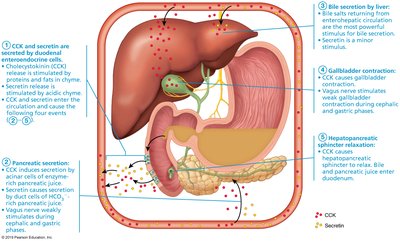
CCK and Secretin Secretion: Both hormones are secreted by duodenal enteroendocrine cells when chyme enters the duodenum. CCK is mainly stimulated by proteins and fats, while secretin is stimulated by acidic chyme.
Pancreatic Secretion: CCK induces secretion of enzyme-rich pancreatic juice, while secretin causes secretion of bicarbonate-rich juice. Parasympathetic stimulation (vagus nerve) also promotes pancreatic secretion.
Bile Secretion by Liver: Bile salts returning from the enterohepatic circulation are the strongest stimulus for bile secretion. Secretin provides a minor stimulus.
Gallbladder Contraction: CCK causes the gallbladder to contract and the hepatopancreatic sphincter to relax, allowing bile to flow into the duodenum. Vagal stimulation also weakly contracts the gallbladder.
Hepatopancreatic Sphincter Relaxation: CCK causes the sphincter to relax, permitting bile and pancreatic juice to enter the duodenum.
Summary Table: Hormonal Control of Bile and Pancreatic Juice
Hormone | Stimulus for Release | Main Actions |
|---|---|---|
CCK | Fatty, protein-rich chyme in duodenum | Stimulates enzyme-rich pancreatic juice; contracts gallbladder; relaxes hepatopancreatic sphincter |
Secretin | Acidic chyme in duodenum | Stimulates bicarbonate-rich pancreatic juice; increases bile secretion by liver |
Example: Digestion of a Fatty Meal
When a fatty meal enters the duodenum, CCK is released, causing the gallbladder to contract and the pancreas to secrete digestive enzymes. Secretin is released in response to acid, stimulating the pancreas to release bicarbonate to neutralize the acid.
Additional info: The coordination of these hormones ensures efficient digestion and absorption of nutrients by regulating the timing and composition of digestive secretions.
