 Back
BackMuscles of the Upper Limb: Structure, Function, and Innervation
Study Guide - Smart Notes
 Tailored notes based on your materials, expanded with key definitions, examples, and context.
Muscles of the Upper Limb
Introduction
The upper limb muscles are specialized for a wide range of movements, allowing for complex actions such as lifting, throwing, and fine motor skills. These muscles are organized into groups based on their location and primary actions: muscles that stabilize the pectoral girdle, move the arm (humerus), move the forearm, and move the wrists, hands, and fingers.
Muscles That Move the Humerus (Shoulder Muscles)
Overview
Muscles that move the humerus originate mainly from the scapula and clavicle and insert onto the humerus. They are responsible for movements such as abduction, adduction, flexion, extension, and rotation of the arm. The rotator cuff muscles play a crucial role in stabilizing the shoulder joint.
Deltoid: Major abductor of the arm; also flexes, extends, and rotates the arm.
Supraspinatus: Abducts the arm.
Infraspinatus: Laterally rotates the arm.
Subscapularis: Medially rotates the arm.
Teres Major: Extends, adducts, and medially rotates the arm.
Teres Minor: Laterally rotates and extends the arm.
Coracobrachialis: Flexes and adducts the arm.
The rotator cuff is formed by the tendons of the subscapularis, supraspinatus, infraspinatus, and teres minor, providing stability to the shoulder joint.
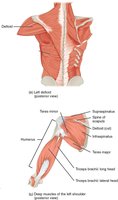
Table: Muscles That Move the Humerus
Name | Primary Action | Origin | Insertion | Nerve |
|---|---|---|---|---|
Deltoid | Abduct, flex, extend, rotate arm | Clavicle, acromion, spine of scapula | Deltoid tuberosity | Axillary |
Supraspinatus | Abduct arm | Supraspinous fossa | Greater tubercle | Suprascapular |
Infraspinatus | Laterally rotate arm | Infraspinous fossa | Greater tubercle | Suprascapular |
Subscapularis | Medially rotate arm | Subscapular fossa | Lesser tubercle | Subscapular |
Teres Major | Extend, adduct, medially rotate arm | Posterior scapula | Intertubercular sulcus of humerus | Subscapular |
Teres Minor | Laterally rotate, extend arm | Lateral border of scapula | Greater tubercle | Axillary |
Muscles That Move the Forearm
Overview
These muscles are responsible for flexion, extension, pronation, and supination of the forearm at the elbow joint. Flexors are located anteriorly, while extensors are posterior. Pronation and supination are rotational movements of the forearm.
Biceps Brachii: Flexes and supinates the forearm; also flexes the arm at the shoulder.
Brachialis: Main flexor of the forearm.
Brachioradialis: Flexes the forearm, especially during rapid movement or lifting.
Triceps Brachii: Main extensor of the forearm.
Anconeus: Assists triceps in forearm extension.
Pronator Teres & Pronator Quadratus: Pronate the forearm.
Supinator: Supinates the forearm.
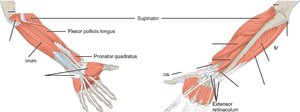
Table: Muscles That Move the Forearm
Name | Primary Action | Origin | Insertion | Nerve |
|---|---|---|---|---|
Biceps Brachii | Flex, supinate forearm | Coracoid process, supraglenoid tubercle | Radial tuberosity | Musculocutaneous |
Brachialis | Flex forearm | Anterior distal humerus | Coronoid process of ulna | Musculocutaneous |
Brachioradialis | Flex forearm | Lateral supracondylar ridge | Styloid process of radius | Radial |
Triceps Brachii | Extend forearm | Infraglenoid tubercle, posterior humerus | Olecranon | Radial |
Pronator Teres | Pronate forearm | Medial epicondyle, coronoid process of ulna | Lateral radius | Median |
Pronator Quadratus | Pronate forearm | Distal anterior ulna | Distal anterior radius | Median |
Supinator | Supinate forearm | Lateral epicondyle, proximal ulna | Proximal radius | Radial |
Muscles That Move the Wrists, Hands, and Fingers
Overview
The muscles of the forearm control the movements of the wrist, hand, and fingers. The anterior compartment contains mainly flexors, while the posterior compartment contains extensors. These muscles allow for complex hand movements and fine motor control.
Flexor Carpi Radialis: Flexes and abducts the wrist.
Flexor Carpi Ulnaris: Flexes and adducts the wrist.
Palmaris Longus: Flexes the wrist.
Flexor Digitorum Superficialis: Flexes wrist and fingers 2-5.
Flexor Digitorum Profundus: Flexes wrist and distal phalanges of fingers 2-5.
Extensor Carpi Radialis Longus/Brevis: Extend and abduct the wrist.
Extensor Carpi Ulnaris: Extends and adducts the wrist.
Extensor Digitorum: Extends fingers and wrist.
Flexor/Extensor Pollicis Longus/Brevis: Flex or extend the thumb.
Abductor Pollicis Longus/Brevis: Abduct the thumb.
Table: Muscles That Move the Wrist, Hand, and Fingers
Name | Primary Action | Origin | Insertion | Nerve |
|---|---|---|---|---|
Flexor Carpi Radialis | Flex, abduct wrist | Medial epicondyle of humerus | Base of 2nd/3rd metacarpals | Median |
Flexor Carpi Ulnaris | Flex, adduct wrist | Medial epicondyle, olecranon, ulna | Pisiform, hamate, base of 5th metacarpal | Ulnar |
Extensor Carpi Radialis Longus | Extend, abduct wrist | Lateral supracondylar ridge | Base of 2nd metacarpal | Radial |
Extensor Carpi Radialis Brevis | Extend, abduct wrist | Lateral epicondyle | Base of 3rd metacarpal | Radial |
Extensor Carpi Ulnaris | Extend, adduct wrist | Lateral epicondyle, posterior ulna | Base of 5th metacarpal | Radial |
Palmaris Longus | Flex wrist | Medial epicondyle | Palmar aponeurosis | Median |
Flexor Digitorum Superficialis | Flex wrist, fingers 2-5 | Medial epicondyle, coronoid process, radius | Middle phalanges 2-5 | Median |
Flexor Digitorum Profundus | Flex wrist, distal phalanges 2-5 | Ulna, interosseous membrane | Distal phalanges 2-5 | Median/Ulnar |
Extensor Digitorum | Extend fingers, wrist | Lateral epicondyle | Phalanges 2-5 | Radial |
Flexor Pollicis Longus | Flex thumb | Radius, interosseous membrane | Distal phalanx of thumb | Median |
Extensor Pollicis Longus | Extend thumb | Dorsal radius/ulna, interosseous membrane | Distal phalanx of thumb | Radial |
Abductor Pollicis Longus | Abduct, extend thumb; abduct wrist | Posterior radius/ulna, interosseous membrane | Base of 1st metacarpal, trapezium | Radial |
Muscle Actions and Attachments
Key Actions
Flexion: Decreases the angle between bones (e.g., biceps brachii flexes the elbow).
Extension: Increases the angle between bones (e.g., triceps brachii extends the elbow).
Abduction: Moves a limb away from the midline (e.g., deltoid abducts the arm).
Adduction: Moves a limb toward the midline (e.g., pectoralis major adducts the arm).
Pronation/Supination: Rotational movements of the forearm (pronator teres/pronator quadratus for pronation; supinator for supination).
Muscle Attachments (Origins and Insertions)
Deltoid: Originates from clavicle, acromion, and spine of scapula; inserts on deltoid tuberosity of humerus.
Biceps Brachii: Originates from coracoid process and supraglenoid tubercle; inserts on radial tuberosity.
Brachialis: Originates from anterior distal humerus; inserts on coronoid process of ulna.
Triceps Brachii: Originates from infraglenoid tubercle and posterior humerus; inserts on olecranon of ulna.
Flexor Carpi Radialis: Originates from medial epicondyle of humerus; inserts on base of 2nd and 3rd metacarpals.
Extensor Carpi Ulnaris: Originates from lateral epicondyle and posterior ulna; inserts on base of 5th metacarpal.
Clinical Application: Carpal Tunnel Syndrome
Repetitive movements of the wrist can irritate the tendons of the flexor muscles as they pass through the carpal tunnel, compressing the median nerve and causing pain, numbness, and weakness in the hand. This is known as Carpal Tunnel Syndrome.
Summary Table: Nerve Supply of Major Upper Limb Muscles
Muscle | Nerve |
|---|---|
Deltoid, Teres Minor | Axillary |
Supraspinatus, Infraspinatus | Suprascapular |
Subscapularis, Teres Major | Subscapular |
Biceps Brachii, Brachialis, Coracobrachialis | Musculocutaneous |
Triceps Brachii, Extensors | Radial |
Flexor Carpi Ulnaris, part of Flexor Digitorum Profundus | Ulnar |
Most forearm flexors, thenar muscles | Median |
Additional info: The thumb can move independently due to the presence of specialized muscles (e.g., abductor pollicis longus, extensor pollicis longus/brevis, flexor pollicis longus/brevis) that are not shared with the other fingers, allowing for a wide range of thumb movements essential for grasping and manipulating objects.
