Back
BackNeuronal Synapses: Structure, Function, and Transmission
Study Guide - Smart Notes
 Tailored notes based on your materials, expanded with key definitions, examples, and context.
Neuronal Synapses
Overview
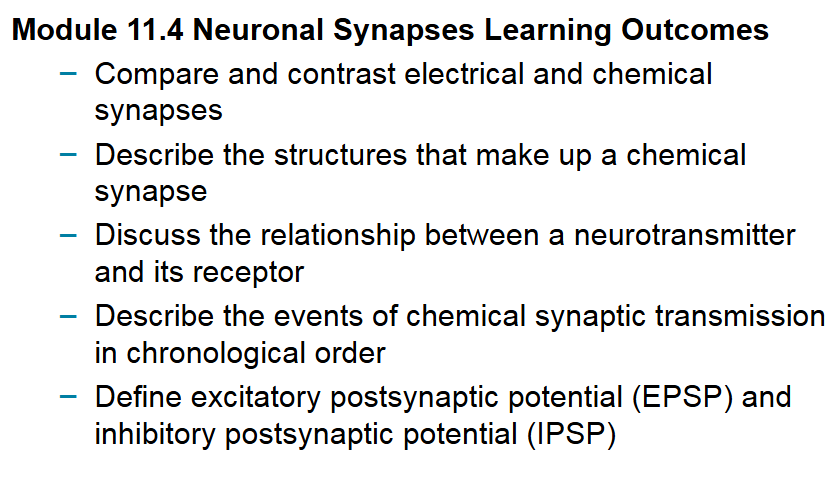
Neuronal synapses are specialized junctions through which neurons communicate with each other or with effector cells. Synapses are essential for the transmission of electrical or chemical signals in the nervous system, allowing for complex processing and integration of information.
Comparison of Electrical and Chemical Synapses
Electrical Synapses: These synapses involve direct physical connections between neurons via gap junctions, allowing ions and small molecules to pass directly from one cell to another. This results in rapid, bidirectional transmission of signals.
Chemical Synapses: These synapses use neurotransmitters to transmit signals across a synaptic cleft. The process is slower than electrical transmission and is typically unidirectional, but allows for greater complexity and modulation of signals.
Key Differences:
Electrical synapses are faster and allow direct ionic current flow; chemical synapses are slower and involve neurotransmitter release.
Chemical synapses can amplify signals and are more common in the human nervous system.
Structures of a Chemical Synapse
A chemical synapse consists of several key components:
Presynaptic neuron: The neuron sending the signal, containing synaptic vesicles filled with neurotransmitters.
Synaptic cleft: The small gap between the presynaptic and postsynaptic membranes.
Postsynaptic neuron: The neuron receiving the signal, with receptors for neurotransmitters on its membrane.
Neurotransmitters and Their Receptors
Neurotransmitters are chemical messengers released from the presynaptic neuron. They bind to specific receptors on the postsynaptic membrane, triggering a response in the postsynaptic cell. The effect depends on the type of neurotransmitter and receptor involved.
Example: Acetylcholine binds to nicotinic or muscarinic receptors, causing excitation or inhibition depending on the receptor type.
Events of Chemical Synaptic Transmission
The process of chemical synaptic transmission occurs in several steps:
An action potential arrives at the presynaptic terminal.
Voltage-gated calcium channels open, allowing Ca2+ to enter the presynaptic neuron.
Synaptic vesicles fuse with the presynaptic membrane and release neurotransmitter into the synaptic cleft (exocytosis).
Neurotransmitter diffuses across the cleft and binds to receptors on the postsynaptic membrane.
Postsynaptic ion channels open or close, leading to changes in the postsynaptic membrane potential.
Neurotransmitter is removed from the synaptic cleft by reuptake, enzymatic degradation, or diffusion.
Excitatory and Inhibitory Postsynaptic Potentials
Excitatory Postsynaptic Potential (EPSP): A depolarizing change in the postsynaptic membrane potential that brings the neuron closer to threshold for firing an action potential. Usually caused by the opening of Na+ or Ca2+ channels.
Inhibitory Postsynaptic Potential (IPSP): A hyperpolarizing change in the postsynaptic membrane potential that makes it less likely for the neuron to fire an action potential. Usually caused by the opening of K+ or Cl- channels.