 Back
BackNeurophysiology: Membrane Potentials and Action Potentials
Study Guide - Smart Notes
 Tailored notes based on your materials, expanded with key definitions, examples, and context.
Neurophysiology: Membrane Potentials and Action Potentials
Ion Channels in Neurons
The movement of ions across the neuronal membrane is fundamental to the generation and propagation of electrical signals in the nervous system. Ion channels are specialized proteins that allow specific ions to pass through the membrane, contributing to changes in membrane potential.
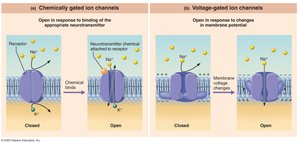
Leakage (nongated) channels: Always open, allowing ions to move down their concentration gradients.
Gated channels: Open or close in response to specific signals. Two main types are:
Chemically gated (ligand-gated) channels: Open when a neurotransmitter or other ligand binds to the channel.
Voltage-gated channels: Open or close in response to changes in membrane potential.
Resting Membrane Potential
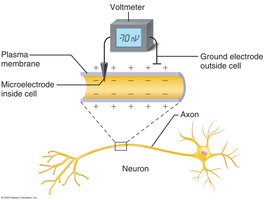
The resting membrane potential is the voltage difference across the membrane of a resting neuron, typically around -70 mV. This potential is essential for the excitability of neurons and is established by differences in ion concentrations and membrane permeability.
Measured with a voltmeter: The inside of the cell is negative relative to the outside.
Polarized membrane: The cytoplasmic side is negatively charged compared to the extracellular side.
Generation of Resting Membrane Potential
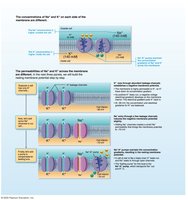
Ionic composition: Differences in the concentrations of Na+, K+, and other ions between the intracellular fluid (ICF) and extracellular fluid (ECF).
Membrane permeability: The membrane is much more permeable to K+ than to Na+ due to more K+ leakage channels.
Maintaining the Resting Membrane Potential
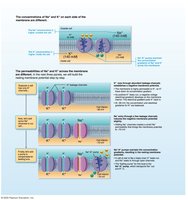
The resting membrane potential is maintained by the selective permeability of the membrane and the activity of the sodium-potassium pump (Na+/K+ ATPase), which transports 3 Na+ ions out and 2 K+ ions into the cell, maintaining the negative internal environment.
Changes in Membrane Potential
Neurons use changes in membrane potential to send, receive, and integrate information. These changes can be classified as:
Graded potentials: Short-distance signals, usually occurring in dendrites and cell bodies.
Action potentials: Long-distance signals that travel along axons.
Terms describing changes:
Depolarization: Membrane potential becomes less negative (inside becomes more positive).
Hyperpolarization: Membrane potential becomes more negative (inside becomes less positive).
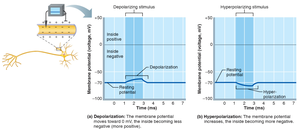
Graded Potentials
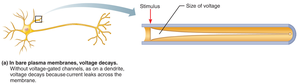
Graded potentials are changes in membrane potential that vary in size and decay with distance. They are typically generated in dendrites and cell bodies by the opening of ligand-gated ion channels.
Excitatory postsynaptic potentials (EPSPs): Depolarizing events that bring the membrane potential closer to threshold for firing an action potential.
Inhibitory postsynaptic potentials (IPSPs): Hyperpolarizing events that move the membrane potential further from threshold.
Summation: Graded potentials can be summed spatially (from multiple inputs) or temporally (from repeated inputs) to reach threshold.
Action Potentials
An action potential (AP) is a rapid, large change in membrane potential that propagates along the axon without decrement. It is the principal means of long-distance neural communication.
All-or-none phenomenon: An AP either occurs fully or not at all, depending on whether threshold is reached.
Phases of the action potential:
Resting state: All voltage-gated Na+ and K+ channels are closed.
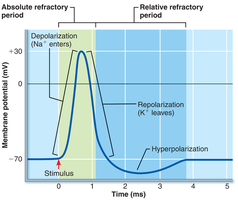
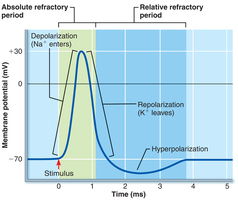
Depolarization: Voltage-gated Na+ channels open, Na+ enters the cell.
Repolarization: Na+ channels inactivate, K+ channels open, K+ exits the cell.
Hyperpolarization: Some K+ channels remain open, causing the membrane potential to become more negative than resting.
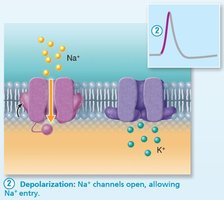
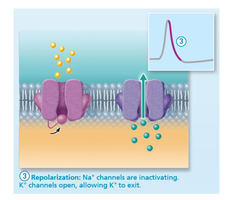
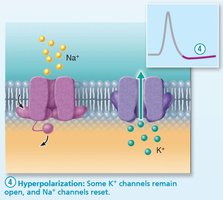
Threshold and the All-Or-None Law
For an action potential to be generated, the membrane potential must reach a critical threshold. If this threshold is not reached, no action potential occurs. If it is reached, the action potential proceeds to completion.
Propagation of the Action Potential
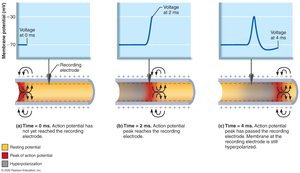
Once initiated, the action potential is self-propagating and travels along the axon. The local current depolarizes adjacent regions of the membrane, opening voltage-gated Na+ channels and continuing the wave of depolarization.
Refractory Periods
After an action potential, the neuron enters a refractory period during which it cannot fire another action potential or requires a stronger stimulus to do so.
Absolute refractory period: No new action potential can be initiated because voltage-gated Na+ channels are open or inactivated.
Relative refractory period: A stronger-than-normal stimulus is required to initiate another action potential, as some K+ channels remain open and the membrane is hyperpolarized.
Conduction Velocity of Action Potentials
The speed at which action potentials travel along axons depends on two main factors:
Axon diameter: Larger axons conduct faster due to lower resistance.
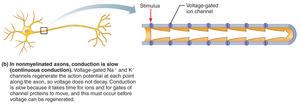
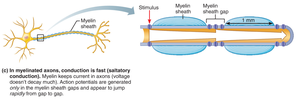
Degree of myelination: Myelinated axons conduct action potentials much faster via saltatory conduction, where the impulse jumps from node to node (nodes of Ranvier). Nonmyelinated axons conduct more slowly via continuous conduction.
Summary Table: Types of Ion Channels and Their Roles
Channel Type | Stimulus | Location | Function |
|---|---|---|---|
Leakage (nongated) | None (always open) | Entire neuron | Establish resting membrane potential |
Chemically gated | Ligand (e.g., neurotransmitter) | Dendrites, cell body | Generate graded potentials |
Voltage-gated | Change in membrane potential | Axon hillock, axon | Generate and propagate action potentials |
Additional info: The sodium-potassium pump is essential for maintaining the ionic gradients that underlie the resting membrane potential. Myelination is provided by oligodendrocytes in the CNS and Schwann cells in the PNS.
