Back
BackNutrient Digestion and Absorption: Mechanisms and Clinical Insights 22.7
Study Guide - Smart Notes
 Tailored notes based on your materials, expanded with key definitions, examples, and context.
Module 22.7 Nutrient Digestion and Absorption
Overview of Digestion and Absorption
The process of digestion breaks down food into individual nutrient molecules through both mechanical and chemical means. Mechanical digestion physically fragments food, while chemical digestion uses enzymes to break chemical bonds. All nutrients undergo mechanical digestion, but chemical digestion is specific to each nutrient due to enzyme specificity.
Mechanical digestion: Includes mastication (mouth), churning (stomach), and segmentation (small intestine).
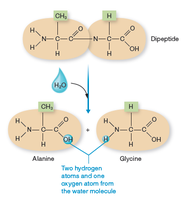
Chemical digestion: Involves enzymatic hydrolysis, where water is used to break bonds between molecules.
Absorption: Nutrients must cross the epithelial lining of the alimentary canal to enter the bloodstream and reach body cells.
Understanding Absorption in the Alimentary Canal
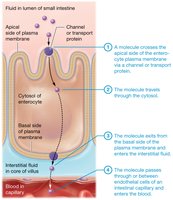
For nutrients to be absorbed, they must traverse several barriers from the lumen of the alimentary canal to the blood. The apical side of the enterocyte plasma membrane is the most significant barrier. Most substances require specific transport proteins or channels to cross membranes; substances lacking these remain unabsorbed and are excreted.
Paracellular transport: Small molecules like water may pass between enterocytes.
Transcellular transport: Most nutrients require transporters or channels to cross cell membranes.
Clinical example: Elemental mercury is not absorbed due to lack of transporters, thus passes through the digestive tract unabsorbed.
Digestion and Absorption of Carbohydrates
Chemical Digestion of Carbohydrates
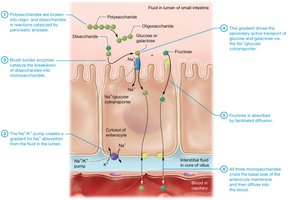
Carbohydrate digestion begins in the mouth with salivary amylase, continues briefly in the stomach, and resumes in the small intestine with pancreatic amylase. Brush border enzymes (lactase, maltase, sucrase) complete the breakdown to monosaccharides (glucose, fructose, galactose).
Salivary amylase: Initiates breakdown of polysaccharides to oligosaccharides.
Pancreatic amylase: Continues digestion in the small intestine.
Brush border enzymes: Complete digestion to monosaccharides.
Absorption of Carbohydrates
Monosaccharides are absorbed via specific mechanisms:
Glucose and galactose: Absorbed by secondary active transport (Na+/glucose cotransporter), requiring energy from sodium gradients established by the Na+/K+ pump.
Fructose: Absorbed by facilitated diffusion, which is passive and depends on a concentration gradient.
All monosaccharides exit the basal membrane by facilitated diffusion and enter capillaries for transport to the liver via the hepatic portal vein.
Lactose Intolerance
Lactose intolerance results from a deficiency of lactase, leading to undigested lactose in the intestine. This causes osmotic retention of water, resulting in cramping and diarrhea. Management includes dietary restriction or enzyme supplementation.
Digestion and Absorption of Proteins
Chemical Digestion of Proteins
Protein digestion begins in the stomach with pepsin and continues in the small intestine with pancreatic and brush border enzymes. Pancreatic enzymes are secreted as inactive precursors to prevent autodigestion.
Pepsin: Activated in the stomach, digests proteins into polypeptides and oligopeptides.
Pancreatic enzymes: Trypsinogen is activated to trypsin, which then activates other proteases.
Brush border enzymes: Complete digestion to free amino acids.
Absorption of Proteins
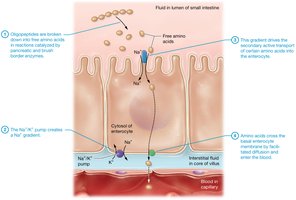
Amino acids and small oligopeptides are absorbed via secondary active transport using sodium gradients. Most oligopeptides are further digested within enterocytes. Free amino acids exit via facilitated diffusion and enter the bloodstream for delivery to the liver.
Special case: Small amounts of whole proteins can be absorbed by endocytosis, important for immune function (e.g., Peyer's patches).
Digestion and Absorption of Lipids
Chemical Digestion of Lipids
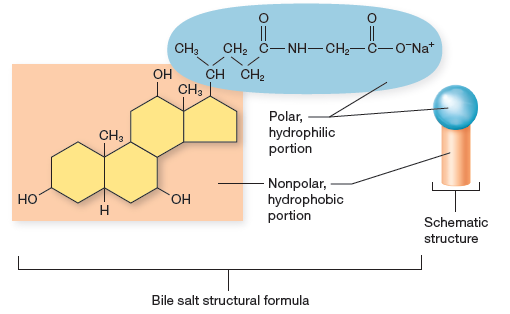
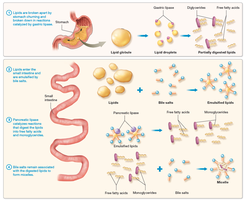
Most dietary lipids are triglycerides. Lipids are hydrophobic and tend to form large globules, which are broken down by mechanical digestion and emulsified by bile salts. Emulsification increases surface area for pancreatic lipase action.
Bile salts: Amphiphilic molecules that emulsify lipids, forming micelles.
Pancreatic lipase: Digests triglycerides into free fatty acids and monoglycerides.
Absorption of Lipids
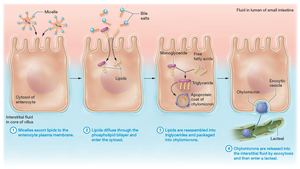
Micelles escort lipids to the enterocyte membrane, where lipids diffuse into the cell, are reassembled into triglycerides, and packaged into chylomicrons. Chylomicrons are released into the lymphatic system, not directly into the blood.
Chylomicrons: Lipoprotein particles that transport dietary lipids through lymphatic vessels to the bloodstream.
Clinical note: Lipids are not delivered directly to the liver after absorption; bile salts are recycled via the hepatic portal vein.
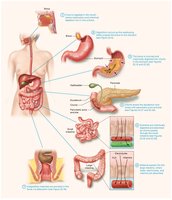
Summary of Digestion of Carbohydrates, Proteins, and Lipids
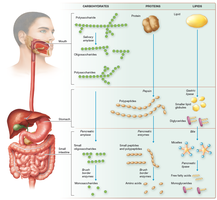
Digestion and Absorption of Nucleic Acids
Nucleic acids are digested in the small intestine by pancreatic nucleases and brush border enzymes, resulting in absorption of phosphate ions, sugars, and nitrogenous bases via active transport into capillaries.
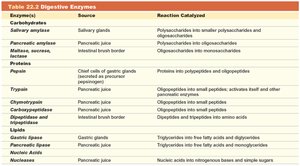
Digestive Enzymes Table
The following table summarizes the main digestive enzymes, their sources, and the reactions they catalyze:
Enzyme(s) | Source | Reaction Catalyzed |
|---|---|---|
Salivary amylase | Salivary glands | Polysaccharides into smaller polysaccharides and oligosaccharides |
Pancreatic amylase | Pancreatic juice | Polysaccharides into oligosaccharides |
Maltase, sucrase, lactase | Intestinal brush border | Oligosaccharides into monosaccharides |
Pepsin | Chief cells of gastric glands | Proteins into polypeptides and oligopeptides |
Trypsin, chymotrypsin, carboxypeptidase | Pancreatic juice | Oligopeptides into small peptides, activates itself and other enzymes |
Dipeptidase, aminopeptidase | Intestinal brush border | Oligopeptides into free amino acids |
Gastric lipase | Gastric glands | Triglycerides into free fatty acids and diglycerides |
Pancreatic lipase | Pancreatic juice | Triglycerides into free fatty acids and monoglycerides |
Nucleases | Pancreatic juice | Nucleic acids into nitrogenous bases and simple sugars |
Absorption of Water, Electrolytes, and Vitamins
The alimentary canal absorbs large quantities of water, electrolytes, and vitamins, primarily in the small intestine but also in the large intestine. Water absorption occurs by osmosis, driven by solute gradients. Electrolytes are absorbed by various mechanisms, including cotransport and active transport. Vitamins are absorbed based on their solubility: water-soluble vitamins by diffusion, fat-soluble vitamins with lipids in micelles.
Vitamin B12: Requires intrinsic factor for absorption in the ileum; deficiency leads to pernicious anemia and neurological issues.
Fat-soluble vitamins (A, D, E, K): Absorbed with dietary fats.
The Big Picture of Digestion