 Back
BackSkeletal System: Bone Development, Growth, and Homeostasis
Study Guide - Smart Notes
 Tailored notes based on your materials, expanded with key definitions, examples, and context.
Bones and Skeletal Tissues
Bone Development (Osteogenesis/Ossification)
Bone development, also known as osteogenesis or ossification, is the process by which new bone is formed. This process begins in the second month of embryonic development and continues through postnatal growth until early adulthood. Bone remodeling and repair are lifelong processes, regulated by hormones such as pituitary growth hormone (GH), testosterone, and estrogen. Disorders such as giantism and dwarfism can result from hormonal imbalances.
Osteogenesis: Formation of bone tissue.
Postnatal bone growth: Continues until early adulthood.
Bone remodeling and repair: Ongoing throughout life.
Types of Ossification
There are two primary types of bone formation:
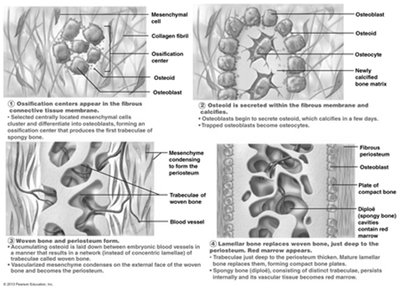
Intramembranous ossification: Bone develops from a fibrous membrane, forming flat bones such as the clavicles and cranial bones.
Endochondral ossification: Bone forms by replacing hyaline cartilage, producing most of the bones in the skeleton except the skull and clavicle.
Intramembranous Ossification
This process forms flat bones of the skull and clavicle from a fibrous membrane model. The steps include:
Ossification centers appear in the fibrous connective tissue membrane.
Bone matrix is secreted by osteoblasts.
Woven bone and periosteum form.
Bone collar of compact bone and red marrow appear.
Endochondral Ossification
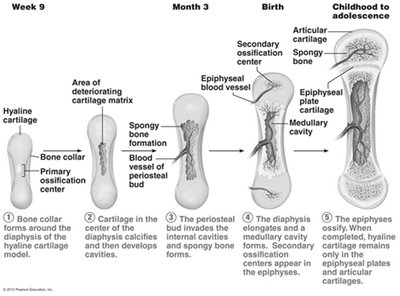
Endochondral ossification forms all bones except those of the skull and clavicle. It begins in the second month of development using hyaline cartilage models. The process is more complex than intramembranous ossification and starts with the primary ossification center.
Formation of bone collar around hyaline cartilage model.
Cavitation of hyaline cartilage.
Invasion of internal cavities by periosteal bud and formation of spongy bone.
Formation of the medullary cavity and appearance of secondary ossification centers in the epiphyses.
Ossification of epiphyses, leaving epiphyseal plates and articular cartilages.
Growth in Long Bones (Postnatal)
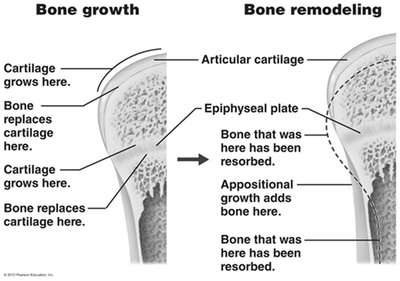
Long bones grow in length by interstitial growth of the epiphyseal plate cartilage and in width by appositional growth (addition of bone tissue by osteoblasts on the bone surface).
Interstitial growth: Increases bone length.
Appositional growth: Increases bone thickness.
Bone Homeostasis: Remodeling and Repair
Bone is a dynamic tissue, constantly undergoing small changes. About 5–7% of bone mass is recycled weekly. Spongy bone is replaced every 3–4 years, and compact bone every 10 years. Bone remodeling involves both deposition (by osteoblasts) and resorption (by osteoclasts).
Bone deposit: Requires protein, vitamins C, D, A, calcium, phosphorus, magnesium, and manganese.
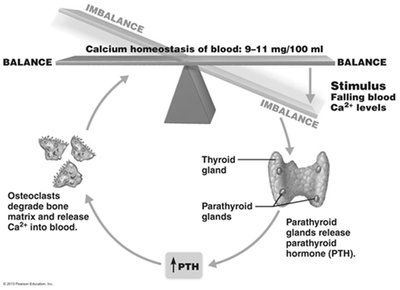
Bone resorption: Osteoclasts digest bone matrix and release minerals into the blood.
Hormonal Control of Blood Calcium
Calcium is essential for nerve impulse transmission, muscle contraction, blood coagulation, gland and nerve cell secretion, and cell division. Blood calcium levels are regulated by parathyroid hormone (PTH) and calcitonin.
PTH: Increases blood calcium by stimulating osteoclasts to degrade bone matrix.
Calcitonin: Lowers blood calcium by inhibiting osteoclast activity.
Response to Mechanical Stress (Wolff’s Law)
Wolff’s Law states that bone grows and remodels in response to the forces or demands placed on it. Bone is deposited where it is needed and resorbed where it is not. This explains why handedness affects bone thickness and why large projections occur where muscles attach.
Fracture Repair
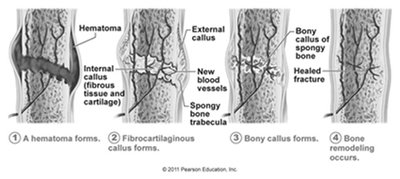
Bone fractures are classified by location, external appearance, and nature of the break. The repair process involves four main steps:
Hematoma formation
Fibrocartilaginous callus formation
Bony callus formation
Bone remodeling
Homeostatic Imbalances of Bone
Osteomalacia: Soft bones due to inadequate mineralization, often from vitamin D deficiency.
Rickets: Osteomalacia in children, leading to bone deformities.
Osteoporosis: Fragile bones due to decreased bone mass, common in postmenopausal women.
Paget’s Disease: Excessive and disorganized bone growth, resulting in weak and deformed bones.
