 Back
BackSleep Regulation: Homeostatic and Circadian Mechanisms, Molecular Pathways, and Hormonal Interactions
Study Guide - Smart Notes
 Tailored notes based on your materials, expanded with key definitions, examples, and context.
Homeostatic Sleep Regulation
Overview of Homeostatic Sleep Regulation
Homeostatic sleep regulation refers to the process by which the body balances sleep and wakefulness, ensuring that sleep need is met based on prior wakefulness. This regulation is essential for maintaining optimal cognitive and physiological function.
Homeostatic Process (Process S): Sleep pressure builds up during wakefulness and dissipates during sleep.
Chemical Mediators: Adenosine is a key molecule that accumulates during wakefulness and promotes sleepiness.
Interaction with Circadian System: The homeostatic process interacts with the circadian system to consolidate sleep and wakefulness at appropriate times.
2-Process Model of Sleep Regulation
The 2-process model describes how homeostatic and circadian processes interact to regulate sleep timing and structure.
Process S (Homeostatic): Reflects sleep pressure based on prior wakefulness.
Process C (Circadian): Reflects the internal biological clock's influence on sleep propensity.
Non-Additive Interaction: The two processes interact in a non-additive manner, explaining phenomena such as shift work and jet lag.
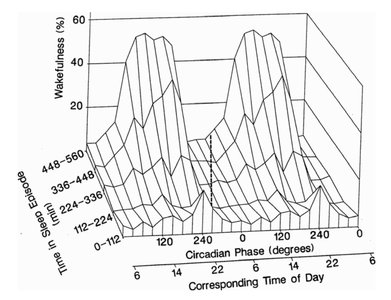
Example: Shift workers may fall asleep easily due to high sleep pressure but have difficulty maintaining sleep if their circadian rhythm promotes wakefulness.
Adenosine and Homeostatic Sleep Regulation
Role of Adenosine
Adenosine is a neuromodulator that accumulates in the brain during wakefulness and decreases during sleep. It is a key mediator of sleep pressure and homeostatic regulation.
Extracellular Adenosine: Levels increase during wakefulness and decrease during sleep, as shown in animal studies.
Pharmacological Modulation: Methylxanthines (e.g., caffeine, theophylline) are adenosine receptor antagonists that promote wakefulness by blocking adenosine's action.
Genetic Variability: Individual differences in caffeine sensitivity are linked to genetic variants in adenosine receptors.
EEG Markers: Sleep deprivation and adenosine analogues produce similar EEG changes, supporting adenosine's role in sleep homeostasis.
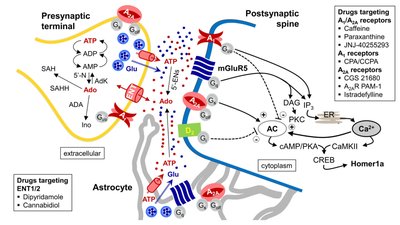
Example: Caffeine consumption reduces EEG markers of sleep pressure after sleep deprivation, demonstrating its antagonistic effect on adenosine receptors.
Circadian Regulation of Sleep
How Light Affects the Molecular Clock
The circadian system is regulated by the suprachiasmatic nucleus (SCN) in the hypothalamus, which synchronizes to environmental light-dark cycles via retinal input.
ipRGCs: Intrinsically photosensitive retinal ganglion cells detect light and send signals to the SCN.
SCN Neuronal Circuitry: Light input targets VIP-expressing neurons in the SCN core, which regulate synchrony in SCN shell neurons.
Clock Genes: Per1 and Per2 genes are highly responsive to light and are critical for photic entrainment of the circadian clock.
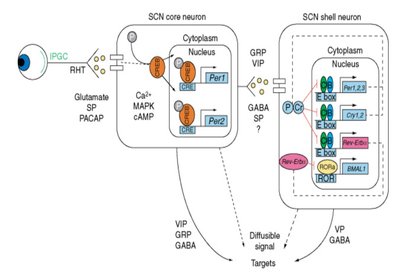
Example: Exposure to light at night can shift the phase of the circadian clock by altering Per gene expression in the SCN.
Neural and Hormonal Pathways in Circadian Regulation
The SCN regulates circadian rhythms in sleep and hormone secretion through both neural and hormonal pathways.
Melatonin Secretion: The SCN controls melatonin release from the pineal gland, which signals night and promotes sleep.
Neural Pathways: The SCN communicates with the hypothalamus and spinal cord to regulate sleep onset and wake signals.
Hormonal Pathways: Melatonin and corticosteroids show robust circadian rhythms, with inverse relationships in their secretion patterns.
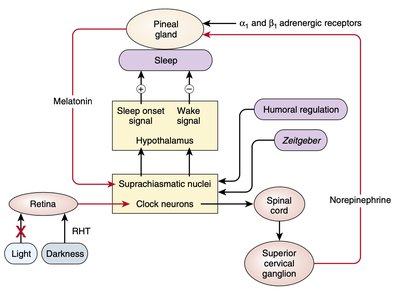
Example: Melatonin levels rise in the evening, promoting sleep, while corticosteroid levels peak in the morning, promoting wakefulness.
Hormonal Regulation and Sleep
Sleep and Growth Hormone
Growth hormone (GH) is a peptide hormone with anabolic effects, primarily released during sleep, especially during slow-wave sleep (SWS).
Regulation: GH release is controlled by growth hormone-releasing hormone (GHRH) and inhibited by somatostatin (SST).
Sleep Influence: GH secretion is more influenced by sleep than by circadian rhythms, with a major increase after sleep onset.
Receptors: GH binds to membrane receptors (GHRs) to exert its effects.
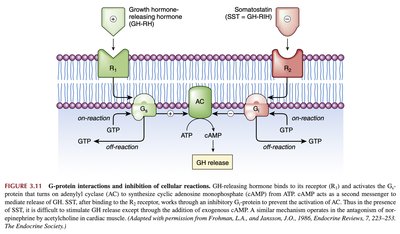
Example: Disruption of sleep architecture can reduce GH secretion, impacting growth and metabolism.
Sleep, Prolactin, and Thyroid Hormone
Other hormones, such as prolactin and thyroid hormone, also show sleep-dependent and circadian patterns of secretion.
Prolactin: Secretion increases during sleep and is influenced by both sleep and circadian factors.
Thyroid Hormone: Shows circadian variation, with levels peaking at specific times of day.
Sleep in Non-Mammalian Species
Do Jellyfish Sleep?
Research suggests that even simple organisms like jellyfish exhibit sleep-like states, indicating that sleep may be a fundamental biological process across evolution.
Criteria for Sleep: Behavioral quiescence, increased arousal threshold, and homeostatic regulation are used to define sleep in non-mammalian species.
Example: Jellyfish show periods of reduced activity and increased arousal threshold, meeting behavioral criteria for sleep.
Summary Table: Key Molecules and Pathways in Sleep Regulation
Molecule/Pathway | Role in Sleep | Regulation |
|---|---|---|
Adenosine | Promotes sleepiness, accumulates during wakefulness | Blocked by caffeine; levels decrease during sleep |
Melatonin | Promotes sleep onset, signals night | Released by pineal gland under SCN control |
Growth Hormone | Stimulates growth, released during sleep | Regulated by GHRH and SST; sleep-dependent |
Corticosteroids | Promote wakefulness, peak in morning | SCN regulates circadian rhythm |
Clock Genes (Per1, Per2) | Regulate circadian timing | Responsive to light via SCN |
Additional info: The notes above integrate molecular, neural, and hormonal mechanisms underlying sleep regulation, as well as evolutionary perspectives, to provide a comprehensive overview suitable for advanced undergraduate study in anatomy and physiology.
