 Back
BackSpecial Senses: Olfaction and Taste – Structure and Function
Study Guide - Smart Notes
 Tailored notes based on your materials, expanded with key definitions, examples, and context.
Special Senses: Olfaction and Taste
Introduction to Special Senses
The special senses of olfaction (smell) and gustation (taste) are essential for detecting chemical stimuli in the environment. These senses rely on specialized epithelial structures and neural pathways to transmit sensory information to the brain for interpretation.
Olfaction (Sense of Smell)
Anatomy of the Nasal Cavity
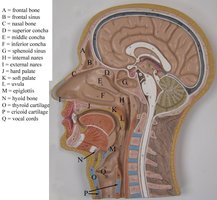
The nasal cavity is a complex structure that houses the olfactory epithelium, which is responsible for detecting odorants. The cavity is divided by the nasal septum and contains several bony structures called conchae that increase surface area for air filtration and olfaction.
Frontal sinus, nasal bone, and frontal bone form the superior boundaries.
Superior, middle, and inferior conchae increase the surface area for olfactory reception.
Hard and soft palate separate the nasal cavity from the oral cavity.
External nares are the nostrils, allowing air entry.
Olfactory Epithelium: Location and Structure
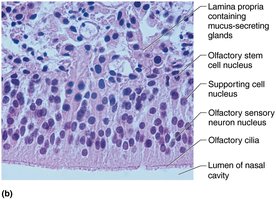
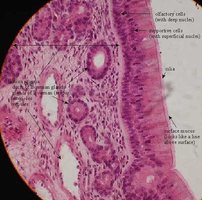
The olfactory epithelium is located in the superior region of the nasal cavity. It contains specialized cells that detect odor molecules and initiate the sense of smell.
Olfactory sensory neurons possess cilia that extend into the mucus layer, where odorants dissolve and bind to receptors.
Supporting cells provide structural and metabolic support.
Basal (stem) cells regenerate olfactory neurons throughout life.
Lamina propria contains mucus-secreting glands that help trap and dissolve odorants.
Microscopic Structure of Olfactory Epithelium
Histological examination reveals the layered organization of the olfactory epithelium, with nuclei of different cell types arranged in distinct zones.
Olfactory cilia project into the mucus and are the site of odorant binding.
Olfactory stem cell nuclei are found near the basal lamina.
Supporting cell nuclei are located more superficially.
Gustation (Sense of Taste)
Location and Structure of Taste Buds
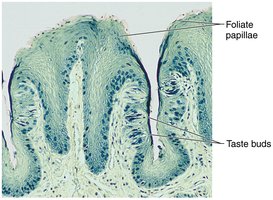
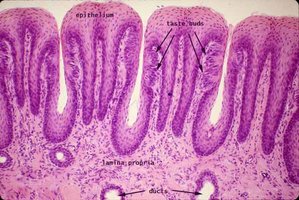
Taste buds are specialized sensory organs located primarily on the tongue, within structures called papillae. They detect dissolved chemicals (tastants) and send signals to the brain for taste perception.
Foliate papillae are found on the lateral aspects of the tongue and contain numerous taste buds.
Other papillae types include fungiform and circumvallate papillae.
Taste buds are also present on the soft palate, pharynx, and epiglottis, but in lower numbers.
Microscopic Structure of Taste Buds
Each taste bud consists of 40–100 specialized epithelial cells, including gustatory (taste) cells, supporting cells, and basal cells. Taste buds are embedded within the epithelium of papillae and open to the oral cavity via a taste pore.
Gustatory cells have microvilli (taste hairs) that extend into the taste pore and interact with tastants.
Supporting cells surround and support gustatory cells.
Basal cells serve as stem cells for regeneration.
Summary Table: Comparison of Olfactory and Gustatory Structures
Feature | Olfaction | Gustation |
|---|---|---|
Location of receptors | Superior nasal cavity (olfactory epithelium) | Tongue papillae (taste buds) |
Type of receptor cell | Olfactory sensory neuron | Gustatory (taste) cell |
Supporting cells | Present | Present |
Stem cells | Olfactory stem cells | Basal cells |
Stimulus type | Odorants (volatile chemicals) | Tastants (dissolved chemicals) |
Clinical and Functional Relevance
Both olfaction and gustation are critical for detecting environmental hazards (e.g., spoiled food, smoke) and contribute to the enjoyment of food. Disorders of these senses can significantly impact quality of life and may be early indicators of neurological diseases.
Additional info: The sense of smell is unique among special senses because olfactory sensory neurons can regenerate throughout life, and olfactory pathways project directly to the limbic system, linking smell with memory and emotion.
