 Back
BackTaste and Smell: Anatomy & Physiology Study Notes
Study Guide - Smart Notes
 Tailored notes based on your materials, expanded with key definitions, examples, and context.
Taste and Smell: The Special Senses
Overview of Taste and Smell
The senses of smell (olfaction) and taste (gustation) are essential for detecting chemicals in our environment and food. Both rely on chemoreceptors that respond to chemicals dissolved in aqueous solutions, allowing us to perceive odors and flavors.
Smell: Detects airborne chemicals (odorants) in the nasal cavity.
Taste: Detects dissolved chemicals in saliva on the tongue and oral cavity.
Olfactory Epithelium and the Sense of Smell
Anatomy of the Olfactory Epithelium
The olfactory epithelium is located in the roof of the nasal cavity, covering the superior nasal conchae. It contains specialized cells responsible for detecting odors.
Olfactory sensory neurons: Detect odorants and transmit signals.
Olfactory stem cells: Replace damaged olfactory neurons.
Supporting cells: Provide structural and metabolic support.
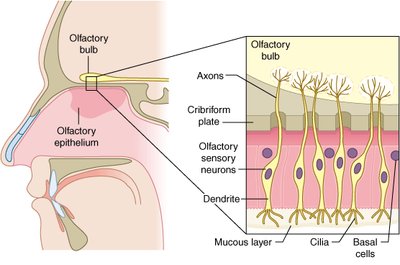
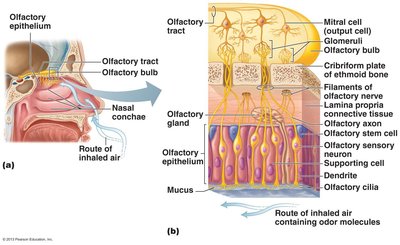
Specificity of Olfactory Receptors
Humans possess approximately 400 functional "smell" genes, enabling the detection of around 10,000 distinct odors. Pain and temperature receptors are also present in the nasal cavity, contributing to the perception of pungent or irritating odors.
Physiology of Smell
For an odor to be detected, the odorant must dissolve in the mucus covering the olfactory epithelium. The dissolved odorant binds to receptor proteins on the cilia of olfactory sensory neurons, initiating a signal.
Odorant binding: Triggers activation of olfactory sensory neurons.
Action potential: Generated and transmitted to the brain.
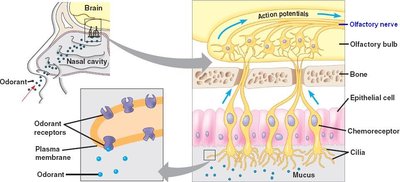
Olfactory Pathway
The olfactory pathway transmits signals from the nose to the brain, allowing conscious perception and emotional responses to odors.
Olfactory receptor cells synapse with mitral cells in the glomeruli of the olfactory bulbs.
Axons from neurons with the same receptor type converge on the same glomerulus.
Mitral cells amplify, refine, and relay signals.
Amacrine granule cells release GABA to inhibit mitral cells, ensuring only highly excitatory impulses are transmitted.
Impulses travel via olfactory tracts to the olfactory cortex.
Some information is sent to the frontal lobe for conscious interpretation and identification of smells.
Other information is sent to the hypothalamus, amygdala, and limbic system, eliciting emotional responses to odors.
Taste Buds and the Sense of Taste
Anatomy of Taste Buds
Taste buds are the primary receptor organs for taste, with most located on the tongue's papillae. There are three main types of papillae associated with taste:
Fungiform papillae: Located on the tops of the tongue.
Foliate papillae: Located on the side walls.
Vallate (circumvallate) papillae: Located at the back of the tongue.
Few taste buds are found on the soft palate, cheeks, pharynx, and epiglottis.
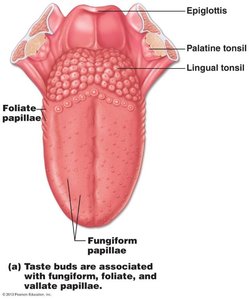
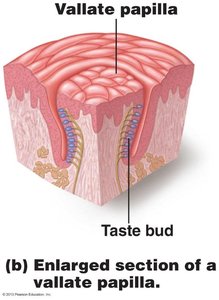
Structure of a Taste Bud
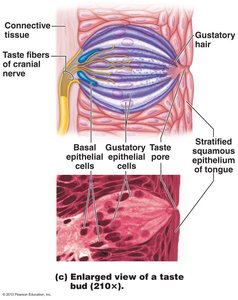
Each taste bud consists of 50–100 flask-shaped epithelial cells of two main types:
Gustatory epithelial cells: Sensory cells responsible for taste detection.
Basal epithelial cells: Stem cells that divide every 7–10 days to replace gustatory cells.
Microvilli (gustatory hairs) extend into the taste pore and serve as receptors.
Three types of gustatory cells: one releases serotonin, others release ATP as a neurotransmitter.
Basic Taste Sensations
There are five primary taste sensations, each associated with specific chemicals:
Sweet: Sugars, saccharin, alcohol, some amino acids, some lead salts.
Sour: Hydrogen ions (acids).
Salty: Metal ions (inorganic salts).
Bitter: Alkaloids such as quinine and nicotine; aspirin.
Umami: Amino acids glutamate and aspartate (beef taste, tang of aging cheese).
There is growing evidence for a possible sixth taste sensation: detection of long-chain fatty acids from lipids, which may explain the preference for fatty foods.
Physiology of Taste
For taste to occur, chemicals must be dissolved in saliva, diffuse into the taste pore, and contact gustatory hairs. Taste plays a role in digestion and protective reflexes.
Triggers reflexes that increase saliva and gastric juice secretion.
May initiate protective reactions such as gagging and reflexive vomiting.
Taste Transduction
Depolarization of gustatory cells leads to the generation of nerve impulses:
Salty taste: Caused by Na+ influx, directly depolarizing the cell.
Sour taste: Caused by H+ ions opening cation channels.
Sweet, bitter, and umami: Detected by receptors coupled to the G protein gustducin. Stored Ca2+ release opens cation channels, leading to depolarization and ATP release as a neurotransmitter.
Gustatory Pathway
The gustatory pathway transmits taste signals from the tongue to the brain:
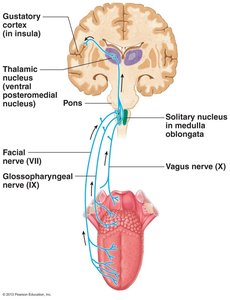
Cranial nerves VII (facial) and IX (glossopharyngeal) carry impulses from taste buds to the solitary nucleus of the medulla.
Impulses then travel to the thalamus, and fibers branch to the gustatory cortex in the insula, hypothalamus, and limbic system for appreciation of taste.
The vagus nerve (X) transmits taste from the epiglottis and lower pharynx.
Summary Table: Comparison of Smell and Taste
Feature | Smell (Olfaction) | Taste (Gustation) |
|---|---|---|
Receptor Type | Chemoreceptor (olfactory sensory neuron) | Chemoreceptor (gustatory epithelial cell) |
Location | Olfactory epithelium in nasal cavity | Taste buds on tongue papillae |
Stimulus | Odorants in air | Chemicals dissolved in saliva |
Pathway | Olfactory bulb → olfactory tract → cortex/limbic system | Cranial nerves VII, IX, X → medulla → thalamus → cortex |
Number of Sensations | ~10,000 odors | 5 (sweet, sour, salty, bitter, umami) + possible sixth (fatty acids) |
Key Equations and Concepts
Depolarization in Taste Transduction
Depolarization of gustatory cells is caused by ion influx:
Salty:
Sour:
Sweet/Bitter/Umami:
Summary
The senses of taste and smell are closely linked and play vital roles in detecting environmental chemicals, guiding food intake, and triggering protective reflexes. Their pathways involve specialized receptors, complex neural circuits, and integration in the brain for conscious perception and emotional responses.
