 Back
BackThe Endocrine System: Structure, Function, and Regulation
Study Guide - Smart Notes
 Tailored notes based on your materials, expanded with key definitions, examples, and context.
Endocrine System Overview
Introduction to the Endocrine System
The endocrine system works in conjunction with the nervous system to coordinate and integrate the activities of body cells. It influences metabolic activities through hormones transported in the blood. The endocrine response is generally slower but longer-lasting than that of the nervous system. The study of hormones and endocrine organs is known as endocrinology.
Hormones: Long-distance chemical signals that travel in blood or lymph.
Autocrines: Chemicals that exert effects on the same cells that secrete them (local messengers, not part of the endocrine system).
Paracrines: Locally acting chemicals that affect cells other than those that secrete them (also local messengers).
Chemistry of Hormones
Hormones are classified based on their chemical structure, which determines their mechanism of action and solubility properties:
Amino acid-based hormones: Includes amino acid derivatives, peptides, and proteins. These are generally polar, hydrophilic, and lipophobic.
Steroid hormones: Synthesized from cholesterol, including gonadal and adrenocortical hormones. These are generally non-polar, hydrophobic, and lipophilic.
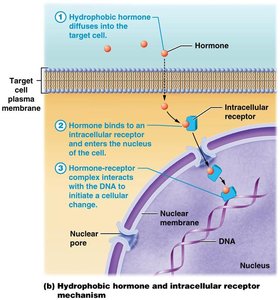
Hormone Action and Regulation
Target Cell Specificity and Activation
Hormones act only on target cells that have specific receptors for them. The response of a target cell depends on:
Blood levels of the hormone
Relative number of receptors on or in the target cell
Affinity of binding between receptor and hormone
Cells can regulate their sensitivity to hormones by altering receptor numbers:
Up-regulation: Target cells form more receptors in response to low hormone levels.
Down-regulation: Target cells lose receptors in response to high hormone levels.
Hormones in the Blood
Hormones are removed from the blood by degrading enzymes, kidneys, or liver.
Half-life: The time required for a hormone's blood level to decrease by half (varies from minutes to a week).
Steroid and thyroid hormones circulate bound to plasma proteins; others circulate freely.
Concentration reflects rate of release and speed of inactivation/removal.
Integration of Hormones at Target Cells
Permissiveness: One hormone cannot exert its effects without another hormone being present.
Synergism: More than one hormone produces the same effects on a target cell, leading to amplification.
Antagonism: One or more hormones oppose the action of another hormone.
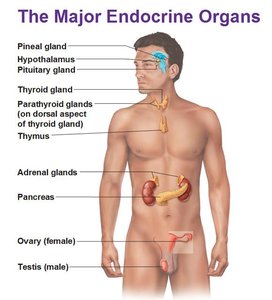
Major Endocrine Organs and Their Hormones
Pineal Gland
Secretes melatonin, derived from serotonin.
Regulates day/night cycles, timing of puberty, and physiological rhythms.
Pituitary Gland and Hypothalamus
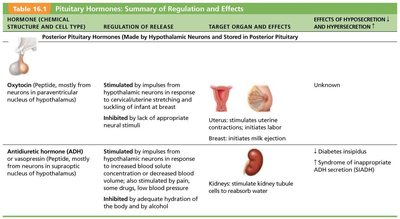
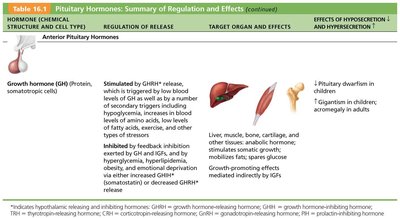
The pituitary gland (hypophysis) consists of two lobes:
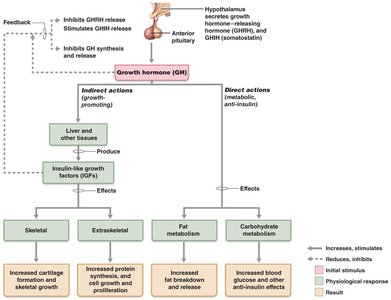
Posterior pituitary (neurohypophysis): Neural tissue; stores and releases hormones made by the hypothalamus.
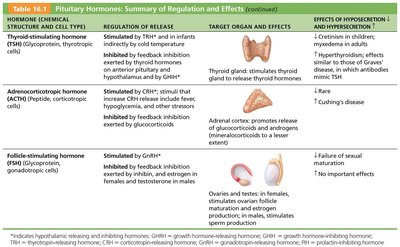
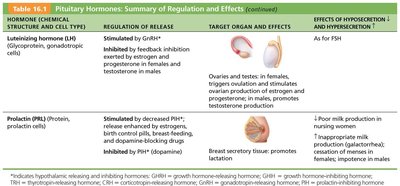
Anterior pituitary (adenohypophysis): Glandular tissue; synthesizes and releases its own hormones.
Adrenal (Suprarenal) Glands
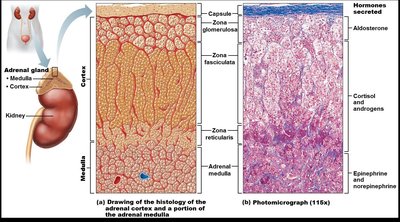
Located atop the kidneys, each adrenal gland consists of two regions:
Adrenal cortex: Three layers of glandular tissue producing corticosteroids.
Adrenal medulla: Nervous tissue; part of the sympathetic nervous system.
Adrenal Cortex Hormones
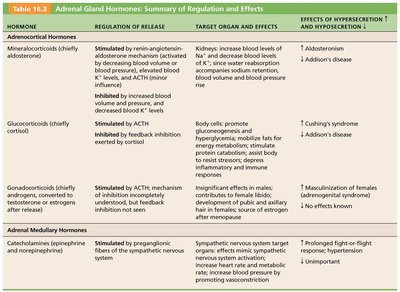
Zona glomerulosa: Produces mineralocorticoids (e.g., aldosterone).
Zona fasciculata: Produces glucocorticoids (e.g., cortisol).
Zona reticularis: Produces gonadocorticoids (sex hormones).
Adrenal Medulla Hormones
Chromaffin cells synthesize epinephrine (80%) and norepinephrine (20%).
Effects include vasoconstriction, increased heart rate, and increased blood glucose.
Thyroid Gland
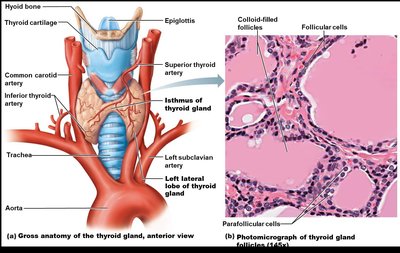
The thyroid gland consists of two lateral lobes connected by an isthmus. It contains follicles that produce thyroglobulin, and parafollicular cells that produce calcitonin.
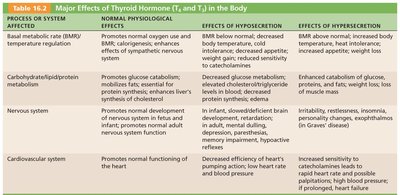
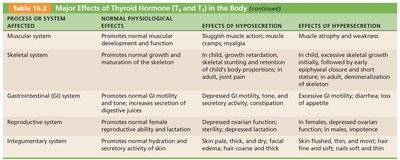
Thyroid hormone (TH): Includes T3 and T4, regulates metabolism, growth, and development.
Calcitonin: Lowers blood calcium levels by inhibiting osteoclast activity and stimulating calcium uptake into bone.
Parathyroid Glands
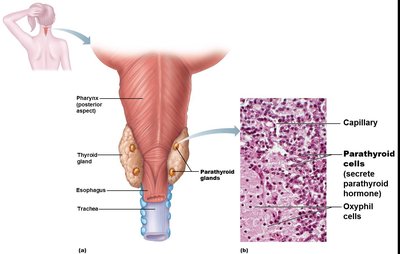
Four to eight small glands embedded in the posterior aspect of the thyroid. They secrete parathyroid hormone (PTH), the most important hormone in calcium homeostasis.
Pancreas
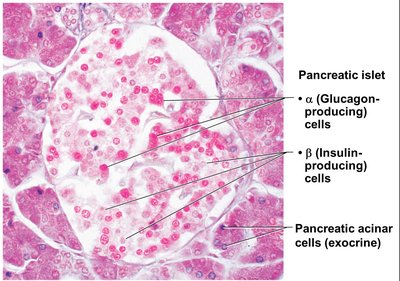
The pancreas has both exocrine and endocrine functions. The endocrine portion consists of pancreatic islets containing alpha (glucagon-producing) and beta (insulin-producing) cells.
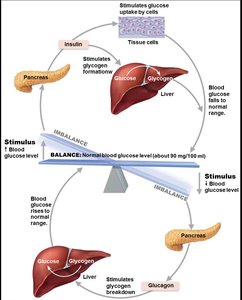
Glucagon: Raises blood glucose by promoting glycogenolysis and gluconeogenesis in the liver.
Insulin: Lowers blood glucose by enhancing cellular uptake and storage of glucose.
Other Endocrine Organs and Hormone-Producing Structures
Ovaries: Produce estrogens and progesterone, regulating female reproductive development and cycles.
Testes: Produce testosterone, regulating male reproductive development and function.
Placenta: Secretes estrogens, progesterone, and human chorionic gonadotropin (hCG) during pregnancy.
Adipose tissue: Produces leptin (appetite control), resistin (insulin antagonist), and adiponectin (enhances insulin sensitivity).
Gastrointestinal tract: Enteroendocrine cells secrete hormones such as gastrin, secretin, and cholecystokinin.
Heart: Produces atrial natriuretic peptide (ANP) to decrease blood sodium and pressure.
Kidneys: Produce erythropoietin (stimulates red blood cell production) and renin (regulates blood pressure).
Skeleton: Osteocalcin regulates insulin secretion and fat storage.
Skin: Produces cholecalciferol, a precursor of vitamin D.
Thymus: Produces thymulin, thymopoietins, and thymosins, involved in T lymphocyte development.
Homeostatic Imbalances of the Endocrine System
Glucocorticoid excess (Cushing's syndrome): Causes cartilage/bone suppression, immune depression, and metabolic disturbances.
Glucocorticoid deficiency (Addison's disease): Causes hypoglycemia, low sodium, dehydration, and hypotension.
Diabetes mellitus: Due to insulin deficiency or resistance, leading to hyperglycemia, glycosuria, and metabolic disturbances.
Summary Table: Major Endocrine Glands and Their Hormones
Gland | Hormone(s) | Main Function(s) |
|---|---|---|
Pineal | Melatonin | Regulates circadian rhythms |
Pituitary | GH, TSH, ACTH, FSH, LH, PRL, ADH, Oxytocin | Growth, metabolism, reproduction, water balance |
Thyroid | T3, T4, Calcitonin | Metabolism, calcium homeostasis |
Parathyroid | PTH | Calcium homeostasis |
Adrenal cortex | Aldosterone, Cortisol, Androgens | Electrolyte balance, stress response, sex characteristics |
Adrenal medulla | Epinephrine, Norepinephrine | Fight-or-flight response |
Pancreas | Insulin, Glucagon | Blood glucose regulation |
Ovaries/Testes | Estrogens, Progesterone, Testosterone | Reproductive function |
Additional info: This summary integrates and expands upon the provided notes and images, ensuring a comprehensive, exam-ready overview of the endocrine system for college-level anatomy and physiology students.
