 Back
BackThe Endocrine System: Structure, Function, and Hormone Regulation
Study Guide - Smart Notes
 Tailored notes based on your materials, expanded with key definitions, examples, and context.
The Endocrine System
Overview of the Endocrine System
The endocrine system is a network of glands and tissues that secrete hormones to regulate various physiological functions throughout the body. Hormones are chemical messengers released into the bloodstream, affecting target cells or organs at distant or local sites.
Endocrine glands: Ductless glands that release hormones directly into the blood.
Hormones: Chemicals secreted in small quantities that alter the activity of target cells.
Target cells/organs: Cells or organs where hormones exert their effects.
Types of hormone actions:
Endocrine: Long-distance signaling via blood.
Autocrine: Hormone acts on the same cell that secretes it.
Paracrine: Hormone acts on neighboring cells.
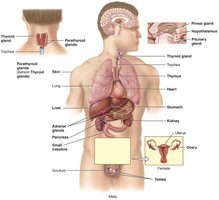
Endocrine vs. Exocrine vs. Mixed Glands
Glands are classified based on their mode of secretion:
Endocrine glands: Ductless, secrete hormones into blood (e.g., pituitary, thyroid).
Exocrine glands: Have ducts, secrete substances onto epithelial surfaces (e.g., sweat, salivary glands).
Mixed glands: Have both endocrine and exocrine functions (e.g., pancreas).
Regulation: Endocrine vs. Nervous System
Both systems regulate body functions, but differ in speed and mechanism:
Endocrine: Slow, long-lasting effects via hormones.
Nervous: Fast, short-lived effects via electrical impulses.
Chemical Nature of Hormones
Classification of Hormones
Hormones are classified by their solubility and chemical structure:
Water-soluble hormones: Amino acid-based (amines, peptides, proteins).
Lipid-soluble hormones: Steroids (from cholesterol), thyroid hormones, nitric oxide.
Eicosanoids: Local hormones (prostaglandins, leukotrienes) derived from fatty acids.
Transport in Blood
Water-soluble hormones: Transported freely in plasma.
Lipid-soluble hormones: Bound to transport proteins.
Hormone-Target Cell Specificity
Receptor Sensitivity and Regulation
Hormones act only on cells with specific receptors. Receptor numbers can change:
Down-regulation: Decrease in receptor numbers when hormone levels are high.
Up-regulation: Increase in receptor numbers when hormone levels are low.
Control of Hormone Secretion
Hormone secretion is regulated by:
Nervous system signals
Other hormones
Chemical changes in blood
Major Endocrine Glands
Pituitary Gland (Hypophysis)
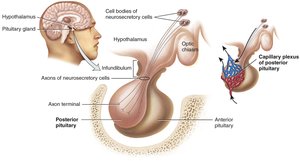
The pituitary gland is located below the hypothalamus and consists of two lobes:
Anterior lobe (adenohypophysis): Produces hormones.
Posterior lobe (neurohypophysis): Stores and releases hormones made by the hypothalamus.
Hormones of the Anterior Pituitary
Growth Hormone (GH): Stimulates growth via IGFs; disorders include dwarfism, gigantism, acromegaly.
Thyroid Stimulating Hormone (TSH): Stimulates thyroid activity.
Adrenocorticotropic Hormone (ACTH): Stimulates adrenal cortex.
Prolactin (PRL): Promotes milk production; disorders include galactorrhea.
Follicle Stimulating Hormone (FSH): Stimulates gonads for gamete production.
Luteinizing Hormone (LH): Stimulates gonads for hormone production.
Melanocyte Stimulating Hormone (MSH): Stimulates melanin production.
Hormones of the Posterior Pituitary
Antidiuretic Hormone (ADH): Increases water reabsorption in kidneys; deficiency causes diabetes insipidus.
Oxytocin (OT): Stimulates milk ejection and uterine contractions; involved in bonding.
Hypothalamus
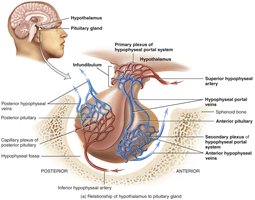
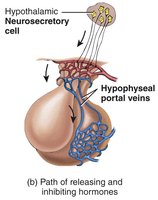
The hypothalamus integrates nervous and endocrine functions, producing releasing and inhibiting hormones that control the anterior pituitary.
Thyroid Gland
Location and Structure
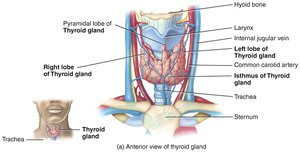
The thyroid gland is located anterior to the trachea, just below the larynx. It consists of two lobes connected by an isthmus.
Histology
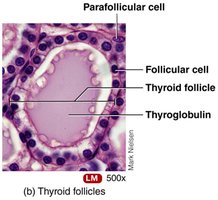
Thyroid follicles contain colloid surrounded by follicle cells, which secrete thyroid hormones. Parafollicular cells (C-cells) secrete calcitonin.
Thyroid Hormones
T3 (triiodothyronine) and T4 (thyroxine): Regulate metabolism, growth, and development; require iodine.
Calcitonin: Lowers blood calcium by inhibiting osteoclasts.
Synthesis of Thyroid Hormones
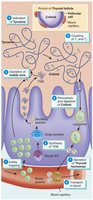
Thyroid hormone synthesis involves trapping iodide, producing thyroglobulin, iodination, coupling, and release into blood.
Parathyroid Glands
Location and Histology
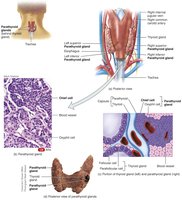
Four small glands located behind the thyroid. Chief cells produce parathyroid hormone (PTH).
Function
PTH: Increases blood calcium by stimulating osteoclasts, increasing reabsorption in kidneys and intestines, and promoting calcitriol formation.
Antagonistic relationship: PTH increases, calcitonin decreases blood calcium.
Adrenal Glands (Suprarenal Glands)
Location and Structure
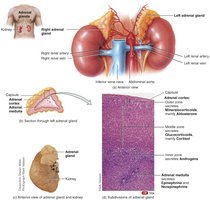
Located atop the kidneys, each adrenal gland has an outer cortex and inner medulla.
Adrenal Cortex
Zone | Hormone Category | Main Hormone | Main Function |
|---|---|---|---|
Zona glomerulosa | Mineralocorticoids | Aldosterone | Regulates minerals (Na+, K+) |
Zona fasciculata | Glucocorticoids | Cortisol | Carbohydrate metabolism, stress response |
Zona reticularis | Sex steroids | Androgens | Sexual function |
Adrenal Medulla
Chromaffin cells: Secrete epinephrine and norepinephrine for 'fight or flight' response.
Renin-Angiotensin-Aldosterone System
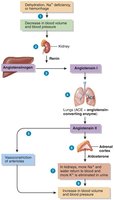
This system regulates blood pressure and volume via aldosterone secretion.
Pancreas
Location and Structure
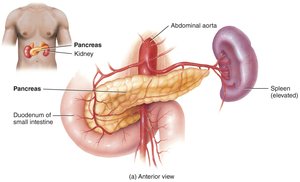
The pancreas is located in the curve of the duodenum and has both exocrine and endocrine functions.
Histology
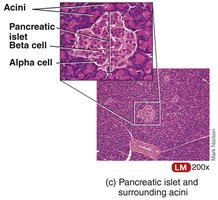
Islets of Langerhans contain alpha, beta, and delta cells.
Hormones
Glucagon (alpha cells): Raises blood glucose.
Insulin (beta cells): Lowers blood glucose.
Somatostatin (delta cells): Inhibits insulin and glucagon release.
Pineal Gland
Location and Function
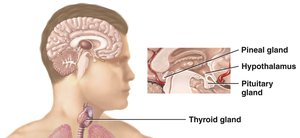
Located in the brain, the pineal gland produces melatonin, which regulates sleep and circadian rhythms.
Gonads
Ovaries and Testes
Produce steroid hormones (testosterone, estrogen, progesterone) for gamete formation, sexual characteristics, and reproductive organ maintenance.
Other Hormone-Producing Organs
Heart: Atrial natriuretic peptide (ANP) lowers blood pressure.
GI tract: Gastrin, secretin, cholecystokinin aid digestion.
Placenta: Estrogens, progesterone, HCG maintain pregnancy.
Kidneys: Erythropoietin, calcitriol, renin regulate RBC production, calcium, and blood pressure.
Leptin: Regulates fat storage and satiety.
Ghrelin: Stimulates hunger and energy regulation.
Mechanisms of Hormone Action
Second Messenger System
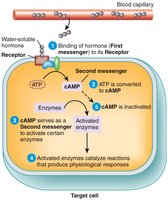
Water-soluble hormones act via second messengers (e.g., cAMP) without entering the cell.
Hormone binds to membrane receptor.
Activates G-protein, which stimulates adenylate cyclase.
Adenylate cyclase converts ATP to cAMP.
cAMP activates protein kinases, leading to cellular responses.
Phosphodiesterase degrades cAMP to stop the response.
Direct Gene Activation
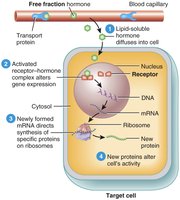
Lipid-soluble hormones enter the cell and directly activate genes in the nucleus.
Hormone diffuses into cell and binds to intracellular receptor.
Receptor-hormone complex activates DNA transcription.
New mRNA is synthesized, leading to new protein production.
Proteins alter cell activity.
Summary Table: Mechanisms of Hormone Action
Mechanism | Hormone Type | Receptor Location | Key Steps |
|---|---|---|---|
Second Messenger | Water-soluble | Plasma membrane | cAMP pathway, enzyme activation |
Direct Gene Activation | Lipid-soluble | Nucleus/cytoplasm | DNA transcription, protein synthesis |
Additional info: These notes expand on brief points with academic context, definitions, and examples for clarity and completeness.
