 Back
BackThe Immune System: Innate and Adaptive Body Defenses
Study Guide - Smart Notes
 Tailored notes based on your materials, expanded with key definitions, examples, and context.
The Immune System: Innate and Adaptive Body Defenses
Introduction to Immunity
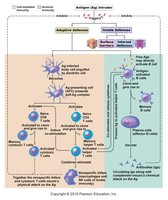
The immune system is essential for maintaining homeostasis by defending the body against invading organisms such as bacteria, viruses, and other pathogens. It consists of both nonspecific (innate) and specific (adaptive) defenses that work together to protect the body from disease.
Innate (Nonspecific) Defenses
First Line of Defense
The first line of defense includes physical and chemical barriers that prevent pathogens from entering the body:
Skin: Acts as a physical barrier and produces sebum, which has antimicrobial properties.
Stomach Acid: The stomach contains hydrochloric acid that destroys many ingested pathogens.
Respiratory Tract: Mucus traps particles and pathogens, which are then expelled or swallowed.
Urinary Tract: Slightly acidic urine discourages bacterial growth.
Phagocytic Cells: Present in tissues and blood, these cells ingest and destroy pathogens.

Endogenous Pyrogens and Fever
Endogenous pyrogens are chemicals produced within the body that induce fever. Fever slows bacterial growth and enhances immune responses.
Internal Defenses
Phagocytosis: Neutrophils, monocytes/macrophages, and organ-specific phagocytes ingest and destroy pathogens.
Natural Killer (NK) Cells: These cells can lyse and kill virus-infected and cancer cells before the adaptive immune response is activated.
Inflammatory Response: Tissue damage triggers the release of histamines, kinins, and prostaglandins, leading to vasodilation, increased blood flow, and recruitment of immune cells to the site of injury.
Antimicrobial Proteins
Complement System: A group of proteins that enhance inflammation, opsonize pathogens, and form the Membrane Attack Complex (MAC) to lyse bacteria.
Interferons: Proteins that interfere with viral replication and activate immune cells.
Adaptive (Specific) Defenses
Antigens
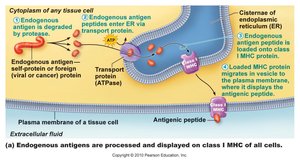
Antigens are large, complex proteins that trigger the production of antibodies or initiate a specific immune response. They can be foreign (non-self) or self-antigens (such as MHC proteins).
Major Histocompatibility Complex (MHC)
Class I MHC: Found on all nucleated cells (except RBCs); present endogenous antigens to cytotoxic T cells.
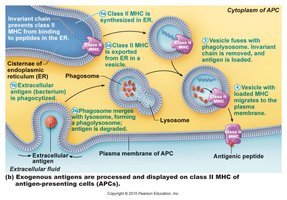
Class II MHC: Found on antigen-presenting cells (APCs); present exogenous antigens to helper T cells.
Antibodies (Immunoglobulins)
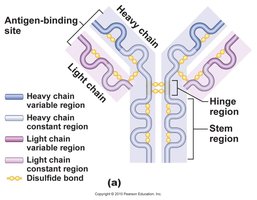
Antibodies are Y-shaped proteins produced by B lymphocytes that bind to specific antigens. Each antibody has two antigen-binding sites and consists of two heavy and two light chains.
Cells of the Immune System
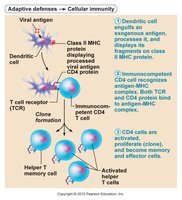
Dendritic Cells: Ingest antigens and present them to T cells via MHC II.
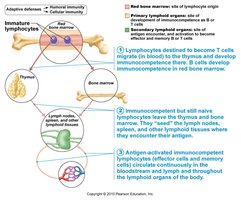
Lymphocytes: Include B cells (mature in bone marrow) and T cells (mature in thymus). T cells are further classified as helper T cells (CD4+), cytotoxic T cells (CD8+), and suppressor T cells.
Humoral Immunity
Primary and Secondary Immune Responses
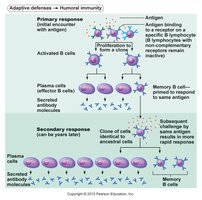
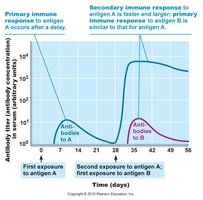
Humoral immunity involves the production of antibodies by B cells. The primary response occurs upon first exposure to an antigen, while the secondary response is faster and stronger due to memory cells.
Types of Acquired Immunity
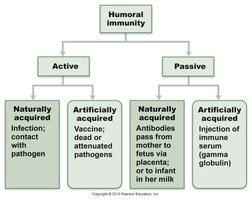
Active Immunity: The body produces its own antibodies (naturally by infection or artificially by vaccination).
Passive Immunity: Antibodies are transferred from another source (naturally from mother to fetus or artificially by injection).
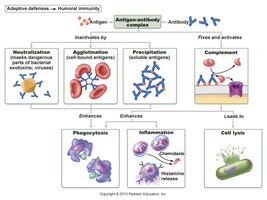
Functions of Antibodies
Complement Fixation and Activation: Antibodies attract complement proteins to destroy pathogens.
Neutralization: Antibodies coat pathogens, preventing them from attaching to host cells.
Agglutination: Antibodies cause pathogens to clump together for easier removal by phagocytes.
Immunoglobulin Classes
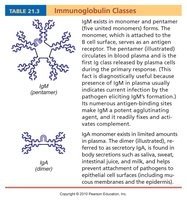
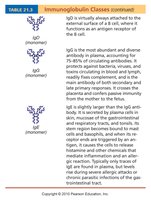
There are five main classes of immunoglobulins (Ig): IgA, IgD, IgE, IgG, and IgM. Each class has distinct functions and locations in the body.
Cell-Mediated Immunity
Cytotoxic T Cells (CD8+)
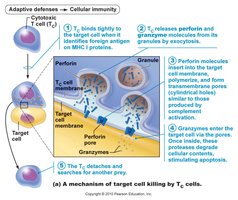
Cytotoxic T cells recognize antigens presented by Class I MHC and destroy infected or abnormal cells by releasing perforin and other cytotoxins.
Helper T Cells (CD4+)
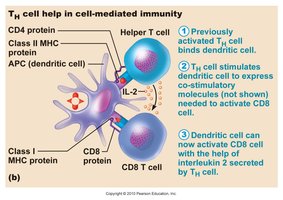
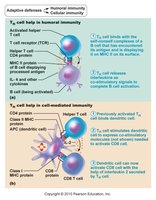
Helper T cells are essential for activating both B cells and cytotoxic T cells by releasing cytokines such as interleukin-2 (IL-2). They recognize antigens presented by Class II MHC on APCs.

Immune Response Coordination
Helper T cells coordinate the immune response by providing costimulatory signals required for the activation and proliferation of B cells and cytotoxic T cells.
Immunodeficiencies and Hypersensitivities
Immunodeficiencies
Primary (Genetic): Examples include Severe Combined Immunodeficiency Diseases (SCID), where individuals lack functional immune systems.
Acquired: Acquired Immunodeficiency Syndrome (AIDS) is caused by HIV, which targets and destroys Helper T cells, crippling the adaptive immune response.
Hypersensitivities (Allergies)
Type I (Immediate): Involves IgE-mediated activation of mast cells and basophils, leading to allergic reactions and potentially anaphylaxis.
Type IV (Delayed): Mediated by cytotoxic T cells, leading to delayed allergic reactions such as contact dermatitis.
Summary
The immune system is a complex network of cells, proteins, and mechanisms that protect the body from infection and disease. Understanding the roles of innate and adaptive defenses, the functions of antibodies, and the coordination of immune responses is essential for comprehending how the body maintains health and responds to threats.
