 Back
BackThe Lymphatic System and Body Defenses: Structure, Function, and Immunity
Study Guide - Smart Notes
 Tailored notes based on your materials, expanded with key definitions, examples, and context.
The Lymphatic System
Overview and Components
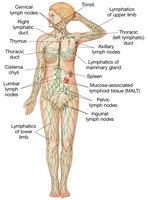
The lymphatic system is a network of vessels, tissues, and organs that play a crucial role in defending the body against infection and disease. It is responsible for the production, maintenance, and distribution of lymphocytes, which are essential for immune responses.
Lymph: Fluid that circulates through lymphatic vessels, carrying cells and substances.
Lymphatic vessels: Network of capillaries and larger vessels that transport lymph.
Lymphoid tissues and organs: Include lymph nodes, thymus, spleen, and mucosa-associated lymphoid tissue (MALT).
Lymphocytes and phagocytic cells: Key cellular components for immune defense.
Functions of the Lymphatic System
The lymphatic system has several vital functions:
Production, maintenance, and distribution of lymphocytes: Ensures immune surveillance and response.
Detection and response to problems: Lymphocytes must detect and migrate to sites of injury or infection.
Lymphatic Vessels
Lymphatic vessels are organized into a hierarchy:
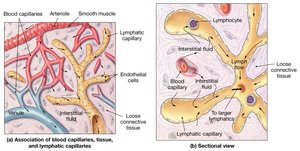
Lymphatic capillaries: Smallest vessels, begin as blind-ended tubes in tissues.
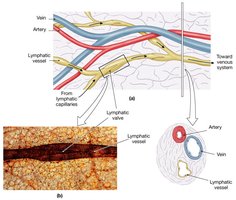
Small lymphatic vessels: Collect lymph from capillaries.
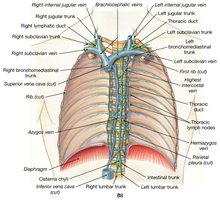
Major lymph-collecting vessels: Include superficial and deep lymphatics, thoracic duct, cisterna chyli, and right lymphatic duct.
Lymph
Lymph is a clear fluid derived from interstitial fluid that enters lymphatic capillaries and is transported through lymphatic vessels back to the bloodstream.
Lymphocyte Production and Types
Lymphopoiesis
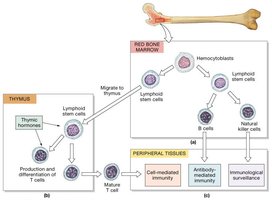
Lymphopoiesis is the process of lymphocyte production, involving the bone marrow, thymus, and peripheral lymphoid tissues.
T cells (thymus-dependent): Mature in the thymus; involved in cell-mediated immunity.
B cells (bone marrow-derived): Mature in bone marrow; responsible for antibody-mediated immunity.
Natural Killer (NK) cells: Mature in bone marrow; provide immunological surveillance.
Lymphoid Tissues and Organs
Lymphoid Tissue
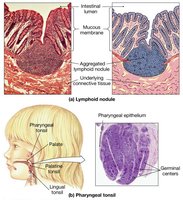
Lymphoid tissue consists of connective tissue dominated by lymphocytes. Lymphoid nodules are densely packed lymphocytes found in the respiratory, digestive, and urinary tracts. MALT (mucosa-associated lymphoid tissue) is a collection of lymphoid tissues associated with the digestive system.
Lymph Nodes
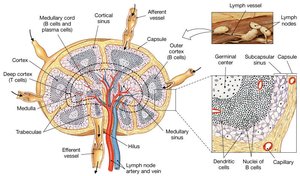
Lymph nodes are small, bean-shaped organs that filter lymph and are sites of lymphocyte activation. They contain afferent vessels (bringing lymph in), efferent vessels (carrying lymph out), and are organized into cortex (B cells) and deep cortex (T cells).
The Thymus
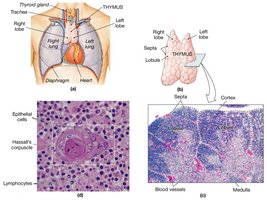
The thymus is located behind the sternum and is essential for T cell maturation. It is divided into lobules, each with a cortex and medulla. The thymus secretes hormones such as thymosins, thymopoietins, and thymulin, which regulate T cell development.
The Spleen
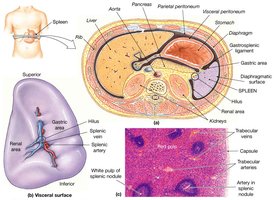
The spleen is the largest lymphoid organ. It contains red pulp (rich in red blood cells) and white pulp (lymphoid tissue). The spleen removes abnormal blood cells, stores iron, and initiates immune responses to blood-borne antigens.
Body Defenses: Nonspecific (Innate) and Specific (Adaptive) Immunity
Nonspecific (Innate) Defenses
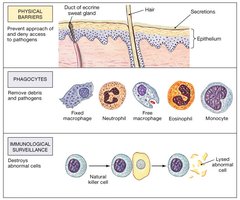
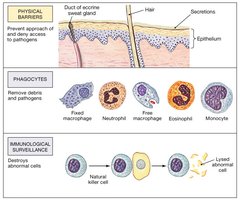
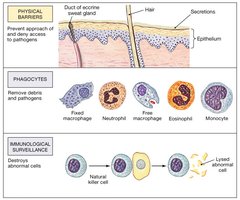
Nonspecific defenses provide general protection and do not distinguish between different threats. There are seven major types:
Physical barriers: Skin, hair, and secretions prevent pathogen entry.
Phagocytes: Neutrophils, eosinophils, monocytes, and macrophages remove debris and pathogens.
Immunological surveillance: NK cells monitor and destroy abnormal cells.
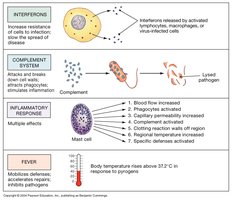
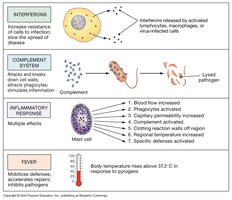
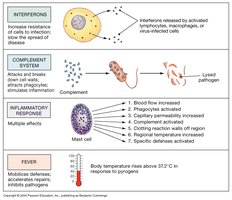
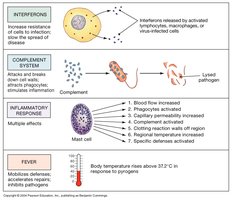
Interferons: Proteins released by infected cells that trigger antiviral defenses.
Complement system: Plasma proteins that enhance immune responses and destroy pathogens.
Inflammation: Localized response to injury, producing swelling, redness, heat, and pain.
Fever: Elevated body temperature inhibits pathogens and accelerates defenses.
Phagocytes
Phagocytes are cells that engulf and digest pathogens and debris. They include neutrophils, eosinophils, monocytes, and macrophages. These cells move by diapedesis and are attracted to infection sites by chemotaxis.
Immunological Surveillance by NK Cells
Natural Killer (NK) cells constantly monitor tissues for abnormal cells. They recognize unusual surface proteins, align their Golgi apparatus, and release perforins that lyse target cells.
Interferons
Interferons are small proteins released by virally infected cells. They trigger the production of antiviral proteins in neighboring cells, helping to slow the spread of infection.
Complement System
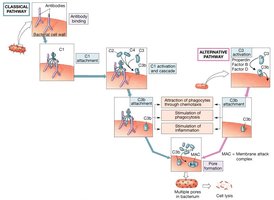
The complement system consists of about 11 plasma proteins that enhance the actions of antibodies. It destroys target cell membranes, stimulates inflammation, attracts phagocytes, and enhances phagocytosis. Complement activation occurs via two pathways: classical (antibody-dependent) and alternative (pathogen surface-dependent).
Inflammation
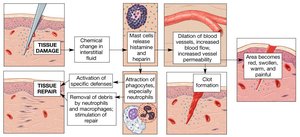
Inflammation is a localized tissue response to injury, characterized by swelling, redness, heat, and pain. It temporarily repairs injury, slows pathogen spread, and mobilizes defenses.
Fever
Fever is the maintenance of body temperature above 37.2°C (99°F). Pyrogens reset the hypothalamic thermostat, raising body temperature to inhibit pathogens and enhance immune responses.
Specific (Adaptive) Defenses: Immunity
Forms of Immunity
Specific defenses protect against particular threats and depend on lymphocyte activation. Immunity can be classified as:
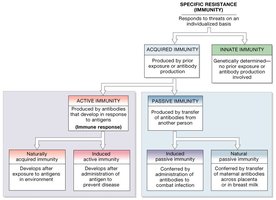
Innate immunity: Genetically determined, present at birth.
Acquired immunity: Developed after exposure to antigens; can be active or passive.
Active immunity: Produced by antibodies after antigen exposure (natural or induced).
Passive immunity: Produced by transfer of antibodies from another source (natural or induced).
Properties of Immunity
Specificity: Immune response is directed against a specific antigen.
Versatility: The immune system can confront any antigen at any time.
Memory: The immune system "remembers" antigens it has encountered.
Tolerance: The immune system ignores normal tissues but responds to foreign substances.
Immune Disorders
Autoimmune disorders: The immune response mistakenly targets normal cells.
Immunodeficiency diseases: The immune system does not develop properly or is blocked.
