 Back
BackThe Skeletal System: Structure, Function, and Major Bones (Ch.7)
Study Guide - Smart Notes
 Tailored notes based on your materials, expanded with key definitions, examples, and context.
The Skeletal System
Introduction to the Skeleton
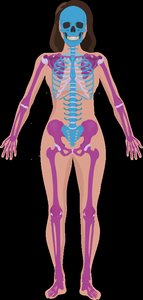
The skeletal system is composed of bones, cartilages, joints, and ligaments. It provides the structural framework for the body, protects internal organs, and enables movement. There are approximately 206 named bones in the adult human body, though this number can vary slightly among individuals due to anatomical differences.
Axial skeleton: Includes the skull, vertebral column, and thoracic cage (80 bones). It forms the central axis of the body and protects vital organs such as the brain, heart, and lungs.
Appendicular skeleton: Comprises the limbs and the pectoral (shoulder) and pelvic (hip) girdles (126 bones). It is primarily responsible for movement and manipulation of the environment.
The Skull
Overview and Functions
The skull is a complex bony structure that houses and protects the brain and forms the structure of the face. It consists of cranial bones, facial bones, and associated bones involved in hearing and swallowing. The skull also contains cavities and sinuses that lighten the bone and enhance vocal resonance.
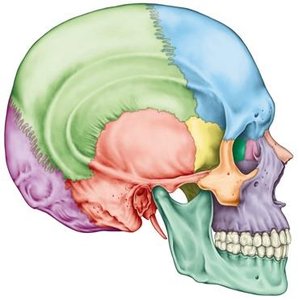
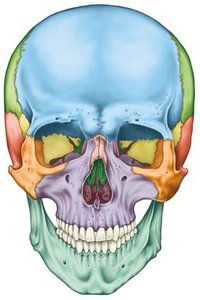
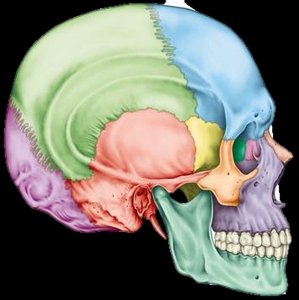
Cranial bones: Form the protective case around the brain.
Facial bones: Shape the face and provide attachment points for muscles.
Associated bones: Involved in hearing and swallowing (e.g., auditory ossicles, hyoid bone).
Sinuses: Air-filled spaces that lighten the skull and contribute to sound resonance.
Major Cranial Bones
Frontal bone (1): Forehead region.
Parietal bones (2): Upper sides of the head.
Occipital bone (1): Back of the head; contains the foramen magnum for the spinal cord.
Temporal bones (2): Sides of the head near the ears; contain the auditory meatus and processes such as the mastoid and styloid.
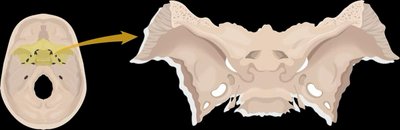
Sphenoid bone (1): Butterfly-shaped bone at the base of the skull; contains the sella turcica, which houses the pituitary gland.
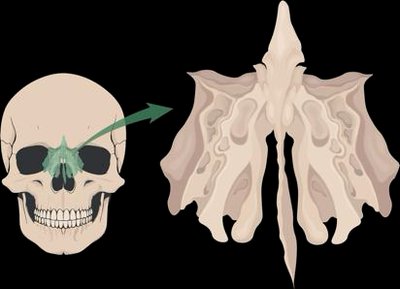
Ethmoid bone (1): Sieve-like bone between the orbits and nasal cavity; contains the crista galli (attachment for brain membranes) and cribriform plate (foramina for olfactory nerves).
Major Facial Bones
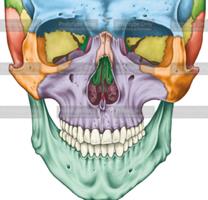
Nasal bones (2): Bridge of the nose.
Maxillae (2): Upper jaw; anchor upper teeth and form part of the orbital and nasal cavities.
Zygomatic bones (2): Cheekbones; form part of the orbit.
Mandible (1): Lower jaw; only freely movable bone of the skull.
Lacrimal bones (2): Medial wall of the orbit.
Vomer (1): Forms part of the nasal septum.
Inferior nasal conchae (2): Lateral walls of the nasal cavity.
Palatine bones (2): Posterior part of the hard palate and part of the nasal cavity and orbit.
Cavities and Sinuses of the Skull
The skull contains several cavities and sinuses that serve important functions:
Orbital cavity: Houses the eyes; formed by the frontal, sphenoid, zygomatic, maxilla, lacrimal, ethmoid, and palatine bones.
Nasal cavity: Formed by the maxilla, nasal, sphenoid, vomer, inferior nasal conchae, palatine, and ethmoid bones.
Paranasal sinuses: Air-filled spaces in the frontal, ethmoid, sphenoid, and maxilla bones. Functions include lightening the skull, warming and humidifying air, and enhancing vocal resonance.
The Vertebral Column (Spine)
Structure and Regions
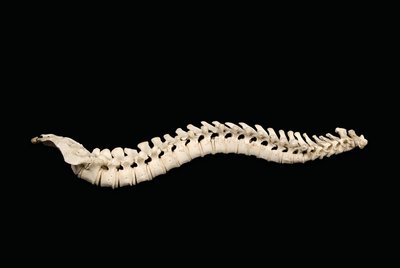
The vertebral column consists of 24 individual vertebrae, the sacrum, and the coccyx. It supports the head, protects the spinal cord, and provides attachment points for ribs and muscles.
Cervical vertebrae (7): Neck region (C1–C7). The atlas (C1) supports the skull; the axis (C2) allows head rotation.
Thoracic vertebrae (12): Upper back (T1–T12); articulate with the ribs.
Lumbar vertebrae (5): Lower back (L1–L5); largest and strongest vertebrae.
Sacrum: Five fused vertebrae; forms the posterior part of the pelvis.
Coccyx: Three to five fused vertebrae; forms the tailbone.
The spine has four curvatures (cervical, thoracic, lumbar, sacral) that help absorb shock and maintain balance. Intervertebral discs act as cushions between vertebrae, except between C1 and C2 and in the sacrum and coccyx.
The Thoracic Cage
Structure and Function
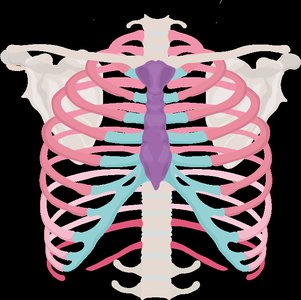
The thoracic cage protects the heart and lungs and supports the shoulder girdles and upper limbs. It consists of the thoracic vertebrae, ribs, and sternum.
Ribs (12 pairs): Flat bones that wrap around the chest.
True ribs (1–7): Attach directly to the sternum via costal cartilage.
False ribs (8–12): Attach indirectly or not at all to the sternum. The last two pairs (11–12) are called floating ribs because they have no sternal attachment.
Sternum: Flat bone consisting of the manubrium, body, and xiphoid process.
Intercostal cartilage: Connects ribs 1–10 to the sternum, providing flexibility and strength to the thoracic cage.
The Pectoral Girdle and Upper Limb
Pectoral Girdle
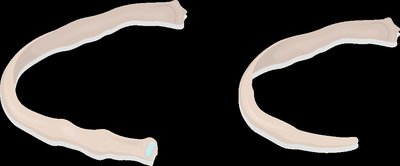
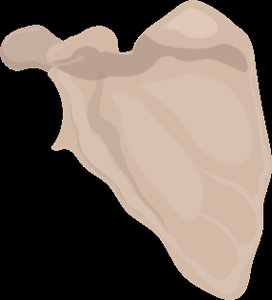
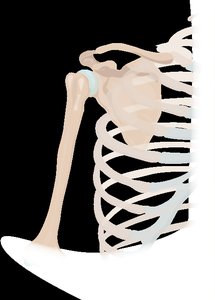
The pectoral girdle (shoulder girdle) attaches the upper limbs to the axial skeleton and consists of the clavicle and scapula.
Clavicle: Collarbone; articulates with the sternum and scapula.
Scapula: Shoulder blade; articulates with the clavicle and humerus. The acromion process is where the scapula meets the clavicle, and the glenoid cavity forms the shoulder socket.
Bones of the Upper Limb
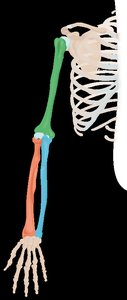
Humerus: The only bone of the upper arm; articulates with the scapula at the shoulder and with the radius and ulna at the elbow.
Radius: Lateral bone of the forearm (thumb side); allows rotation of the hand.
Ulna: Medial bone of the forearm (pinky side); forms a hinge joint with the humerus.
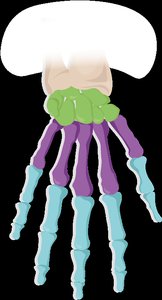
Carpals (8): Short bones of the wrist.
Metacarpals (5): Long bones of the palm; numbered I (thumb) to V (pinky).
Phalanges (14): Bones of the fingers; each finger has three (proximal, middle, distal) except the thumb, which has two (proximal and distal).
The Pelvic Girdle and Lower Limb
Pelvic Girdle
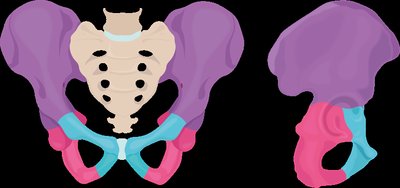
The pelvic girdle consists of the right and left coxal (hip) bones, which together with the sacrum and coccyx form the pelvis. Each coxal bone is formed from three fused bones: the ilium, ischium, and pubis. The acetabulum is the deep socket that receives the head of the femur.
Ilium: Superior, flared region; forms the iliac crest (hip).
Ischium: Posterior, inferior region; forms the obturator foramen and the bones you sit on.
Pubis: Anterior, inferior region; forms the pubic symphysis where the two pubic bones meet.
Differences Between Male and Female Pelvis
The pelvis differs between males and females, reflecting adaptations for childbirth in females.
Feature | Male | Female |
|---|---|---|
General Appearance | Narrow & heavy | Wider & lighter |
Angle of Pubic Arch | Acute | Obtuse |
Shape of Pelvic Inlet | Heart-shaped & closer together | Oval & further apart |
Bones of the Lower Limb
Femur: Thigh bone; the longest and strongest bone in the body. The head fits into the acetabulum of the pelvis.
Patella: Kneecap; a sesamoid bone embedded in the tendon of the quadriceps muscle.
Tibia: Medial, larger bone of the lower leg; bears most of the body’s weight and forms the medial malleolus (inner ankle).
Fibula: Lateral, slender bone of the lower leg; forms the lateral malleolus (outer ankle).
Tarsals (7): Short bones of the ankle; includes the talus (articulates with tibia) and calcaneus (heel bone).
Metatarsals (5): Long bones of the foot; help form the arches of the foot.
Phalanges (14): Bones of the toes; each toe has three (proximal, middle, distal) except the big toe, which has two.
Summary Table: Major Skeletal Regions and Bones
Region | Main Bones | Key Functions |
|---|---|---|
Axial Skeleton | Skull, vertebral column, thoracic cage | Protection, support |
Appendicular Skeleton | Pectoral girdle, upper limbs, pelvic girdle, lower limbs | Movement, manipulation |
Skull | Cranial and facial bones | Protect brain, form face |
Vertebral Column | Cervical, thoracic, lumbar vertebrae, sacrum, coccyx | Support, protect spinal cord |
Thoracic Cage | Ribs, sternum | Protect thoracic organs |
Pectoral Girdle | Clavicle, scapula | Attach upper limbs |
Upper Limb | Humerus, radius, ulna, carpals, metacarpals, phalanges | Manipulation, movement |
Pelvic Girdle | Ilium, ischium, pubis | Attach lower limbs, support |
Lower Limb | Femur, patella, tibia, fibula, tarsals, metatarsals, phalanges | Support, locomotion |
