Ch. 10 Muscle Tissue and Physiology
Amerman - Human Anatomy & Physiology 2nd Edition
Amerman2nd EditionHuman Anatomy & PhysiologyISBN: 9780136873822Not the one you use?Change textbook
Chapter 10, Problem 13

Which of the following types of muscle fibers have low myosin ATPase activity and are classified as slow-twitch?
a. Type I fibers
b. Type IIa fibers
c. Type IIx fibers
d. Type III fibers

Verified step by step guidance
1
Understand the classification of muscle fibers: Muscle fibers are categorized into different types based on their contraction speed, metabolic properties, and myosin ATPase activity. The main types are Type I, Type IIa, and Type IIx fibers. Note that Type III fibers are not a recognized category in human muscle physiology.
Recall the characteristics of Type I fibers: These are slow-twitch fibers that have low myosin ATPase activity, meaning they hydrolyze ATP at a slower rate. This contributes to their slower contraction speed. They are highly resistant to fatigue and rely primarily on aerobic metabolism.
Compare with Type II fibers: Type IIa fibers are fast-twitch fibers with intermediate myosin ATPase activity and a mix of aerobic and anaerobic metabolism. Type IIx fibers are also fast-twitch but have high myosin ATPase activity and rely predominantly on anaerobic metabolism. Both are faster and less fatigue-resistant than Type I fibers.
Eliminate incorrect options: Since Type IIa and Type IIx fibers have higher myosin ATPase activity and faster contraction speeds, they do not fit the description of slow-twitch fibers with low myosin ATPase activity. Type III fibers are not a valid category, so they can also be eliminated.
Conclude that Type I fibers are the correct answer: Based on their low myosin ATPase activity, slow contraction speed, and reliance on aerobic metabolism, Type I fibers are classified as slow-twitch fibers.

Verified video answer for a similar problem:

This video solution was recommended by our tutors as helpful for the problem above.
Was this helpful?

Key Concepts

Here are the essential concepts you must grasp in order to answer the question correctly.

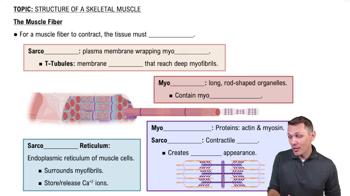
Muscle Fiber Types

Muscle fibers are categorized into different types based on their physiological and biochemical properties. The primary types are Type I (slow-twitch) and Type II (fast-twitch), with Type II further divided into IIa and IIx. Type I fibers are known for their endurance capabilities, while Type II fibers are more suited for explosive movements.
Recommended video:
Guided course
7:47
The Muscle Fiber

Slow-Twitch Fibers

Slow-twitch fibers, or Type I fibers, are characterized by their high endurance and low fatigue rates. They have a rich supply of blood vessels and mitochondria, allowing for efficient aerobic metabolism. These fibers are primarily used in activities requiring sustained effort, such as long-distance running.
Recommended video:
Guided course
03:00
Protein Fibers

Myosin ATPase Activity

Myosin ATPase activity refers to the enzyme's ability to hydrolyze ATP, which is crucial for muscle contraction. Fibers with low myosin ATPase activity, like Type I fibers, contract more slowly and are more efficient in using oxygen for energy. In contrast, fast-twitch fibers (Type II) have higher ATPase activity, enabling quicker contractions but less endurance.
Recommended video:
02:37
Active Transport