Ch. 13 The Peripheral Nervous System
Amerman - Human Anatomy & Physiology 2nd Edition
Amerman2nd EditionHuman Anatomy & PhysiologyISBN: 9780136873822Not the one you use?Change textbook
Chapter 13, Problem 12

The tracts of the posterior columns decussate in the ________, whereas the tracts of the anterolateral system decussate in the ________.

Verified step by step guidance
1
Understand the term 'decussate': In anatomy, 'decussate' refers to the crossing of nerve fibers from one side of the central nervous system to the other. This is a key concept in understanding how sensory and motor pathways function.
Identify the posterior columns: The posterior columns, also known as the dorsal columns, are responsible for transmitting fine touch, vibration, and proprioception (sense of body position). These tracts decussate at a specific location in the central nervous system.
Determine where the posterior columns decussate: The sensory information carried by the posterior columns crosses over (decussates) in the medulla oblongata, a part of the brainstem.
Identify the anterolateral system: The anterolateral system, which includes the spinothalamic tracts, is responsible for transmitting pain, temperature, and crude touch. These tracts also decussate, but at a different location compared to the posterior columns.
Determine where the anterolateral system decussates: The sensory information carried by the anterolateral system crosses over (decussates) at the level of the spinal cord, near the point of entry of the sensory nerve fibers.

Verified video answer for a similar problem:

This video solution was recommended by our tutors as helpful for the problem above.
Was this helpful?

Key Concepts

Here are the essential concepts you must grasp in order to answer the question correctly.

Decussation

Decussation refers to the crossing over of nerve fibers from one side of the central nervous system to the other. This process is crucial for the integration of sensory and motor pathways, allowing the brain to process information from the opposite side of the body. Understanding where decussation occurs helps in localizing neurological functions and understanding the pathways of sensory information.

Posterior Columns

The posterior columns, also known as the dorsal columns, are a pair of pathways in the spinal cord that carry sensory information related to fine touch, vibration, and proprioception. These tracts ascend to the brainstem and decussate at the level of the medulla oblongata before reaching the thalamus. This pathway is essential for the perception of detailed sensory information.
Recommended video:
Guided course
6:29
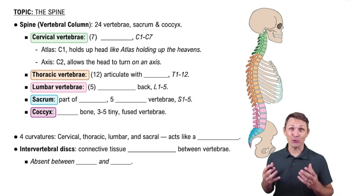
Spine (Vertebral Column)

Anterolateral System

The anterolateral system, which includes the spinothalamic tract, transmits pain, temperature, and crude touch sensations. Unlike the posterior columns, the fibers of the anterolateral system decussate at the level of the spinal cord shortly after entering. This system is vital for the rapid response to potentially harmful stimuli, allowing for quick reflex actions.
Recommended video:
4:25
Complement System
Related Practice
Textbook Question

Mark the following statements about the spinal cord as true or false. If a statement is false, correct it to make a true statement.

The corticospinal tracts are the main sensory tracts in the spinal cord.

549
views
Textbook Question

Place the following sequence of events for the detection of somatic sensation in the proper order. Place a 1 by the first event, a 2 by the second event, and so on.     

a. ______The central process transmits the action potential to a second-order sensory neuron in the CNS.     

b. ______The action potential is transferred to the central process in the posterior root ganglion.     

c. ______The stimulus triggers an action potential.     

d. ______The signal is transferred to other CNS sensory neurons for eventual perception and interpretation.     

e. ______The action potential is propagated along the peripheral process of the neuron.

734
views
Textbook Question

How do upper and lower motor neurons differ?

830
views
Textbook Question

Which parts of the body have the greatest amount of space dedicated to them in the primary somatosensory cortex? Why?

760
views
Textbook Question

Which of the following statements is false?

a. The spinothalamic tracts are part of the anterolateral system.

b. Pain, temperature, and crude touch stimuli are carried by the anterolateral system.

c. Descending pathways from the brain and spinal cord can make the spinal cord less receptive to pain stimuli.

d. The thalamus serves as the 'gateway' for entry of all special sensory stimuli into the cerebral cortex, with the exception of audition (hearing).

552
views
Textbook Question

List and describe the basic steps involved in producing movement, beginning with the upper motor neurons in the cerebral cortex.

515
views