Ch. 13 The Peripheral Nervous System
Amerman - Human Anatomy & Physiology 2nd Edition
Amerman2nd EditionHuman Anatomy & PhysiologyISBN: 9780136873822Not the one you use?Change textbook
Chapter 13, Problem 13

Which parts of the body have the greatest amount of space dedicated to them in the primary somatosensory cortex? Why?

Verified step by step guidance
1
Understand the primary somatosensory cortex: It is located in the postcentral gyrus of the brain and is responsible for processing sensory information from the body, such as touch, pressure, pain, and temperature.
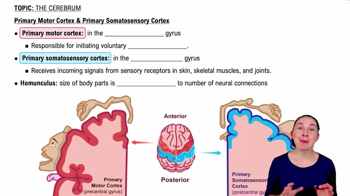
Learn about the sensory homunculus: The primary somatosensory cortex is organized in a way that reflects the sensory input from different parts of the body. This organization is represented by the sensory homunculus, a distorted map of the body where the size of each body part corresponds to the amount of cortical space dedicated to it.
Identify the body parts with the greatest cortical representation: The hands, fingers, lips, and tongue have the largest areas dedicated to them in the primary somatosensory cortex. This is because these parts are highly sensitive and require fine sensory discrimination.
Understand the reason for this distribution: The amount of cortical space is proportional to the density of sensory receptors in a body part. Areas like the hands and lips have a high concentration of mechanoreceptors, which are specialized for detecting fine touch and texture, necessitating more cortical processing power.
Relate this to functional importance: The hands and lips are crucial for tasks requiring precision, such as manipulating objects or speaking. The brain allocates more resources to these areas to ensure accurate sensory input and control, which is vital for survival and interaction with the environment.

Verified video answer for a similar problem:

This video solution was recommended by our tutors as helpful for the problem above.
Was this helpful?

Key Concepts

Here are the essential concepts you must grasp in order to answer the question correctly.

Primary Somatosensory Cortex

The primary somatosensory cortex (S1) is a region of the brain located in the postcentral gyrus, responsible for processing sensory information from the body. It receives input from the thalamus and is organized in a topographical manner, meaning different body parts are represented in specific areas. This organization allows for the perception of touch, temperature, pain, and proprioception.
Recommended video:
4:31
Primary Motor Cortex & Primary Somatosensory Cortex

Somatotopic Organization

Somatotopic organization refers to the mapping of the body's surface onto the brain, particularly in the somatosensory cortex. This means that areas of the cortex correspond to specific body parts, with larger areas allocated to regions with higher sensory acuity, such as the hands and face. This organization is often illustrated by the 'homunculus,' a visual representation showing the relative size of cortical areas dedicated to different body parts.
Recommended video:
Guided course
05:04
The Levels of Organization

Sensory Acuity

Sensory acuity is the ability to perceive and discriminate sensory stimuli with precision. Body parts with higher sensory acuity, like the fingertips and lips, have more sensory receptors and thus require more cortical space in the primary somatosensory cortex. This increased representation allows for finer tactile discrimination and greater sensitivity in these areas, which is crucial for tasks requiring detailed sensory feedback.
Recommended video:
2:47
Sensory Receptors