Ch. 16 The Endocrine System
Amerman - Human Anatomy & Physiology 2nd Edition
Amerman2nd EditionHuman Anatomy & PhysiologyISBN: 9780136873822Not the one you use?Change textbook
Chapter 16, Problem 12

The outer part of the adrenal gland is the______, which secretes______. The inner part of the adrenal gland is the_____, which secretes ______.

Verified step by step guidance
1
Step 1: Understand the anatomy of the adrenal gland. The adrenal gland has two distinct regions: the outer part called the adrenal cortex and the inner part called the adrenal medulla.
Step 2: Learn the functions of the adrenal cortex. The adrenal cortex secretes steroid hormones, including glucocorticoids (e.g., cortisol), mineralocorticoids (e.g., aldosterone), and androgens.
Step 3: Learn the functions of the adrenal medulla. The adrenal medulla secretes catecholamines, primarily epinephrine (adrenaline) and norepinephrine (noradrenaline), which are involved in the fight-or-flight response.
Step 4: Match the anatomical regions to their secretions. The adrenal cortex is responsible for secreting steroid hormones, while the adrenal medulla is responsible for secreting catecholamines.
Step 5: Use this information to fill in the blanks: The outer part of the adrenal gland is the adrenal cortex, which secretes steroid hormones. The inner part of the adrenal gland is the adrenal medulla, which secretes catecholamines.

Verified video answer for a similar problem:

This video solution was recommended by our tutors as helpful for the problem above.
Was this helpful?

Key Concepts

Here are the essential concepts you must grasp in order to answer the question correctly.

Adrenal Gland Structure

The adrenal gland consists of two main parts: the outer adrenal cortex and the inner adrenal medulla. The cortex is responsible for producing steroid hormones, while the medulla produces catecholamines. Understanding this structure is essential for grasping the functions of the hormones secreted by each part.
Recommended video:
Guided course
2:38
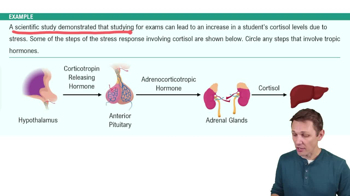
The Hypothalamus and Pituitary Gland Example 1

Hormones of the Adrenal Cortex

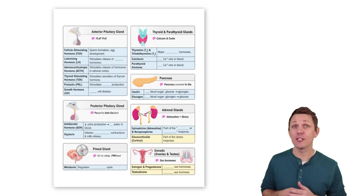
The adrenal cortex secretes several important hormones, including cortisol, aldosterone, and androgens. Cortisol helps regulate metabolism and stress responses, aldosterone controls blood pressure by managing sodium and potassium levels, and androgens contribute to the development of male characteristics and reproductive functions.
Recommended video:
Guided course
13:06
Review of Major Hormones

Hormones of the Adrenal Medulla

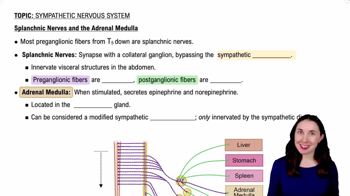
The adrenal medulla primarily secretes catecholamines, such as adrenaline (epinephrine) and noradrenaline (norepinephrine). These hormones are crucial for the body's 'fight or flight' response, increasing heart rate, blood flow, and energy availability during stressful situations.
Recommended video:
4:04
Splanchnic Nerves and the Adrenal Medulla
Related Practice
Textbook Question

Cortisol is:

a. A potent inhibitor of the inflammatory response.

b. An important part of the stress response.

c. Both a and b are correct.

d. Neither a nor b is correct.

1046
views

Textbook Question

Describe the components of the hypothalamic-pituitary-adrenocortical axis, and explain how it regulates secretion from the adrenal gland.

799
views
Textbook Question

Which of the following statements correctly describes the role of parathyroid hormone?

a. Parathyroid hormone regulates the metabolic rate.

b. Parathyroid hormone increases the blood calcium ion concentration.

c. Parathyroid hormone decreases the blood sodium ion concentration.

d. Parathyroid hormone causes water retention by the kidneys.

1243
views
Textbook Question

Mark the following statements as true or false. If a statement is false, correct it to make a true statement.

Excess secretion of thyroid hormones produces weight gain, cold intolerance, and slow heart rate.

863
views
Textbook Question

A rise in free T3 and T4 would be expected to produce a(n) ______ in TRH and TSH secretion. A decrease in free T3 and T4 would be expected to produce a(n) _____ a(n)_____in TRH and TSH secretion.

1184
views
Textbook Question

Which of the following is not an effect of aldosterone?

a. Increased excretion of hydrogen ions from the fluid in the kidneys

b. Increased retention of sodium ions from the fluid in the kidneys

c. Increased retention of potassium ions from the fluid in the kidneys

d. Increased retention of water from the fluid in the kidneys

1106
views