Ch. 22 The Digestive System
Amerman - Human Anatomy & Physiology 2nd Edition
Amerman2nd EditionHuman Anatomy & PhysiologyISBN: 9780136873822Not the one you use?Change textbook
Chapter 22, Problem 2

The peritoneal cavity is located:
a. Around each of the digestive organs
b. Between layers of mesentery
c. Superior to the greater omentum
d. Between the parietal and visceral peritoneum

Verified step by step guidance
1
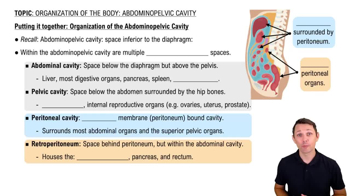
Understand the anatomy of the peritoneal cavity: The peritoneal cavity is a potential space within the abdominal cavity that is lined by a serous membrane called the peritoneum. This membrane has two layers: the parietal peritoneum (lining the abdominal wall) and the visceral peritoneum (covering the abdominal organs).
Clarify the relationship between the parietal and visceral peritoneum: The peritoneal cavity is the space between these two layers. It contains a small amount of lubricating serous fluid that allows the organs to move smoothly against each other and the abdominal wall.
Analyze the options provided: Option (a) refers to the digestive organs, but the peritoneal cavity is not specifically 'around' each organ—it is the space between the two peritoneal layers. Option (b) mentions the mesentery, which is a fold of the peritoneum that supports the intestines, but the peritoneal cavity is not located between layers of mesentery. Option (c) refers to the greater omentum, which is a large fold of peritoneum, but the peritoneal cavity is not defined as being superior to it. Option (d) correctly describes the peritoneal cavity as the space between the parietal and visceral peritoneum.
Eliminate incorrect options: Based on the anatomical definitions, options (a), (b), and (c) do not accurately describe the location of the peritoneal cavity. Option (d) is the most accurate description.
Conclude that the correct answer is the one that aligns with the anatomical definition of the peritoneal cavity: It is located between the parietal and visceral peritoneum.

Verified video answer for a similar problem:

This video solution was recommended by our tutors as helpful for the problem above.
Was this helpful?

Key Concepts

Here are the essential concepts you must grasp in order to answer the question correctly.

Peritoneal Cavity

The peritoneal cavity is a potential space within the abdominal cavity that houses various organs. It is lined by a serous membrane called the peritoneum, which consists of two layers: the parietal peritoneum, lining the abdominal wall, and the visceral peritoneum, covering the abdominal organs. This cavity allows for movement and expansion of the organs while providing a lubricated surface.
Recommended video:
Guided course
5:46
Organization of the Abdominopelvic Cavity

Mesentery

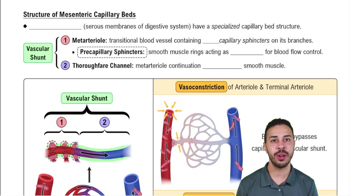
Mesentery is a fold of peritoneum that attaches the intestines to the posterior abdominal wall, providing support and containing blood vessels, nerves, and lymphatics. It plays a crucial role in anchoring the intestines in place while allowing for their mobility. Understanding the relationship between the mesentery and the peritoneal cavity is essential for comprehending abdominal anatomy.
Recommended video:
6:52
Structure of Mesenteric Capillary Beds

Visceral and Parietal Peritoneum

The visceral peritoneum is the layer of peritoneum that directly covers the abdominal organs, while the parietal peritoneum lines the abdominal wall. The space between these two layers forms the peritoneal cavity, which can be a site for fluid accumulation or infection. Recognizing the distinction between these layers is vital for understanding abdominal pathology and surgical procedures.
Recommended video:
2:12
Visceral Reflex Arcs