Ch. 3 The Cell
Amerman - Human Anatomy & Physiology 2nd Edition
Amerman2nd EditionHuman Anatomy & PhysiologyISBN: 9780136873822Not the one you use?Change textbook
Chapter 3, Problem 15d

Each of the following statements about protein synthesis is false. Correct each to make a true statement.
Proteins destined for secretion from the cell enter the nucleus after translation, to be folded and modified.

Verified step by step guidance
1
Identify the incorrect statement: The statement claims that proteins destined for secretion enter the nucleus after translation to be folded and modified. This is false because proteins destined for secretion do not enter the nucleus.
Understand the correct pathway for proteins destined for secretion: Proteins destined for secretion are synthesized by ribosomes attached to the rough endoplasmic reticulum (RER). These ribosomes translate the mRNA into a polypeptide chain.
Explain the folding and modification process: After translation, the polypeptide chain enters the lumen of the rough endoplasmic reticulum, where it undergoes initial folding and modifications, such as glycosylation.
Describe the transport to the Golgi apparatus: The modified protein is packaged into vesicles and transported to the Golgi apparatus. In the Golgi, further modifications and sorting occur to prepare the protein for secretion.
Clarify the final step: After processing in the Golgi apparatus, the protein is packaged into secretory vesicles, which fuse with the plasma membrane to release the protein outside the cell. Proteins destined for secretion do not enter the nucleus at any point in this process.

Verified video answer for a similar problem:

This video solution was recommended by our tutors as helpful for the problem above.
Was this helpful?

Key Concepts

Here are the essential concepts you must grasp in order to answer the question correctly.

Protein Synthesis

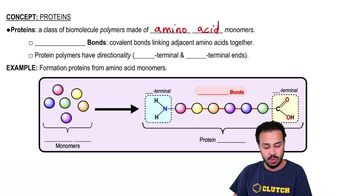
Protein synthesis is the biological process through which cells generate new proteins. It involves two main stages: transcription, where DNA is converted into messenger RNA (mRNA) in the nucleus, and translation, where ribosomes synthesize proteins based on the mRNA sequence. Understanding this process is crucial for correcting misconceptions about how proteins are produced and modified.
Recommended video:
02:50
Proteins

Endoplasmic Reticulum (ER)

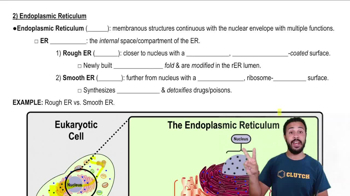
The endoplasmic reticulum (ER) is an organelle in eukaryotic cells that plays a key role in the synthesis and processing of proteins. The rough ER, studded with ribosomes, is primarily involved in the translation of proteins destined for secretion or for use in the cell membrane. Proteins are folded and modified in the ER before being transported to their final destinations, making it essential to recognize its function in protein maturation.
Recommended video:
06:07
Endoplasmic Reticulum

Post-Translational Modification

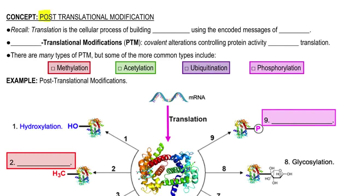
Post-translational modification refers to the chemical changes that proteins undergo after their synthesis. These modifications can include phosphorylation, glycosylation, and cleavage, which are critical for the protein's final functional state. Understanding these modifications is important for correcting the statement about protein folding and modification occurring in the nucleus, as they primarily occur in the ER and Golgi apparatus.
Recommended video:
04:26
Post-Translational Modification
Related Practice
Textbook Question

Each of the following statements about protein synthesis is false. Correct each to make a true statement.

In a gene, each nucleotide specifies one amino acid in a protein sequence.

899
views

Textbook Question

Number the following steps of protein synthesis in the order in which they occur, starting with 1 and ending with 9.

a. _____The stop codon is reached, and the polypeptide is released. 

b. _____The small ribosomal subunit finds the start codon, and the large ribosomal subunit joins. 

c. _____The end of the gene is reached, and the pre-mRNA is released and then edited. 

d. _____The transcription factor binds the promoter. 

e. _____The protein is folded and modified to become functional. 

f. _____ RNA polymerase builds the mRNA transcript. 

g. _____mRNA and initiator tRNA bind the small ribosomal subunit. 

h. _____ New tRNAs are brought into the A site successively, and the peptide chain of the tRNA in the P site is joined to the amino acid of the tRNA in the A site.

i. ______mRNA exits the nucleus via a nuclear pore.

874
views
Textbook Question

Each of the following statements about protein synthesis is false. Correct each to make a true statement.

The enzyme RNA polymerase builds a strand of transfer RNA, whose codons are complementary to DNA's triplets.

700
views
Textbook Question

Each of the following statements about protein synthesis is false. Correct each to make a true statement.

A transcription factor must bind to the promoter region of a gene before the enzyme DNA synthetase is able to bind and begin transcription.

696
views
Textbook Question

Which of the following is not a phase of mitosis?

a. Interphase

b. Prophase

c. Anaphase

d. Metaphase

883
views
Textbook Question

Each of the following statements about protein synthesis is false. Correct each to make a true statement.

During translation, amino acids are delivered by the messenger RNA transcript.

676
views