
Ch. 3 The Cell
Amerman - Human Anatomy & Physiology 2nd Edition
Amerman2nd EditionHuman Anatomy & PhysiologyISBN: 9780136873822Not the one you use?Change textbook
Chapter 3, Problem 17

Which of the following is not a phase of mitosis?
a. Interphase
b. Prophase
c. Anaphase
d. Metaphase

Verified step by step guidance
1
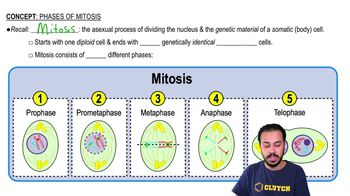
Step 1: Begin by understanding the process of mitosis. Mitosis is the division of a cell's nucleus into two identical nuclei, and it consists of specific phases: prophase, metaphase, anaphase, and telophase.
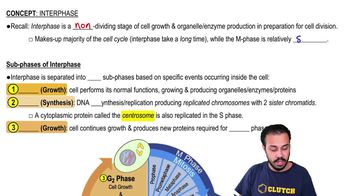
Step 2: Recognize that interphase is not part of mitosis. Interphase is the phase where the cell prepares for division by growing and replicating its DNA, but it occurs before mitosis begins.
Step 3: Review the phases of mitosis: Prophase involves the condensation of chromatin into chromosomes and the breakdown of the nuclear envelope. Metaphase is when chromosomes align at the cell's equatorial plane. Anaphase is the separation of sister chromatids toward opposite poles.
Step 4: Compare the options provided in the question. Identify which phase does not belong to the process of mitosis based on the explanation above.
Step 5: Conclude that interphase is not a phase of mitosis, as it occurs prior to mitosis and is part of the cell cycle rather than the mitotic process itself.

Verified video answer for a similar problem:

This video solution was recommended by our tutors as helpful for the problem above.
Was this helpful?

Key Concepts

Here are the essential concepts you must grasp in order to answer the question correctly.

Mitosis

Mitosis is a process of cell division that results in two genetically identical daughter cells from a single parent cell. It consists of several distinct phases: prophase, metaphase, anaphase, and telophase. Each phase plays a critical role in ensuring that the chromosomes are accurately replicated and distributed to the daughter cells.
Recommended video:
03:21
Phases of Mitosis

Interphase

Interphase is the phase of the cell cycle that occurs before mitosis and is not considered a part of mitosis itself. It is divided into three sub-phases: G1 (cell growth), S (DNA synthesis), and G2 (preparation for mitosis). During interphase, the cell prepares for division by replicating its DNA and increasing its organelle count.
Recommended video:
08:05
Interphase

Phases of Mitosis

The phases of mitosis include prophase, metaphase, anaphase, and telophase. Each phase has specific events: prophase involves chromatin condensing into chromosomes, metaphase aligns chromosomes at the cell's equator, anaphase separates sister chromatids, and telophase reforms the nuclear envelope around the separated sets of chromosomes. Understanding these phases is essential for recognizing the complete process of cell division.
Recommended video:
03:21
Phases of Mitosis
Related Practice
Textbook Question

Number the following steps of protein synthesis in the order in which they occur, starting with 1 and ending with 9.

a. _____The stop codon is reached, and the polypeptide is released. 

b. _____The small ribosomal subunit finds the start codon, and the large ribosomal subunit joins. 

c. _____The end of the gene is reached, and the pre-mRNA is released and then edited. 

d. _____The transcription factor binds the promoter. 

e. _____The protein is folded and modified to become functional. 

f. _____ RNA polymerase builds the mRNA transcript. 

g. _____mRNA and initiator tRNA bind the small ribosomal subunit. 

h. _____ New tRNAs are brought into the A site successively, and the peptide chain of the tRNA in the P site is joined to the amino acid of the tRNA in the A site.

i. ______mRNA exits the nucleus via a nuclear pore.

874
views
Textbook Question

Mark the following statements about the cell cycle as true or false. If a statement is false, correct it to make a true statement.

During metaphase, the sister chromatids are pulled apart and the chromosomes move to the opposite poles of the cell.

810
views
Textbook Question

Each of the following statements about protein synthesis is false. Correct each to make a true statement.

Proteins destined for secretion from the cell enter the nucleus after translation, to be folded and modified.

625
views
Textbook Question

Why is regulation of the cell cycle necessary?

1106
views
Textbook Question

Each of the following statements about protein synthesis is false. Correct each to make a true statement.

During translation, amino acids are delivered by the messenger RNA transcript.

676
views
Textbook Question

Mark the following statements about the cell cycle as true or false. If a statement is false, correct it to make a true statement.

During the S phase of the cell cycle, the cell stalls until conditions for division are more favorable

1048
views