
At the clinic, Harry was told that blood would be drawn from his antecubital region. What body part was Harry asked to hold out? Later, the nurse came in and gave Harry a shot of penicillin in the area just distal to his acromial region. Did Harry take off his shirt or drop his pants to receive the injection? Before Harry left, the nurse noticed that Harry had a nasty bruise on his gluteal region. What part of his body was black and blue?
Ch. 1 The Human Body: An Orientation
Hoehn, Haynes, Abbott12th EditionMarieb Human Anatomy & PhysiologyISBN: 9780138242732Not the one you use?Change textbook
Chapter 1, Problem 22
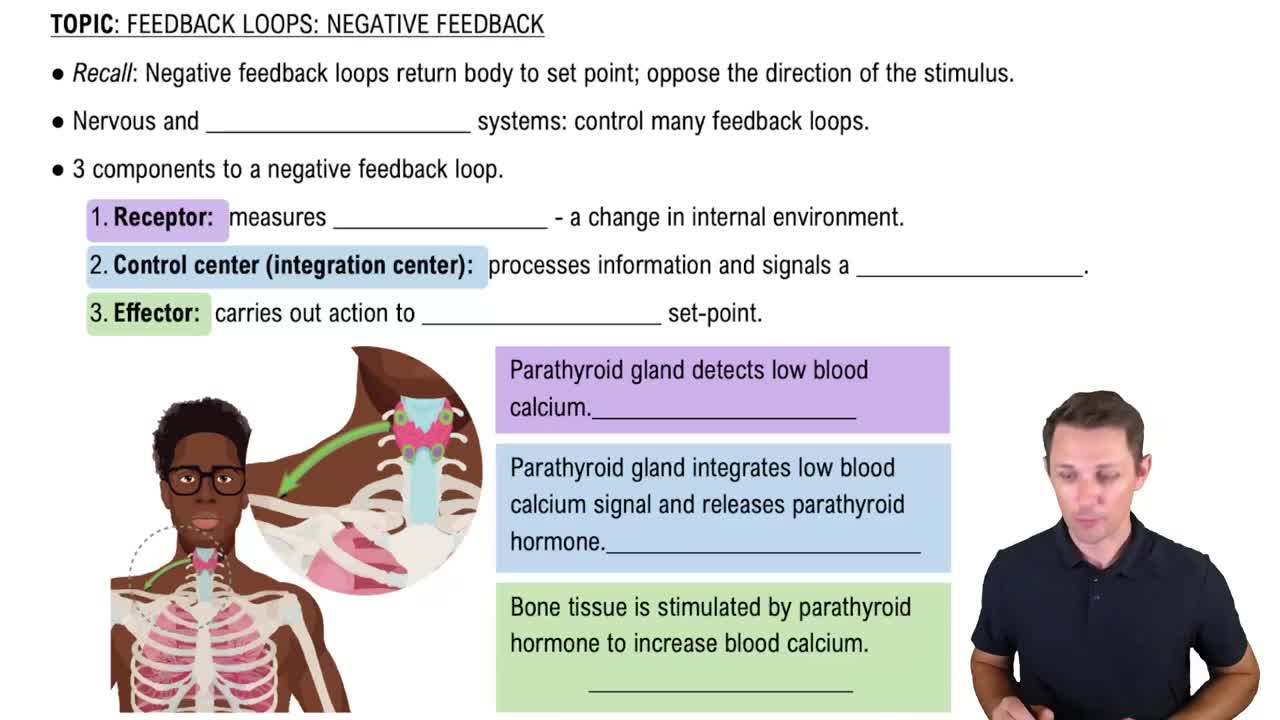
Calcium levels in Mr. Gallariani's blood are dropping to dangerously low levels. The hormone PTH is released and soon blood calcium levels begin to rise. Shortly after, PTH release slows. Is this an example of a positive or negative feedback mechanism? What is the initial stimulus? What is the result?
Verified step by step guidance1
Identify the type of feedback mechanism by analyzing the process: When calcium levels drop, PTH (parathyroid hormone) is released to increase calcium levels, and once calcium levels rise, PTH release slows down. This regulation that reverses the initial change is characteristic of a negative feedback mechanism.
Determine the initial stimulus: The initial stimulus is the drop in blood calcium levels, which triggers the release of PTH.
Explain the role of PTH: PTH acts to increase blood calcium levels by stimulating bone resorption, increasing calcium absorption in the intestines, and reducing calcium excretion by the kidneys.
Describe the result of the feedback loop: The blood calcium levels rise back toward normal, which then signals the parathyroid glands to reduce PTH secretion.
Summarize the overall process: The negative feedback mechanism maintains calcium homeostasis by detecting low calcium levels, releasing PTH to correct the imbalance, and then slowing PTH release once calcium levels are restored.

Verified video answer for a similar problem:
This video solution was recommended by our tutors as helpful for the problem above.
Video duration:
2mWas this helpful?
Key Concepts
Here are the essential concepts you must grasp in order to answer the question correctly.
Negative Feedback Mechanism
A negative feedback mechanism is a biological process where a change in a variable triggers a response that counteracts the initial change, restoring balance. In this case, low calcium levels stimulate PTH release, which raises calcium, then PTH release slows as levels normalize, maintaining homeostasis.
Recommended video:
Guided course
Negative Feedback Loops
Parathyroid Hormone (PTH) Function
Parathyroid hormone (PTH) is secreted by the parathyroid glands in response to low blood calcium. It increases calcium levels by stimulating bone resorption, enhancing calcium absorption in the intestines, and reducing calcium excretion by the kidneys.
Recommended video:
Guided course
Review of Major Hormones
Initial Stimulus and Result in Hormonal Regulation
The initial stimulus is the drop in blood calcium levels, which triggers PTH release. The result is an increase in blood calcium concentration, restoring normal levels and ensuring proper physiological functions like muscle contraction and nerve signaling.
Recommended video:
Guided course
Review of Major Hormones
Related Practice
Textbook Question
1072
views
Textbook Question
Use as many directional terms as you can to describe the relationship between the elbow's olecranal region and your palm.
1641
views
Textbook Question
Why is an understanding of the anatomical position important?
1651
views
Textbook Question
Mr. Harvey, a computer programmer, has been complaining of numbness and pain in his right hand. The nurse practitioner diagnosed his problem as carpal tunnel syndrome and prescribed use of a splint. Where will Mr. Harvey apply the splint?
78
views
Textbook Question
Aiden has been suffering agonizing pain with each breath and has been informed by the physician that he has pleurisy.
a. Specifically, what membranes are involved in this condition?
b. What is their usual role in the body?
c. Explain why Aiden's condition is so painful.
955
views
