
Ch. 1 The Human Body: An Orientation
Hoehn - Marieb Human Anatomy & Physiology, 12th edition
Hoehn, Haynes, Abbott12th EditionMarieb Human Anatomy & PhysiologyISBN: 9780138242732Not the one you use?Change textbook
Chapter 1, Problem 20

Use as many directional terms as you can to describe the relationship between the elbow's olecranal region and your palm.

Verified step by step guidance
1
Identify the anatomical locations involved: the olecranal region refers to the posterior aspect of the elbow (the bony point of the elbow), and the palm refers to the anterior surface of the hand.
Determine the relative positions using directional terms. Since the olecranal region is located at the back of the elbow and the palm is on the front of the hand, the olecranal region is posterior to the palm.
Consider the position along the limb: the olecranal region is proximal (closer to the trunk) compared to the palm, which is distal (farther from the trunk).
Since both regions are on the upper limb, note that the olecranal region is superior to the palm because it is higher up on the arm.
Summarize the relationship using multiple directional terms: the olecranal region is posterior, proximal, and superior to the palm, while the palm is anterior, distal, and inferior relative to the olecranal region.

Verified video answer for a similar problem:

This video solution was recommended by our tutors as helpful for the problem above.
Video duration:
1m
Was this helpful?

Key Concepts

Here are the essential concepts you must grasp in order to answer the question correctly.

Directional Terms in Anatomy

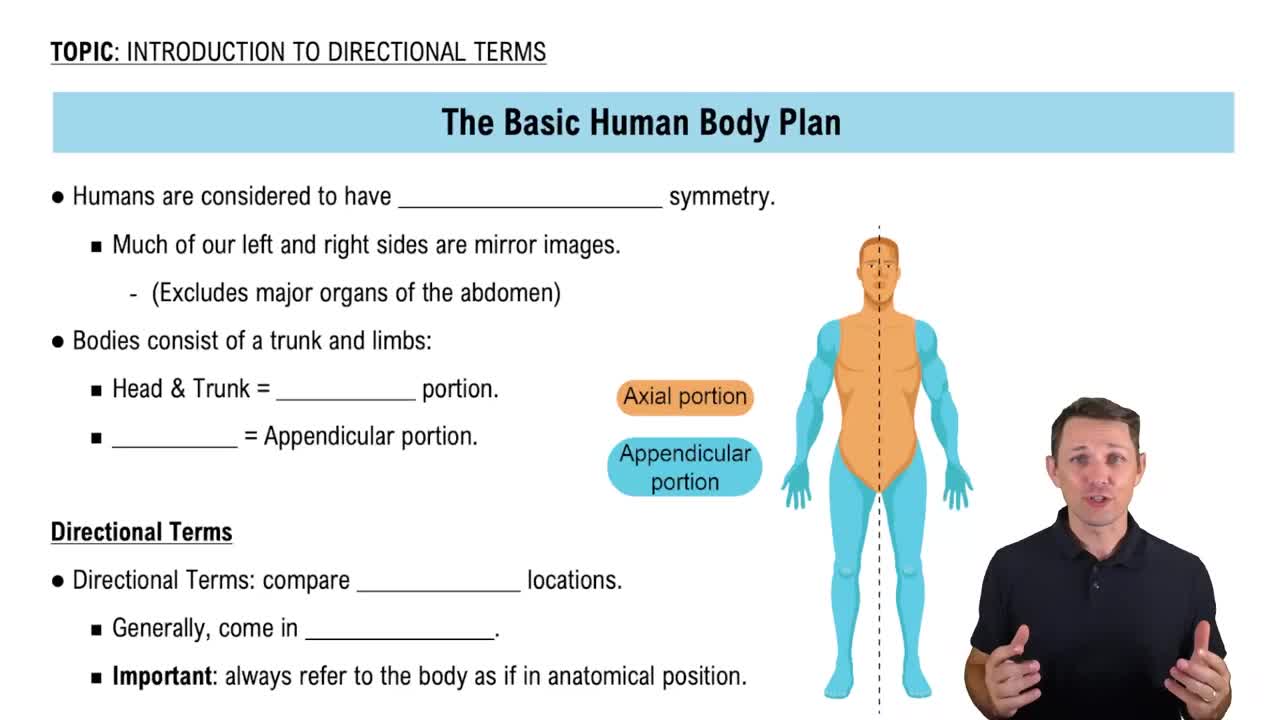
Directional terms are standardized words used to describe the locations of structures relative to each other in the body. Examples include anterior (front), posterior (back), proximal (closer to the trunk), distal (farther from the trunk), medial (toward the midline), and lateral (away from the midline). These terms help clearly communicate spatial relationships.
Recommended video:
Guided course
03:00
Introduction to Directional Terms

Olecranal Region

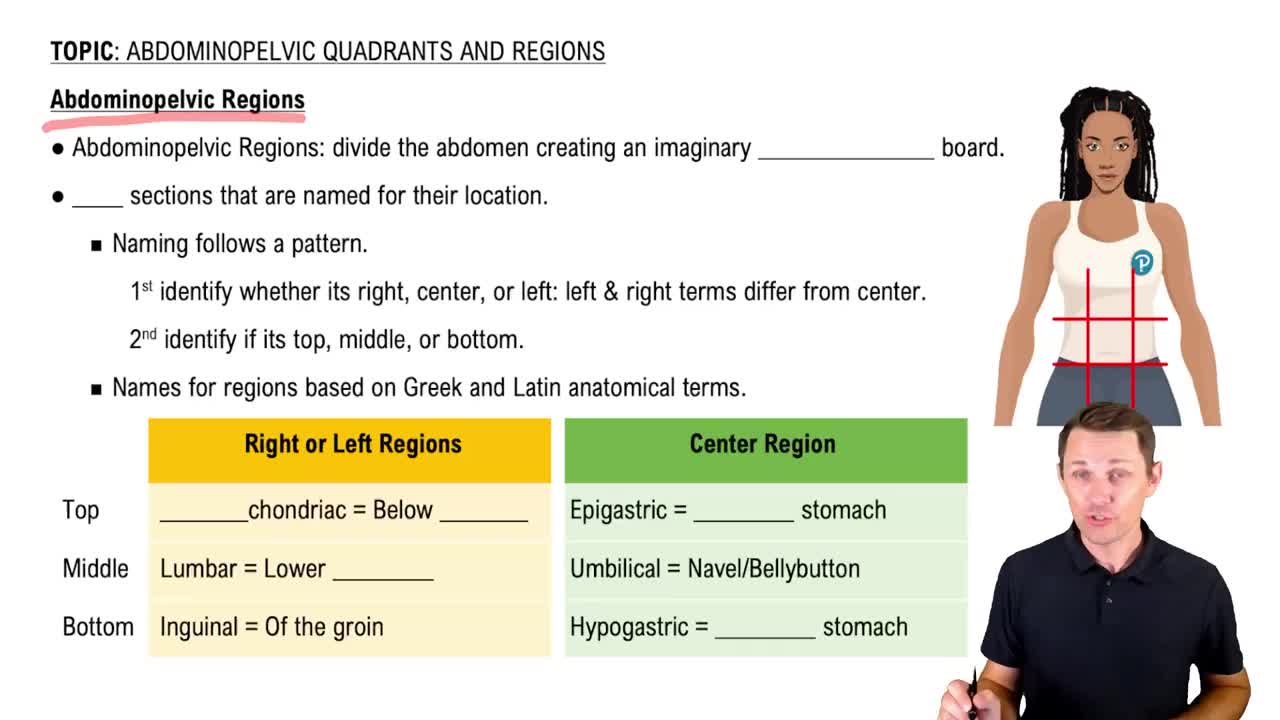
The olecranal region refers to the bony prominence of the elbow, specifically the posterior part of the elbow joint. It is located at the back of the arm where the ulna bone forms the elbow's tip. Understanding this region is key to describing its position relative to other parts of the arm or hand.
Recommended video:
Guided course
04:21
The 9 Abdominopelvic Regions

Anatomical Position and Palm Orientation

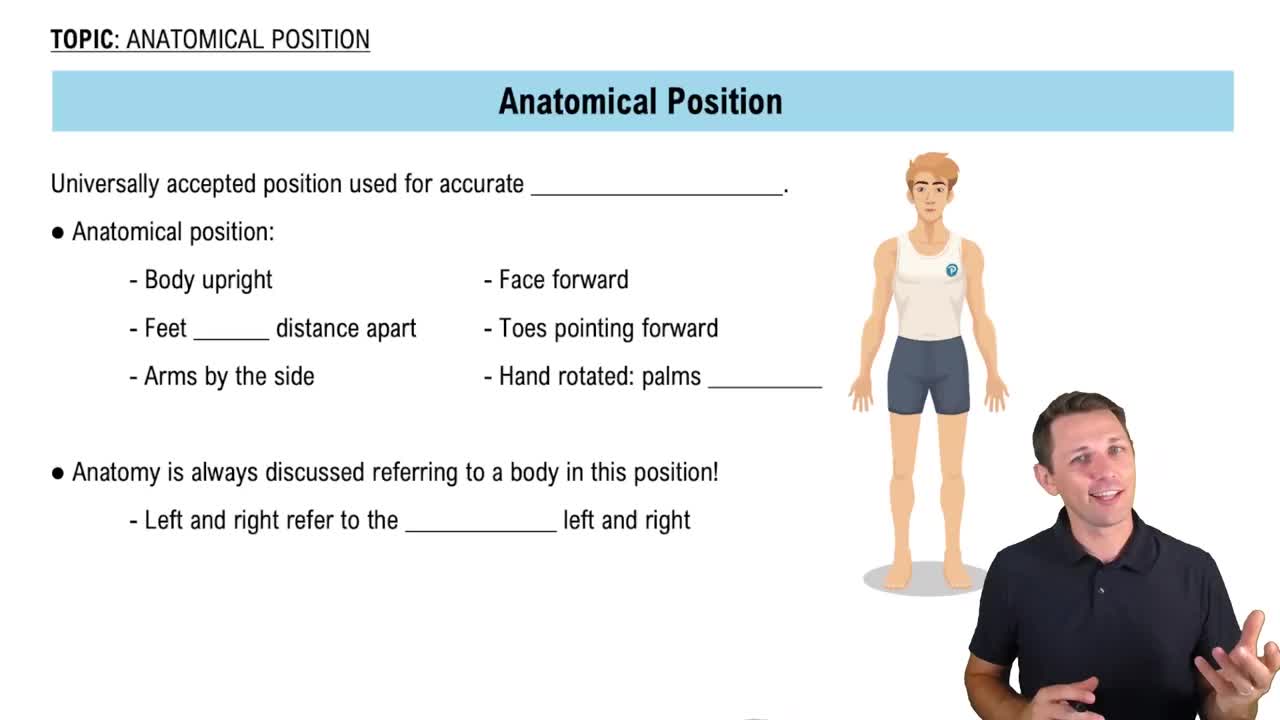
The anatomical position is a standard stance where the body stands upright, facing forward, with arms at the sides and palms facing forward. The palm is the anterior (front) surface of the hand. Knowing this helps in accurately describing the olecranal region as posterior and proximal relative to the palm.
Recommended video:
Guided course
02:40
Anatomical Position
Related Practice
Textbook Question

Calcium levels in Mr. Gallariani's blood are dropping to dangerously low levels. The hormone PTH is released and soon blood calcium levels begin to rise. Shortly after, PTH release slows. Is this an example of a positive or negative feedback mechanism? What is the initial stimulus? What is the result?

1260
views
2
rank
Textbook Question

Compare and contrast the operation of negative and positive feedback mechanisms in maintaining homeostasis. Provide two examples of variables controlled by negative feedback mechanisms and one example of a process regulated by a positive feedback mechanism.

1981
views
Textbook Question

At the clinic, Harry was told that blood would be drawn from his antecubital region. What body part was Harry asked to hold out? Later, the nurse came in and gave Harry a shot of penicillin in the area just distal to his acromial region. Did Harry take off his shirt or drop his pants to receive the injection? Before Harry left, the nurse noticed that Harry had a nasty bruise on his gluteal region. What part of his body was black and blue?

1072
views
Textbook Question

Which of the following relationships is incorrect?

a. Visceral peritoneum/outer surface of small intestine

b. Parietal pericardium/outer surface of heart

c. Parietal pleura/wall of thoracic cavity

1175
views
1
rank
Textbook Question

Why is an understanding of the anatomical position important?

1651
views
Textbook Question

Mr. Harvey, a computer programmer, has been complaining of numbness and pain in his right hand. The nurse practitioner diagnosed his problem as carpal tunnel syndrome and prescribed use of a splint. Where will Mr. Harvey apply the splint?

78
views