
Ch. 19 The Cardiovascular System: Blood Vessels
Hoehn - Marieb Human Anatomy & Physiology, 12th edition
Hoehn, Haynes, Abbott12th EditionMarieb Human Anatomy & PhysiologyISBN: 9780138242732Not the one you use?Change textbook
Chapter 19, Problem 28

Edema is a common clinical problem. On your first day of a clinical rotation, you encounter four patients who have edema for different reasons. Your challenge is to explain the edema in terms of either an increase or a decrease in one of the four pressures that causes bulk flow.
(1) First you encounter Mrs. Taylor in the medical unit awaiting a liver transplant. What is the connection between liver failure and her edema?
(2) Next in the obstetric ward, Mrs. So is experiencing premature labor and has edema in her legs. Which bulk flow pressures might be altered here?
(3) In emergency, Mr. Herrera is in anaphylactic shock. His capillaries have become leaky, allowing plasma proteins that are normally kept inside the blood vessels to escape into the interstitial fluid. Which of the bulk flow pressures is altered in this case and in what direction is the change?
(4) Finally, in oncology Mrs. O'Leary is recovering from breast cancer surgery. Her right breast and all of her axillary lymph nodes were removed. Unfortunately, this severed most of the lymphatic vessels draining her right arm. You notice that this arm is quite edematous. Why? Mrs. O'Leary is given a compression sleeve to wear on this arm to help relieve the edema. Which of the bulk flow pressures will be altered by the compression sleeve?

Verified step by step guidance
1
Step 1: Understand the four pressures involved in bulk flow across capillary membranes: capillary hydrostatic pressure (P_c), interstitial hydrostatic pressure (P_i), capillary oncotic pressure (π_c), and interstitial oncotic pressure (π_i). Edema results when the balance of these pressures favors excess fluid movement into the interstitial space.
Step 2: For Mrs. Taylor with liver failure, recognize that the liver produces plasma proteins like albumin, which contribute to capillary oncotic pressure (π_c). Liver failure decreases plasma protein synthesis, lowering π_c, which reduces the reabsorption of fluid back into capillaries, leading to edema.
Step 3: For Mrs. So in premature labor with leg edema, consider that increased venous pressure due to compression of veins (e.g., from the gravid uterus) raises capillary hydrostatic pressure (P_c) in the legs. This increased P_c pushes more fluid out of capillaries into the interstitial space, causing edema.
Step 4: For Mr. Herrera in anaphylactic shock, the capillaries become more permeable, allowing plasma proteins to leak into the interstitial fluid. This increases interstitial oncotic pressure (π_i), which draws more fluid out of the capillaries into the interstitial space, resulting in edema.
Step 5: For Mrs. O'Leary after lymph node and lymphatic vessel removal, lymphatic drainage is impaired, causing accumulation of interstitial fluid. The compression sleeve increases interstitial hydrostatic pressure (P_i), which opposes fluid movement out of capillaries and helps reduce edema.

Verified video answer for a similar problem:

This video solution was recommended by our tutors as helpful for the problem above.
Video duration:
2m
Was this helpful?

Key Concepts

Here are the essential concepts you must grasp in order to answer the question correctly.

Starling Forces and Bulk Flow

Starling forces describe the balance of hydrostatic and oncotic pressures across capillary walls that regulate fluid movement between blood vessels and interstitial spaces. Hydrostatic pressure pushes fluid out of capillaries, while oncotic pressure, mainly from plasma proteins, pulls fluid in. Edema occurs when this balance is disrupted, causing excess fluid accumulation in tissues.
Recommended video:
Guided course
5:45
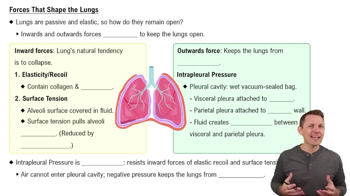
Forces That Shape the Lungs

Role of Plasma Proteins in Oncotic Pressure

Plasma proteins, especially albumin, generate oncotic pressure that retains fluid within blood vessels. Liver failure reduces albumin production, lowering plasma oncotic pressure and leading to fluid leakage into tissues, causing edema. Loss or leakage of plasma proteins into interstitial fluid also decreases oncotic pressure inside vessels, promoting edema.
Recommended video:
04:00
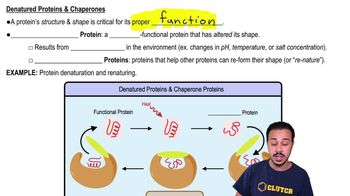
Denatured Proteins & Chaperones

Lymphatic System and Edema Management

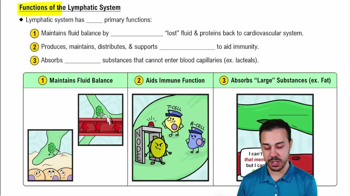
The lymphatic system drains excess interstitial fluid and proteins back into circulation, preventing edema. Surgical removal of lymph nodes or vessels impairs this drainage, causing fluid buildup. Compression sleeves increase interstitial hydrostatic pressure, helping push fluid into lymphatics and veins, reducing edema.
Recommended video:
3:57
Functions of the Lymphatic System