Ch. 19 The Cardiovascular System: Blood Vessels
Hoehn - Marieb Human Anatomy & Physiology, 12th edition
Hoehn, Haynes, Abbott12th EditionMarieb Human Anatomy & PhysiologyISBN: 9780138242732Not the one you use?Change textbook
Chapter 19, Problem 25

Your friend Jillian, who knows little about science, is reading a magazine article about a patient who had an 'aneurysm at the base of his brain that suddenly grew much larger.' The surgeons' first goal was to 'keep it from rupturing,' and the second goal was to 'relieve the pressure on the brain stem and cranial nerves.' The surgeons were able to 'replace the aneurysm with a section of plastic tubing,' so the patient recovered. Jillian asks you what all this means. Explain.

Verified step by step guidance
1
Step 1: Explain what an aneurysm is — it is a localized, abnormal dilation or ballooning of a blood vessel wall, often caused by weakness in the vessel. In the brain, this can be dangerous because the vessel wall can rupture, leading to bleeding in the brain.
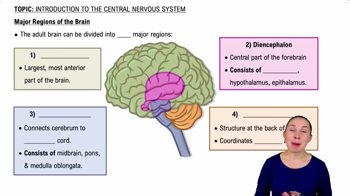
Step 2: Describe why an aneurysm at the base of the brain is concerning — this area contains critical structures like the brain stem and cranial nerves, which control vital functions such as breathing, heart rate, and movement. A growing aneurysm can press on these structures, causing serious problems.
Step 3: Clarify the surgeons' first goal — to prevent the aneurysm from rupturing, which would cause bleeding (hemorrhage) and potentially life-threatening damage. This is often done by isolating the aneurysm from blood flow.
Step 4: Explain the second goal — relieving pressure on the brain stem and cranial nerves. The enlarged aneurysm can compress these areas, so reducing this pressure helps restore normal function and prevent neurological damage.
Step 5: Describe the surgical solution — replacing the aneurysm with a section of plastic tubing (a vascular graft) means the damaged part of the blood vessel is removed and replaced with a synthetic tube that allows blood to flow normally without the risk of rupture or pressure on nearby brain structures.

Verified video answer for a similar problem:

This video solution was recommended by our tutors as helpful for the problem above.
Video duration:
2m
Was this helpful?

Key Concepts

Here are the essential concepts you must grasp in order to answer the question correctly.

Brain Aneurysm

A brain aneurysm is a weak or bulging spot in a blood vessel in the brain that can grow larger and risk bursting. If it ruptures, it can cause serious bleeding and damage. Understanding what an aneurysm is helps explain why surgeons want to prevent it from breaking.
Recommended video:
3:10
Major Regions of the Brain

Surgical Treatment of Aneurysms

Surgery for brain aneurysms often involves removing or isolating the damaged vessel and replacing it with a synthetic tube or clip. This prevents rupture and restores normal blood flow, reducing the risk of bleeding and further brain injury.
Recommended video:
Guided course
1:46
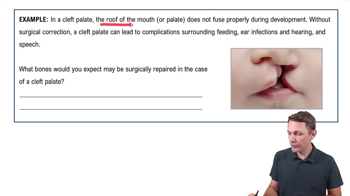
The Skull Example 2

Pressure on Brain Stem and Cranial Nerves

An enlarged aneurysm can press on the brain stem and cranial nerves, causing symptoms like pain or nerve dysfunction. Relieving this pressure is crucial to protect vital brain functions and improve recovery after surgery.
Recommended video:
Guided course
6:12
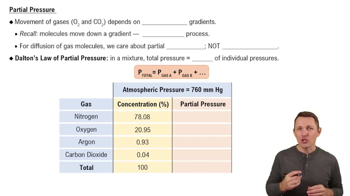
Partial Pressure
Related Practice
Textbook Question

The Agawam High School band is playing some lively marches while the coaches are giving pep talks to their respective football squads. Although it is September, it is unseasonably hot (88°F/31°C) and the band uniforms are wool. Suddenly Ryan, the tuba player, becomes light-headed and faints. Explain his fainting in terms of vascular events.

966
views
Textbook Question

When we are cold or the external temperature is low, most venous blood returning from the distal part of the arm travels in the deep veins where it picks up heat (by countercurrent exchange) from the nearby brachial artery en route. However, when we are hot, and especially during exercise, venous return from the distal arm travels in the superficial veins and those veins tend to bulge superficially in a person who is working out. Explain why venous return takes a different route in the second situation.

974
views
Textbook Question

Edema is a common clinical problem. On your first day of a clinical rotation, you encounter four patients who have edema for different reasons. Your challenge is to explain the edema in terms of either an increase or a decrease in one of the four pressures that causes bulk flow.

(1) First you encounter Mrs. Taylor in the medical unit awaiting a liver transplant. What is the connection between liver failure and her edema?

(2) Next in the obstetric ward, Mrs. So is experiencing premature labor and has edema in her legs. Which bulk flow pressures might be altered here?

(3) In emergency, Mr. Herrera is in anaphylactic shock. His capillaries have become leaky, allowing plasma proteins that are normally kept inside the blood vessels to escape into the interstitial fluid. Which of the bulk flow pressures is altered in this case and in what direction is the change?

(4) Finally, in oncology Mrs. O'Leary is recovering from breast cancer surgery. Her right breast and all of her axillary lymph nodes were removed. Unfortunately, this severed most of the lymphatic vessels draining her right arm. You notice that this arm is quite edematous. Why? Mrs. O'Leary is given a compression sleeve to wear on this arm to help relieve the edema. Which of the bulk flow pressures will be altered by the compression sleeve?
1058
views
Textbook Question

How does the control of blood flow to the skin for the purpose of regulating body temperature differ from the control of nutrient blood flow to skin cells?

869
views
1
rank
Textbook Question

A 60-year-old man is unable to walk more than 100 yards without experiencing severe pain in his left leg; the pain is relieved by resting for 5–10 minutes. He is told that the arteries of his leg are becoming occluded with fatty material and is advised to have the sympathetic nerves serving that body region severed. Explain how such surgery might help to relieve this man's problem.

1051
views
Textbook Question

Describe neural and chemical (both systemic and local) effects exerted on the blood vessels when you are fleeing from a mugger. (Be careful, this is more involved than it appears at first glance.)

1093
views