Ch. 24 Nutrition, Metabolism, and Energy Balance
Hoehn - Marieb Human Anatomy & Physiology, 12th edition
Hoehn, Haynes, Abbott12th EditionMarieb Human Anatomy & PhysiologyISBN: 9780138242732Not the one you use?Change textbook
Chapter 24, Problem 15

Describe the site, major events, and outcomes of glycolysis.

Verified step by step guidance
1
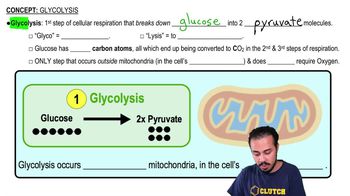
Step 1: Glycolysis occurs in the cytoplasm of the cell. It is the first stage of cellular respiration and does not require oxygen (anaerobic process). The process begins with one molecule of glucose (C₆H₁₂O₆).
Step 2: The glucose molecule is phosphorylated twice using two molecules of ATP, forming fructose-1,6-bisphosphate. This step is catalyzed by enzymes such as hexokinase and phosphofructokinase, and it prepares the glucose molecule for cleavage.
Step 3: Fructose-1,6-bisphosphate is split into two three-carbon molecules: glyceraldehyde-3-phosphate (G3P) and dihydroxyacetone phosphate (DHAP). DHAP is quickly converted into another G3P, so two G3P molecules proceed to the next steps.
Step 4: Each G3P molecule undergoes a series of reactions where it is oxidized and phosphorylated, producing 2 molecules of NADH (one per G3P) and 4 molecules of ATP (two per G3P) through substrate-level phosphorylation. The enzyme glyceraldehyde-3-phosphate dehydrogenase plays a key role in this step.
Step 5: The final products of glycolysis are two molecules of pyruvate, two molecules of NADH, and a net gain of two ATP molecules (since two ATP were used in the initial steps). Pyruvate can enter the mitochondria for further aerobic respiration or be converted into lactate in anaerobic conditions.

Verified video answer for a similar problem:

This video solution was recommended by our tutors as helpful for the problem above.
Video duration:
1m
Was this helpful?

Key Concepts

Here are the essential concepts you must grasp in order to answer the question correctly.

Glycolysis

Glycolysis is a metabolic pathway that converts glucose into pyruvate, producing a small amount of ATP and NADH in the process. It occurs in the cytoplasm of cells and is the first step in cellular respiration, providing energy for cellular activities. Glycolysis can function under both aerobic and anaerobic conditions, making it a crucial pathway for energy production.
Recommended video:
05:04
Glycolysis

Major Events of Glycolysis

The major events of glycolysis include the phosphorylation of glucose, the cleavage of fructose-1,6-bisphosphate into two three-carbon molecules, and the conversion of these molecules into pyruvate. Throughout these steps, ATP is consumed and generated, and NAD+ is reduced to NADH. These events are catalyzed by specific enzymes, ensuring the pathway's efficiency and regulation.
Recommended video:
05:04
Glycolysis

Outcomes of Glycolysis

The primary outcomes of glycolysis are the production of two molecules of pyruvate, a net gain of two ATP molecules, and the generation of two NADH molecules. These products are vital for further energy production in aerobic respiration (via the citric acid cycle) or fermentation processes in anaerobic conditions. The balance of energy production and substrate availability influences the direction and efficiency of glycolysis.
Recommended video:
9:16
Outcomes of Antibody Binding to Antigen