Ch. 24 Nutrition, Metabolism, and Energy Balance
Hoehn - Marieb Human Anatomy & Physiology, 12th edition
Hoehn, Haynes, Abbott12th EditionMarieb Human Anatomy & PhysiologyISBN: 9780138242732Not the one you use?Change textbook
Chapter 24, Problem 14

What is cellular respiration? What is the common role of FAD and NAD⁺ in cellular respiration?

Verified step by step guidance
1
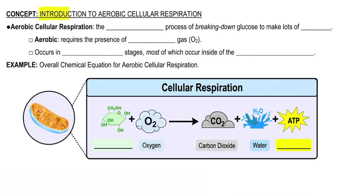
Cellular respiration is the process by which cells convert glucose and oxygen into energy in the form of ATP (adenosine triphosphate), along with byproducts such as carbon dioxide and water. It occurs in three main stages: glycolysis, the citric acid cycle (Krebs cycle), and oxidative phosphorylation.
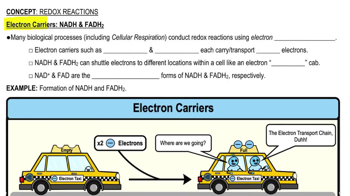
FAD (flavin adenine dinucleotide) and NAD⁺ (nicotinamide adenine dinucleotide) are coenzymes that play a critical role in cellular respiration by acting as electron carriers. They help transfer high-energy electrons from metabolic intermediates to the electron transport chain.
During glycolysis and the citric acid cycle, NAD⁺ is reduced to NADH, and FAD is reduced to FADH₂. This reduction involves the addition of electrons and hydrogen ions to these molecules, enabling them to store energy temporarily.
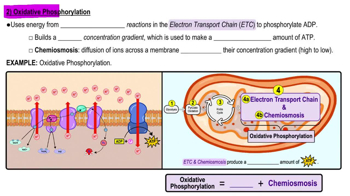
NADH and FADH₂ then transport the high-energy electrons to the electron transport chain located in the inner mitochondrial membrane. Here, the electrons are passed through a series of protein complexes, driving the production of ATP via oxidative phosphorylation.
The common role of FAD and NAD⁺ in cellular respiration is to facilitate the transfer of electrons and hydrogen ions, which are essential for generating ATP, the primary energy currency of the cell.

Verified video answer for a similar problem:

This video solution was recommended by our tutors as helpful for the problem above.
Video duration:
3m
Was this helpful?

Key Concepts

Here are the essential concepts you must grasp in order to answer the question correctly.

Cellular Respiration

Cellular respiration is a biochemical process in which cells convert glucose and oxygen into energy, carbon dioxide, and water. This process occurs in three main stages: glycolysis, the citric acid cycle, and oxidative phosphorylation. It is essential for producing adenosine triphosphate (ATP), the energy currency of the cell, enabling various cellular functions.
Recommended video:
03:38
Introduction to Cellular Respiration

FAD and NAD⁺

FAD (flavin adenine dinucleotide) and NAD⁺ (nicotinamide adenine dinucleotide) are coenzymes that play crucial roles in cellular respiration. They act as electron carriers, accepting electrons during metabolic reactions and transporting them to the electron transport chain. This transfer is vital for the production of ATP, as it helps establish the proton gradient necessary for ATP synthesis.
Recommended video:
05:22
Electron Carriers: NADH & FADH2

Oxidative Phosphorylation

Oxidative phosphorylation is the final stage of cellular respiration, occurring in the mitochondria. It involves the transfer of electrons through a series of protein complexes in the electron transport chain, leading to the pumping of protons across the mitochondrial membrane. This creates a proton gradient that drives ATP synthesis through ATP synthase, ultimately producing the majority of ATP generated during cellular respiration.
Recommended video:
06:27
Oxidative Phosphorylation