
Oogenesis in the female results in one functional gamete—the egg, or ovum. What other cells are produced? What is the significance of this rather wasteful type of gamete production—that is, production of a single functional gamete instead of four, as seen in males?
Ch. 27 The Reproductive System
Hoehn, Haynes, Abbott12th EditionMarieb Human Anatomy & PhysiologyISBN: 9780138242732Not the one you use?Change textbook
Chapter 27, Problem 18
Trace the pathway of a sperm from the male testes to the uterine tube of a female.
Verified step by step guidance1
Start at the testes, where sperm are produced in the seminiferous tubules. From here, sperm move into the rete testis, a network of tubules that collects sperm.
Next, sperm travel through the efferent ductules to reach the epididymis, where they mature and are stored until ejaculation.
During ejaculation, sperm are propelled from the epididymis into the vas deferens (ductus deferens), a muscular tube that transports sperm toward the urethra.
The vas deferens joins with the duct of the seminal vesicle to form the ejaculatory duct, which passes through the prostate gland and empties into the urethra.
Sperm then travel through the urethra and are ejaculated into the female reproductive tract, where they swim through the cervix and uterus to reach the uterine (fallopian) tube, the site of potential fertilization.

Verified video answer for a similar problem:
This video solution was recommended by our tutors as helpful for the problem above.
Video duration:
2mWas this helpful?
Key Concepts
Here are the essential concepts you must grasp in order to answer the question correctly.
Male Reproductive Anatomy
Understanding the male reproductive system is essential to trace sperm's journey. Key structures include the testes (where sperm is produced), epididymis (where sperm matures), vas deferens (transports sperm), and the urethra (through which sperm exits the body).
Recommended video:
Anatomy of the Male Reproductive System Example 1
Sperm Transport Mechanism
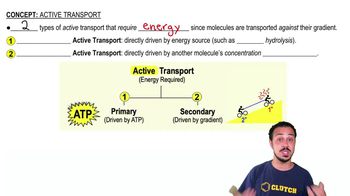
Sperm moves through a series of ducts aided by muscular contractions and fluid secretions. After maturation in the epididymis, sperm travels via the vas deferens, mixes with seminal fluid from accessory glands, and is ejaculated through the urethra into the female reproductive tract.
Recommended video:
Active Transport
Female Reproductive Anatomy and Fertilization Site
Once inside the female, sperm must navigate the vagina, cervix, and uterus to reach the uterine (fallopian) tube, the typical site of fertilization. Understanding these structures and their roles helps explain how sperm reaches the ovum for potential fertilization.
Recommended video:
Anatomy of the Female Reproductive System Example 8
Related Practice
Textbook Question
107
views
Textbook Question
Define menarche. What does it indicate?
96
views
Textbook Question
Describe the major structural (and functional) regions of a sperm.
111
views
Textbook Question
Both the epithelium of the vagina and the cervical glands of the uterus help prevent the invasion and spread of vaginal pathogens. Explain how each of these mechanisms works.
130
views
Textbook Question
Why is the term urogenital system more applicable to males than to females?
191
views
Textbook Question
In menstruation, the functional layer is shed from the endometrium. Explain the hormonal and physical factors responsible for this shedding. (Hint: See Figure.)
123
views
