Ch. 28 Pregnancy and Human Development

Hoehn, Haynes, Abbott12th EditionMarieb Human Anatomy & PhysiologyISBN: 9780138242732
Not the one you use?Change textbookSelect a different textbook
Table of contents
- Ch. 1 The Human Body: An Orientation25
- Ch. 2 Chemistry Comes Alive24
- Ch. 3 Cells: The Living Units24
- Ch. 4 Tissue: The Living Fabric19
- Ch. 5 The Integumentary System12
- Ch. 6 Bones and Skeletal Tissues19
- Ch. 7 The Skeleton14
- Ch. 8 Joints7
- Ch. 9 Muscles and Muscle Tissue26
- Ch. 10 The Muscular System25
- Ch. 11 Fundamentals of the Nervous System and Nervous Tissue23
- Ch. 12 The Central Nervous System25
- Ch. 13 The Peripheral Nervous System and Reflex Activity30
- Ch. 14 The Autonomic Nervous System16
- Ch. 15 The Special Senses26
- Ch. 16 The Endocrine System26
- Ch. 17 Blood27
- Ch. 18 The Cardiovascular System: The Heart25
- Ch. 19 The Cardiovascular System: Blood Vessels27
- Ch. 20 The Lymphatic System and Lymphoid Organs and Tissues16
- Ch. 21 The Immune System: Innate and Adaptive Body Defenses27
- Ch. 22 The Respiratory System21
- Ch. 23 The Digestive System31
- Ch. 24 Nutrition, Metabolism, and Energy Balance26
- Ch. 25 The Urinary System26
- Ch. 26 Fluid, Electrolyte, and Acid-Base Balance24
- Ch. 27 The Reproductive System24
- Ch. 28 Pregnancy and Human Development25
- Ch. 29 Heredity11
Hoehn, Haynes, Abbott12th EditionMarieb Human Anatomy & PhysiologyISBN: 9780138242732Not the one you use?Change textbook

Chapter 28, Problem 21
While Mark was cramming for his anatomy test, he read that some parts of the mesoderm become segmented. He suddenly realized that he could not remember what segmentation is. Define segmentation, and give two examples of segmented structures in the embryo.
 Verified step by step guidance
1
Understand that segmentation in embryology refers to the division of the body or certain tissues into repetitive, similar units called segments or somites, which are arranged in a linear series along the body axis.
Recognize that segmentation is a fundamental process during the development of the mesoderm layer, leading to the formation of repeated structures that contribute to the organization of the body plan.
Define segmentation as the process by which the mesoderm is divided into paired blocks called somites, which later differentiate into specific tissues such as vertebrae, skeletal muscles, and dermis.
Identify two examples of segmented structures derived from the mesoderm in the embryo: (1) somites themselves, which are the segmented blocks of mesoderm, and (2) the vertebral column, which develops from the sclerotome portion of the somites.
Summarize that segmentation is crucial for the proper organization of the musculoskeletal system and other structures, establishing the segmented pattern seen in the adult body.
Key Concepts
Here are the essential concepts you must grasp in order to answer the question correctly.
Segmentation
Segmentation refers to the division of the body or an organ into repetitive, similar units called segments. In embryology, it involves the formation of repeated structures along the body axis, which helps organize the body plan and facilitates specialized functions.
Recommended video:
 7:52
7:52
Antibody Class Switching
Mesoderm and Its Role in Segmentation
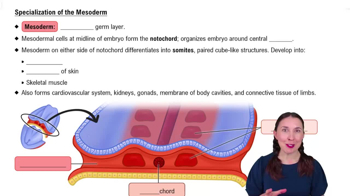
The mesoderm is the middle germ layer in the embryo that gives rise to many tissues, including muscles, bones, and the circulatory system. Parts of the mesoderm become segmented during development, forming structures like somites that contribute to the segmented body plan.
Recommended video:
 2:45
2:45Specialization of the Mesoderm
Examples of Segmented Structures in the Embryo
Two key examples of segmented structures derived from the mesoderm are somites and the vertebral column. Somites are blocks of mesoderm that form along the neural tube and later differentiate into vertebrae, skeletal muscles, and dermis.
Recommended video:
Guided course
 4:16
4:16Structure of the Eyeball Example 1
Related Practice