Ch. 4 Tissue: The Living Fabric
Hoehn - Marieb Human Anatomy & Physiology, 12th edition
Hoehn, Haynes, Abbott12th EditionMarieb Human Anatomy & PhysiologyISBN: 9780138242732Not the one you use?Change textbook
Chapter 4, Problem 1

Use the key to classify each of the following described tissue types into one of the four major tissue categories.
Key:
a. Connective tissue
b. Epithelium
c. Muscle
d. Nervous tissue 
_________    (1) Tissue type composed largely of nonliving extracellular matrix; important in protection and support 
_________    (2) The tissue immediately responsible for body movement 
_________    (3) The tissue that enables us to be aware of the external environment and to react to it 
_________    (4) The tissue that lines body cavities and covers surfaces

Verified step by step guidance
1
Step 1: Understand the four major tissue categories: (a) Connective tissue, which typically has abundant extracellular matrix and provides support and protection; (b) Epithelium, which covers body surfaces and lines cavities; (c) Muscle tissue, responsible for producing movement; and (d) Nervous tissue, which processes sensory information and controls responses.
Step 2: For the first description, 'Tissue type composed largely of nonliving extracellular matrix; important in protection and support,' identify which tissue type is characterized by a large amount of extracellular matrix and functions in support and protection. This matches connective tissue.
Step 3: For the second description, 'The tissue immediately responsible for body movement,' determine which tissue type contracts to produce movement. This is muscle tissue.
Step 4: For the third description, 'The tissue that enables us to be aware of the external environment and to react to it,' recognize that this involves sensory input and response, which is the role of nervous tissue.
Step 5: For the fourth description, 'The tissue that lines body cavities and covers surfaces,' identify the tissue that forms protective layers on body surfaces and lines internal cavities, which is epithelium.

Verified video answer for a similar problem:

This video solution was recommended by our tutors as helpful for the problem above.
Video duration:
2m
Was this helpful?

Key Concepts

Here are the essential concepts you must grasp in order to answer the question correctly.

Connective Tissue

Connective tissue is characterized by a large amount of nonliving extracellular matrix that provides structural support and protection. It connects and binds other tissues, stores energy, and helps in tissue repair. Examples include bone, cartilage, and blood.
Recommended video:
Guided course
01:27
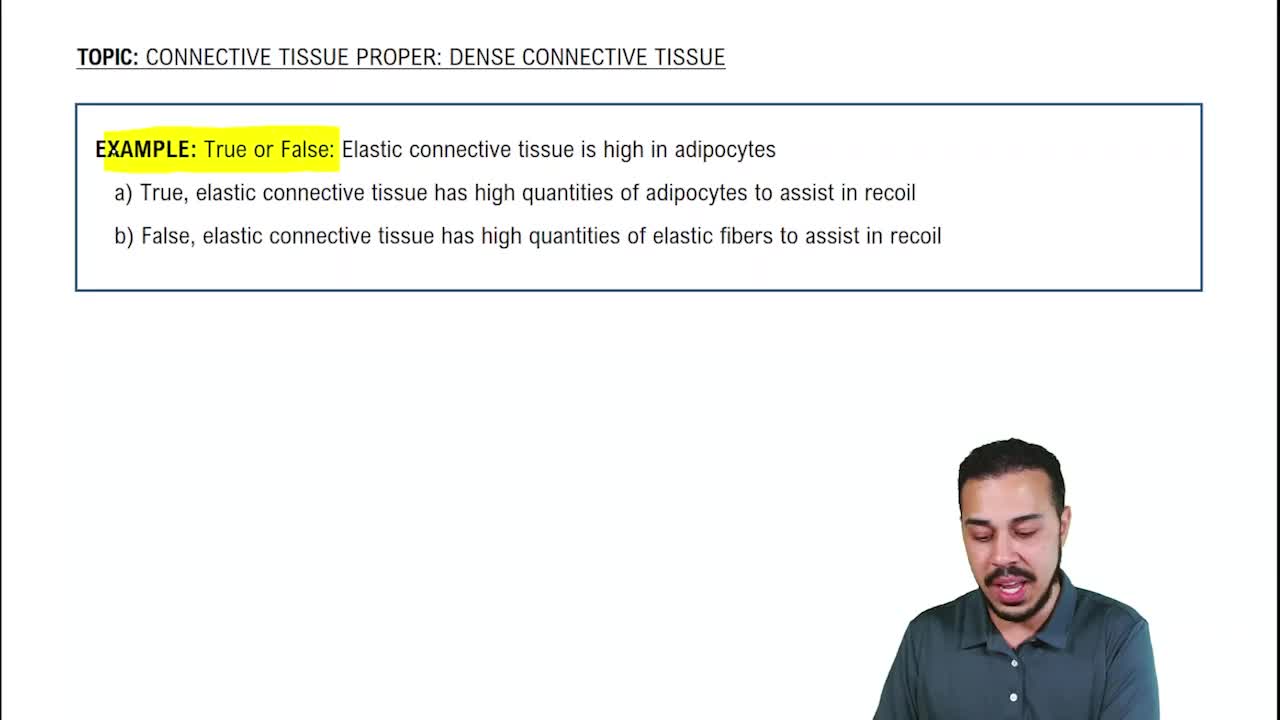
Connective Tissue Proper: Dense Connective Tissue Example 3

Muscle Tissue

Muscle tissue is specialized for contraction and is responsible for producing body movement. It contains cells called muscle fibers that can shorten and generate force. Types include skeletal, cardiac, and smooth muscle.
Recommended video:
Guided course
4:36
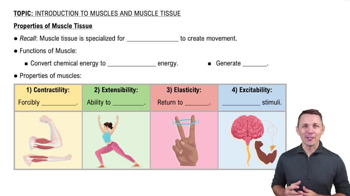
Properties of Muscle Tissue

Nervous Tissue

Nervous tissue is composed of neurons and supporting cells that detect stimuli, process information, and coordinate responses. It enables awareness of the environment and controls body functions through electrical signals.
Recommended video:
Guided course
04:36
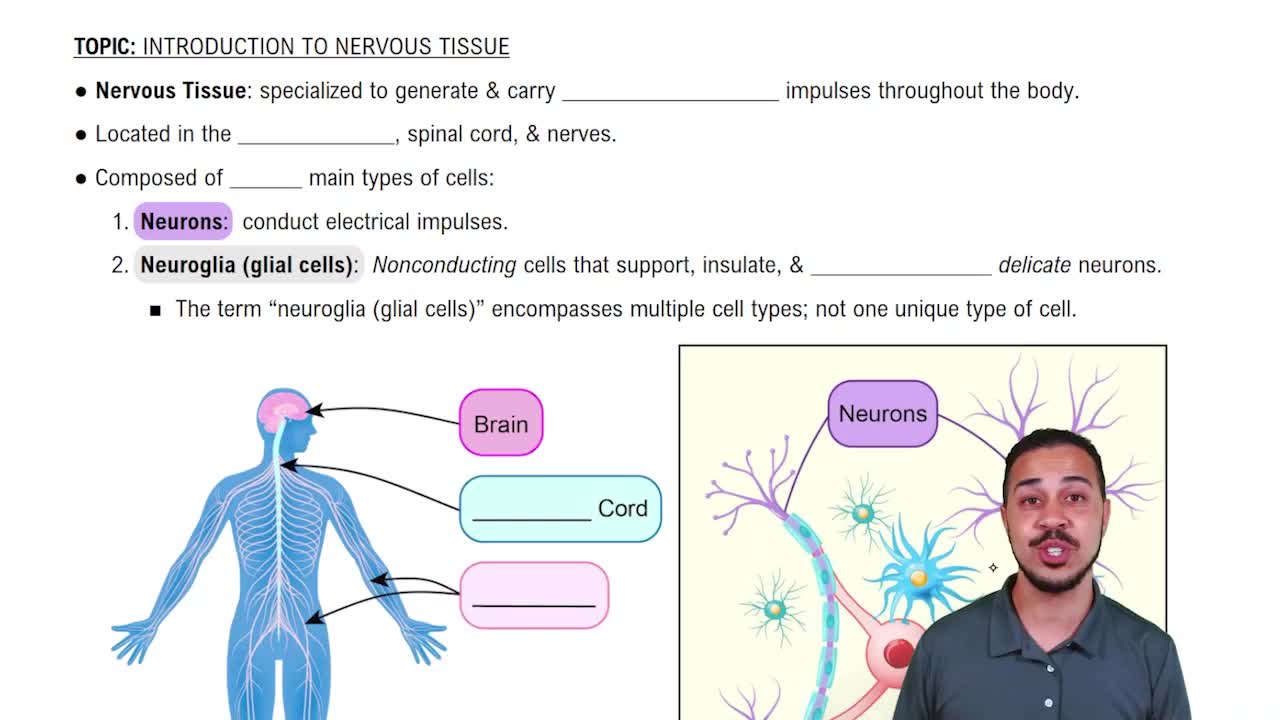
Intro to Nervous Tissue