Compare and contrast controls of bone remodeling exerted by hormones and by mechanical and gravitational forces, including the purpose of each control system and changes in bone architecture that might occur.
Ch. 6 Bones and Skeletal Tissues
Hoehn, Haynes, Abbott12th EditionMarieb Human Anatomy & PhysiologyISBN: 9780138242732Not the one you use?Change textbook
Chapter 6, Problem 22
Noah Beckenstein went to weight-lifting camp in the summer between seventh and eighth grade. He noticed that the camp trainer put tremendous pressure on him and his friends to improve their strength. After an especially vigorous workout, Noah's arm felt extremely sore and weak around the elbow. He went to the camp doctor, who took X rays and then told him that the injury was serious, for the 'end of his upper arm bone was starting to twist off.' What had happened? Could the same thing happen to Noah's 23-year-old sister, Karen, who was also starting a program of weight lifting? Why or why not?
Verified step by step guidance1
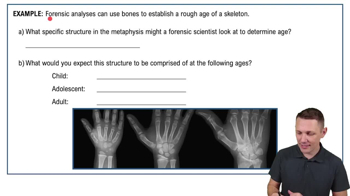
Step 1: Identify the bone involved and the nature of the injury. The 'end of his upper arm bone' refers to the distal end of the humerus near the elbow. The description of it 'starting to twist off' suggests a fracture or injury at the growth plate (epiphyseal plate).
Step 2: Understand the anatomy and physiology of growth plates. In children and adolescents, the long bones have growth plates made of cartilage, which are weaker and more susceptible to injury compared to the surrounding bone and ligaments. This area is responsible for bone lengthening during development.
Step 3: Explain why this injury occurs in adolescents like Noah. Because the growth plate is weaker, intense physical stress or trauma (such as vigorous weight lifting) can cause a fracture or separation at this site, known as a Salter-Harris fracture.
Step 4: Consider whether the same injury could happen to Karen, the 23-year-old adult. In adults, the growth plates have already closed and ossified, meaning the bone ends are fully fused and stronger. Therefore, the same type of growth plate injury cannot occur in adults.
Step 5: Summarize the key difference. Noah's injury is due to the presence of an open growth plate in his adolescent bones, making them vulnerable to twisting injuries, whereas Karen's mature bones lack growth plates, so she is less likely to experience this specific injury, though other types of fractures are still possible.

Verified video answer for a similar problem:
This video solution was recommended by our tutors as helpful for the problem above.
Video duration:
3mWas this helpful?
Key Concepts
Here are the essential concepts you must grasp in order to answer the question correctly.
Growth Plate (Epiphyseal Plate) Anatomy and Function
Growth plates are areas of developing cartilage tissue near the ends of long bones in children and adolescents. They allow bones to lengthen during growth and are weaker than mature bone, making them susceptible to injury under stress. In Noah's case, the twisting injury likely affected his growth plate, which is still open and vulnerable.
Recommended video:
Guided course
Gross Anatomy of Bones - Structure of a Long Bone Example 1
Differences Between Pediatric and Adult Bone Structure
Children's bones have growth plates that are not yet fused, making them more prone to specific injuries like fractures or separations at these sites. Adults, like Noah's 23-year-old sister, have fully fused growth plates, so their bones are stronger and less likely to experience the same type of injury under similar stress.
Recommended video:
Guided course
Gross Anatomy of Bones - Structure of a Long Bone Example 1
Mechanism of Injury in Weight Lifting and Bone Stress
Weight lifting applies mechanical stress to bones and muscles, which can cause microtrauma or acute injuries. In young athletes, excessive or improper loading can damage growth plates, leading to conditions like epiphyseal fractures. Proper technique and gradual progression are essential to prevent such injuries.
Recommended video:
Guided course
Trabeculae
Related Practice
Textbook Question
532
views
Textbook Question
Mrs. Abbruzzo brought her 4-year-old daughter to the doctor, complaining that she didn't 'look right.' The child's forehead was enlarged, her rib cage was knobby, and her lower limbs were bent and deformed. X rays revealed very thick epiphyseal plates. Mrs. Abbruzzo was advised to increase dietary amounts of vitamin D and milk and to get the girl outside to play in the sun. Considering the child's signs and symptoms, what disease do you think she has? Explain the doctor's instructions.
987
views
Textbook Question
What would a long bone look like at the end of adolescence if bone remodeling did not occur?
825
views