Ch. 14 The Autonomic Nervous System
Marieb - Human Anatomy & Physiology 11th Edition
Marieb, Hoehn11th EditionHuman Anatomy & PhysiologyISBN: 9780136874034Not the one you use?Change textbook
Chapter 14, Problem 10

A reflex that causes reciprocal activation of the antagonist muscle is the
a. Crossed-extensor
b. Flexor
c. Tendon
d. Muscle stretch

Verified step by step guidance
1
Understand the concept of reflexes: Reflexes are automatic, involuntary responses to stimuli. They involve sensory input, integration in the central nervous system, and motor output to muscles.
Learn about reciprocal activation: Reciprocal activation refers to the process where the contraction of one muscle group leads to the relaxation of its antagonist muscle group. This ensures smooth and coordinated movement.
Review the types of reflexes mentioned: a) Crossed-extensor reflex involves the opposite limb compensating for the movement of the stimulated limb. b) Flexor reflex is a withdrawal reflex in response to painful stimuli. c) Tendon reflex monitors tension in a muscle and prevents excessive force. d) Muscle stretch reflex responds to muscle length changes to maintain posture.
Focus on the tendon reflex: The tendon reflex specifically involves reciprocal activation. When tension in a muscle becomes too high, the reflex inhibits the contracting muscle and activates the antagonist muscle to prevent damage.
Conclude that the reflex causing reciprocal activation of the antagonist muscle is the tendon reflex, based on its mechanism of action and function.

Verified video answer for a similar problem:

This video solution was recommended by our tutors as helpful for the problem above.
Video duration:
3m
Was this helpful?

Key Concepts

Here are the essential concepts you must grasp in order to answer the question correctly.

Reciprocal Inhibition

Reciprocal inhibition is a physiological process where the activation of one muscle (the agonist) leads to the simultaneous relaxation of its antagonist muscle. This mechanism is crucial for coordinated movement, allowing for smooth transitions between muscle contractions and relaxations. For example, when you flex your arm, the biceps contract while the triceps relax.
Recommended video:
05:03
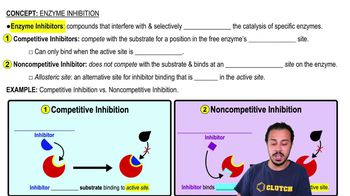
Enzyme Inhibition

Reflex Arcs

Reflex arcs are neural pathways that mediate reflex actions. They typically involve sensory neurons, interneurons, and motor neurons, allowing for rapid responses to stimuli without direct involvement of the brain. In the context of muscle activation, reflex arcs can facilitate reciprocal inhibition, ensuring that when one muscle contracts, its antagonist relaxes to prevent injury and maintain balance.
Recommended video:
2:12
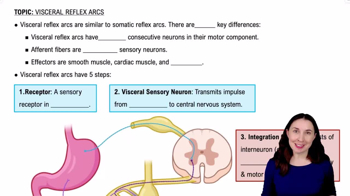
Visceral Reflex Arcs

Types of Reflexes

There are several types of reflexes, including flexor, crossed-extensor, and tendon reflexes. The flexor reflex involves the withdrawal of a limb from a painful stimulus, while the crossed-extensor reflex helps maintain balance by activating the opposite limb. Understanding these reflex types is essential for identifying how muscles interact during various movements and responses.
Recommended video:
5:15
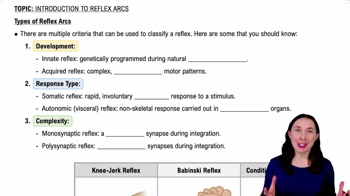
Types of Reflex Arcs