Which of the effects listed in response to question 9 would be reversed by parasympathetic activity?
Ch. 14 The Autonomic Nervous System

Marieb, Hoehn11th EditionHuman Anatomy & PhysiologyISBN: 9780136874034Not the one you use?Change textbook
Chapter 14, Problem 8
Describe the anatomical relationship of the white and gray rami communicantes to the spinal nerve, and indicate the kind of fibers found in each ramus type.
Verified step by step guidance1
Begin by identifying the spinal nerve as the main nerve trunk that emerges from the spinal cord and serves as a connection point for various nerve fibers.
Understand that the rami communicantes are two small nerve branches that connect the spinal nerve to the sympathetic trunk (a chain of ganglia involved in the autonomic nervous system). These are the white ramus communicans and the gray ramus communicans.
Describe the white ramus communicans as the branch that carries preganglionic sympathetic fibers from the spinal nerve to the sympathetic ganglia. Anatomically, it connects the spinal nerve to the sympathetic trunk and is typically found only at spinal levels T1 to L2.
Explain that the gray ramus communicans carries postganglionic sympathetic fibers from the sympathetic ganglia back to the spinal nerve. It connects the sympathetic trunk back to the spinal nerve and is present at all spinal levels.
Summarize the fiber types: the white ramus communicans contains myelinated preganglionic sympathetic fibers, while the gray ramus communicans contains unmyelinated postganglionic sympathetic fibers.

Verified video answer for a similar problem:
This video solution was recommended by our tutors as helpful for the problem above.
Video duration:
1mWas this helpful?
Key Concepts
Here are the essential concepts you must grasp in order to answer the question correctly.
White and Gray Rami Communicantes
White and gray rami communicantes are nerve fibers connecting the spinal nerve to the sympathetic trunk. White rami carry preganglionic sympathetic fibers from the spinal nerve to the sympathetic ganglia, while gray rami carry postganglionic fibers back to the spinal nerve. Their color difference reflects the myelination status of the fibers.
Recommended video:
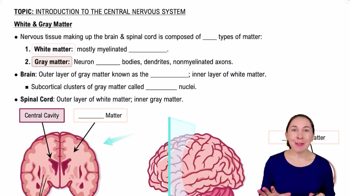
White & Gray Matter
Anatomical Relationship to the Spinal Nerve
Both rami communicantes connect to the spinal nerve near the intervertebral foramen. The white ramus enters the sympathetic trunk from the spinal nerve, typically found only in spinal segments T1 to L2, while the gray ramus exits the sympathetic trunk to rejoin the spinal nerve at all levels, allowing postganglionic fibers to reach peripheral targets.
Recommended video:
Guided course
Anatomical Position
Types of Nerve Fibers in Each Ramus
White rami communicantes contain myelinated preganglionic sympathetic fibers, which transmit signals from the spinal cord to the sympathetic ganglia. Gray rami contain unmyelinated postganglionic sympathetic fibers that return from the ganglia to the spinal nerve, enabling sympathetic innervation of skin and blood vessels.
Recommended video:
Guided course
3 Types of Protein Fibers
Related Practice
Textbook Question
663
views
Textbook Question
Which ANS fibers release acetylcholine? Which release norepinephrine?
1040
views
Textbook Question
A reflex that causes reciprocal activation of the antagonist muscle is the
a. Crossed-extensor
b. Flexor
c. Tendon
d. Muscle stretch
924
views
Textbook Question
Indicate the results of sympathetic activation of the following structures: sweat glands, eye pupils, adrenal medullae, heart, bronchioles of the lungs, liver, blood vessels of vigorously working skeletal muscles, blood vessels of digestive viscera, salivary glands.
959
views
Textbook Question
Where are the cell bodies of visceral sensory neurons?
1119
views
Textbook Question
Briefly explain why the following terms are sometimes used to refer to the autonomic nervous system: involuntary nervous system and emotional-visceral system.
815
views
1
rank