Ch. 2 Chemistry Comes Alive
Marieb - Human Anatomy & Physiology 11th Edition
Marieb, Hoehn11th EditionHuman Anatomy & PhysiologyISBN: 9780136874034Not the one you use?Change textbook
Chapter 2, Problem 23

Explain why, if you pour water into a glass very carefully, you can 'stack' the water slightly above the rim of the glass.

Verified step by step guidance
1
Understand the concept of surface tension, which is the cohesive force between water molecules at the surface that allows the water to resist external force and maintain its shape.
Recognize that when you pour water carefully, the water molecules stick together due to hydrogen bonding, creating a sort of 'skin' on the surface that can hold the water above the rim without spilling immediately.
Consider the role of adhesion between the water molecules and the glass surface, which helps the water cling to the rim and supports the formation of a convex meniscus above the glass edge.
Note that the balance between gravitational force pulling the water down and the surface tension holding it together allows the water to 'stack' slightly above the rim before gravity overcomes the cohesive forces.
Realize that if you disturb the water or add too much, the surface tension breaks, and the water spills over, demonstrating the delicate balance maintained by these forces.

Verified video answer for a similar problem:

This video solution was recommended by our tutors as helpful for the problem above.
Video duration:
3m
Was this helpful?

Key Concepts

Here are the essential concepts you must grasp in order to answer the question correctly.

Surface Tension

Surface tension is the cohesive force between liquid molecules at the surface, causing the liquid to behave like a stretched elastic membrane. This allows water to resist external force and maintain a shape slightly above the rim without spilling immediately.
Recommended video:
4:05
Cell Surface Receptors

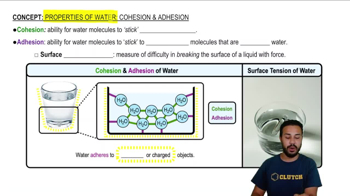
Cohesion and Adhesion

Cohesion refers to the attraction between water molecules, while adhesion is the attraction between water molecules and the glass surface. Together, these forces help water molecules stick to each other and the glass, enabling the water to form a convex meniscus above the rim.
Recommended video:
03:52
Properties of Water- Cohesion and Adhesion

Capillary Action and Meniscus Formation

Capillary action involves the movement of liquid within narrow spaces due to adhesion and cohesion. The meniscus is the curved surface of the liquid; in this case, the convex meniscus forms as water molecules cling to the glass edge, allowing the water to 'stack' slightly above the rim.
Recommended video:
9:42
Types of Capillaries
Related Practice
Textbook Question

Mrs. Roberts, in a diabetic coma, has just been admitted to Noble Hospital. Her blood pH indicates that she is in severe acidosis (low blood pH), and measures are quickly instituted to bring her blood pH back within normal limits.

a. Define pH and note the normal pH of blood.

b. Why is severe acidosis a problem?

95
views
Textbook Question

Some antibiotics act by binding to certain essential enzymes in the target bacteria.

a. How might these antibiotics influence the chemical reactions controlled by the enzymes?

b. What is the anticipated effect on the bacteria? On the person taking the antibiotic prescription?

51
views
Textbook Question

What are hydrogen bonds and how are they important in the body?

45
views
Textbook Question

Jason, a 12-year-old boy, was awakened suddenly by a loud crash. As he sat up in bed, straining to listen, his fright was revealed by his rapid breathing (hyperventilation), a breathing pattern effective in ridding the blood of CO₂. At this point, was his blood pH rising or falling?

57
views
Textbook Question

Differentiate clearly between primary, secondary, and tertiary protein structure.

124
views
Textbook Question

Consider the following information about three atoms: 12/6 C 13/6 C 14/6 C

a. How are they similar to one another?

b. How do they differ from one another?

c. What are the members of such a group of atoms called?

d. Using the planetary model, draw the atomic configuration of 12/6 C, showing the relative position and numbers of its subatomic particles

77
views